
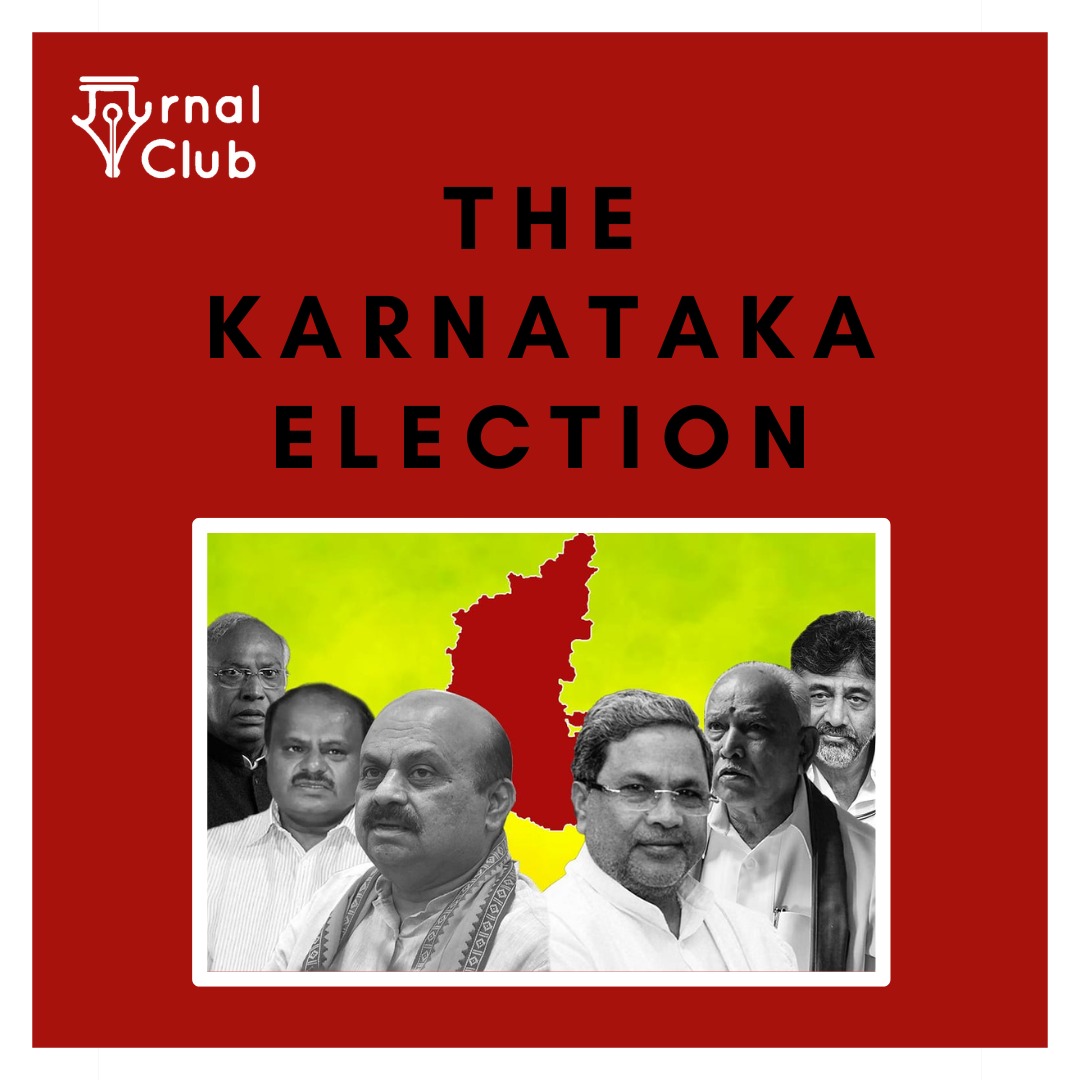
The whole nation was caught off guard on 13 May when the ECI (Election Commission of India) announced that the congress had swept the Karnataka Assembly election with 135 seats out of the 224 seat assembly (20 seats more than the required majority), while BJP with 66 seats formed a weak opposition. Even the loyalist JD(S) party was pushed to its lowest vote count ever with just 19 seats. So, how did Congress pull off such a huge win while it is defeated all over the country? Was it the result of relentless efforts from Congress? Was it just luck? Or was it the misadministration of the BJP? Before diving into conclusions it is important to know a little about the political and demographic landscape of Karnataka first, and by little, I mean a lot .So, let’s get started!
Although not noticeable superficially, Karnataka is more complex than any southern state. For starters, it is the only southern state where BJP has a real on the ground presence, and is often called the BJP’s “Gateway to the South”. While most states have a 2 party dynamic such as DMK vs ADMK in Tamil nadu, YSR Congress vs TDP in Andhra Pradesh, and BJP vs Congress in many other states, Karnataka has a 3 party system with Congress, BJP and JD(S) regularly getting a sizable number of votes. Moreover, the attitude and demographic of people change throughout the state, and while the coastal areas are a hotbed for communal politics, the inner regions are devoid of such polarisation. And the north and south have their own caste differences. All these peculiarities are a result of a plethora of things such as caste affiliations, ideology, political movements and so on. Let’s unravel this one by one.
BACKGROUND :
Karnataka was formed from the previous Mysore state in 1973, and as always the Indian National Congress had consistently won the state elections since independence in Mysore and later Karnataka. The Janata party broke this trend in 1983 forming the first non-congress government in karnataka. And since then non- Congress national parties such as Janata Dal and BJP have tried and contested in the Assembly elections. With BJP winning its first election in 2008.
The BJP has formed or been a part of several governments and has won 2 Assembly elections in karnataka since it first contested in 1983. The most recent being the 2019-23 period headed mainly by two chief ministers, B.S.Yeddyurappa, and Basavaraj Bommai.
2018-19 Political fiasco
The 2018 – 19 period can only be described as a rollercoaster ride for Karnataka politics. The 2018 polls resulted in a hung assembly with BJP winning the most with 104 seats but failing the required 113 seats for the majority, and Congress winning the popular vote with 38.14% vote share and 80 seats, and JD(S) with 37 seats. This resulted in an unexpected alliance between Congress and JD(S) who were arch rivals for decades, but joined hands for the sole purpose of forming a government, and keeping BJP out. Congress had to concede a lot for this, including many lucrative portfolios and the CM post was given to JD(S). And its party leader H.D.Kumaraswamy became the CM.
Even though Congress and JD(S) were selling an optimistic picture to the people, rifts started to form in the alliance. The 2019 General elections result did not help when BJP won a whopping 26 of the total 28 parliamentary seats in Karnataka. But the final nail in the coffin struck when 15 alliance members, 12 from Congress, 3 from JD(S) and 2 independent candidates switched sides and joined BJP. Which resulted in H.D.Kumaraswamy losing a trust vote, and he had to resign his CM post. Following which the BJP took over the government with B.S.Yeddurappa as the CM.
CASTE AFFILIATIONS
It is a well known fact that caste plays a quintessential role in Indian politics. People belonging to certain castes try to vote for certain political parties for various reasons. And this is one of the major reasons why the people of Karnataka vote for BJP, unlike the other southern states.
The two most prominent political castes of Karnataka are the Veerashaiva Lingayats and the Vokkaligas which make up around 17% and 14% of the Kannada population. The Lingayats are influential in northern and central Karnataka and play a decision making role in about 100 off the total 224 constituencies, whereas the Vokkaligas are prominent in southern karnataka or the “old mysore region”, and influence around 50 constituencies in those regions. The Lingayats make up the primary voter base of BJP besides other upper caste hindu communities and few minorities.
The Lingayats were a major reason behind BJPs success in Karnataka. And Vokkaligas support the JD(S). For example, in the 2018 Assembly election BJP had won 38 out of 70 Lingayat dominated seats, while the JD(S) won 24 out of 40 Vokkaliga dominated seats.
And hence, it has been a consistent trend for all the political parties to gain popularity in these communities by having mass caste leaders in their party and giving MLA tickets to people from the respective communities. Lingayat nominees always get the majority of MLA tickets from all the three parties, followed by Vokkaligas and others such as SCs, STs, and OBCs.
The Congress tries to grab both the Lingayat And Vokkaliga vote bank by having leaders from both the castes, and by appealing to all the communities with its ideology of Secularism and Social justice, it is one of the main reasons why the Congress won. Moreover, Congress has a huge support base from backward classes, dalits, muslims, SCs and STs who make up the majority of the population. All due to its ‘AHINDA’ movement led by the senior Congress party member and former CM of Karnataka, Dr.Siddaramaiah.
Now you know why the Bommai government had canceled the 4% muslim reservation and distributed it equally to Lingayat and Vokkaliga communities.
CONGRESS’ PROMINENT LEADERS
D.K.Shiva Kumar is the KPCC (Karnataka Pradesh Congress Committee) President from 2020. Nicknamed as ‘Karnataka’s Chanakya’, he is the chief political strategist of the Congress in Karnataka. He played a pivotal role in forming the post-poll coalition between Congress and JD(S) in the run-up to the 2018 Assembly election that formed the government. A mass Vokkaliga leader, he brings a sizable number of their votes to the Congress. And after the 2023 Election results, some even consider him as the most popular Vokkaliga Leader, even above H.D.Kumaraswamy
Next up we have Dr.Subbaramaiah, former chief minister of Karnataka from 2013 to 2018 and also the chairman of KPCC, and the chief architect of organising the ‘AHINDA’ group which abbreviates to “Alpashinkya group, Hindruludawlu, and Dalit” which in english translates to “Minorities, Scheduled castes, and Backward castes”. This movement brings the most vulnerable societies together in one voice to demand their rights, and these groups make up 70% of the Karnataka population but have far less political power due to their traditional backwardness. Coming from a backward community himself, Siddaramaiah has had support from backward classes from all over Karnataka, and by further organizing the AHINDA group Siddaramaiah and the Congress has hugely benefited electorally. Both these men were involved in distributing tickets to the MLA candidates.
Other prominent Congressmen include Dalit leader Dr.G.Parameshwara, Former deputy chief minister of Karnataka; Mallikarjun kharge, Lingayat leader M.B.Patil, former chief minister of Karnataka. It is important to note that many powerful BJP ministers have joined the Congress before the elections such as Jagadish Shettar, and Laxman Savadi who have both been former deputy CMs of Karnataka. This gave an impression that the BJP was not strong within its party itself.
AND OF THE BJP..
The face of Lingayats in Karnataka, the biggest vote getter for BJP in Karnataka, B.S.Yeddyurappa, he for Karnataka, is like Narendra Modi for Gujarat, Although not so young and not that successful in winning elections, he enjoys a similar kind of mass popularity in Karnataka. The importance of BSY for BJP cannot be understated. He is single handedly responsible for most of the votes for the BJP. This fact was on full display when he left BJP and launched his own party the “Karnataka Janata Paksha (KJP)” in the run-up to the 2013 Assembly Elections.
The results showed the spectacular vulnerability of BJP in Karnataka. The BJP had lost around half of its vote share and a crushing 72 seats, Going from 112 seats before the elections to 40. The KJP didn’t do any good either winning only 6 seats with 9.8% vote share. So this situation of a separate BJP and BSY gave the previous BJP voters (Lingayat) a choice to either vote KJP or the Congress, And as the result speaks most chose Congress just because BSY did not have the support of the BJP.
It is important to note that the KJP headed by B.S.Yeddurappa did not follow hindutva and had a secular outlook. So, unlike other BJP strongman CMs like Yogi Adityanath, BSY is not a hindutva icon. A fine example of it can be his opposition to Hindi imposition when he said “Kannada is the primary language of Karnataka”. Perhaps this also added the other then existing issues for him, for which he had been sacked from the CM post not once but twice.
The CAMPAIGN :
The Congress’s campaign was very typical, conducted by regional leaders who appealed to their locality with few appearances from national leaders like Rahul and Priyanka gandhi. This was in stark contrast to BJPs campaign which featured a plethora of national leaders such as J.P.Nadda, Home Minister Amit Shah, UP CM Yogi Adityanath, Assam CM Himanta Biswa and as always PM Narendra Modi himself. The BJP gave its full strength and conducted a high-octane campaign, including hundreds of mass public meetings and rallies and a grand 26 KM roadshow by PM Modi passing through 13 constituencies. So, one can only imagine the massive scale of BJP’s lucrative campaign.
CAMPAIGN issues:
The Congress spearheaded an opposition campaign targeting the inefficiency and corruption of the previous Bommai government. With fancy terms like “40% sarkara” ,“pay CM” and issuing “corruption report cards” for BJP MLAs.
The Congress made 5 promises to the people of Karnataka, as its grand strategy to win the elections, these include free bus transport for women, 200 units of free electricity for the poor,10 kgs of rice to the poor, 2000 rupees every month for every women household and 3000 rupees every month for all unemployed graduates. Moreover the Congress also gave its word to implement these 5 schemes right after the elections in the first cabinet meeting itself. This quickly became very popular among people, and made people think of the popular schemes of 7 KG free rice to every BPL home and “Indra Canteens” of the 2013-18 Congress government.
The BJP held on to its two pronged attack against Congress, On one hand the BJPs campaign was all about preaching its successful development projects over the last three and half years in the state, and in the centre over the last nine years. These included infra projects, farmers benefit, women empowerment and other popular central schemes.
An interesting thing to notice is that BJP leaders stressed on this fancy term called “Double-Engine Sarkar,” which encourages people to vote for the same party in the state, as in the centre. While it does seem like an overt act to decrease political diversity and representation, the BJPs stance was that such a “double-engine” can help in better coordination between the state and centre in implementing central government schemes. For example Home Minister Amit Shah said in an interview that Kisan Sanmaan Nidhi was not implemented in Bengal for a long time because the ruling TMC feared the rise in popularity of BJP because of the scheme, and Ayushmaan Bharat yogana is not implemented in Delhi for a similar reason.
On the other hand the campaign was all about demeaning the Congress party altogether, by citing its historic mismanagement in the state and center. For instance PM Modi cited Rajiv Gandhi’s famous “1 Rs 15 paisa” remark to brand congress as a “85% commission” government in a public rally in Badami. Other such serious allegations include humiliation of OBCs, SCs, STs, Lingayats in the hands of Congress, 85% commission, supporting terrorism and riots, making fake promises, hatred against adivasis, and much more.
Besides all these, ofcourse, the BJP also played its communal card by bringing up issues such as Tipu Sultan, Bajrang Dal and PFl, although not as much as they do in the Hindi heartland, yet the words made national headlines. Basavaraj Bommai had publicly said in a press meet that halal, hijab are not real election issues. But many national leaders who were formerly from the RRS had mentioned these communal issues time and time, indicating a disconnect between regional and national leaders on this issue.
Analysis and Conclusion :
With all this said and done, what is the exact reason behind BJPs spectacular defeat? Well it is a bunch of things, at the center is the B.S.Yeddyurappa factor. Although he campaigned for BJP, this is the first election after a long time that BSY did not contest. Anti-incumbency played a major factor for the defeat, BJPs CM ship was always marred with inconsistency, and the people were quite fed up with that. And finally the BJP positioned its campaign like that of a general election rather than a state election, focused exclusively on state issues. This is important because people in karnataka vote differently in state and general elections.
In the view of Congress this election was a success of its ideology of inclusiveness, social justice, and secularism. But the matter lies with the regional leaders, who were able to fend off the BJP in their own style. And frankly Congress’s outreach programs and the previous Bharat Jodo Yatra showed that Congress is well organised than BJP in karnataka. The Congress’s clear and decisive promises also had a great response from people. It has been around a month since election results and 3 of the 5 promised schemes are already in place with varying degrees of implementation.
To conclude, this election has given the much needed moral boost for the Congress and a very painful lesson for BJP, to focus on state leaders during state elections, especially in southern india. Going ahead this election will definitely lead to changes in both Congress and BJP. And it will be a feast to watch these changes take shape in the upcoming state elections and ultimately the 2024 general elections.
References :
2018-19 political fiasco :
Siddaramiah’s caste :
Reservation policy change :
Lingayat influence in Karnataka :
Congress’s campaign strategy :
Youtube References :
 The Journal Club
Leave a comment