
Undoubtedly the pinnacle of sporting talent, the Olympic Games took place from 26th July to 11th August this year. An obligatory event today, these games, from when the Greeks were around, have always been a centerpiece of attraction for the masses. Today, the olive leaves might have changed to nylon, but the pride of winning a medal has remained the same. Athletes from every nook and cranny of the planet, along with their loyal fans, flock to the host nation once every four years. Paris, the city of love, took up the honor of continuing the tradition this time and hosted this esteemed event.
There was a lot to look forward to in this year’s Paris Olympics. For starters, this was the first time there were exactly equal amounts of male and female athletes taking part across all sports. It was also a case of returning to normalities, as crowds made their way back to the stadiums after the pandemic. And for us Indians, we were heading into these games on the back of our best ever performance in the history of the tournament, looking to compound this form and prove our worth consistently on the biggest stage.
117 athletes, spread across 16 sports disciplines, unfurled our tricolor while sailing on the Seine River for the opening ceremony. The hotshots among them? Neeraj Chopra with his golden arm, PV Sindhu and her experience, Harmanpreet Singh and his vigor, and others, to name a few. Although some of our marquee athletes might have returned empty-handed, we discovered new, young heroes, including Manu Bhaker and Lakshya Sen, who keep the future bright. Shooting, unsurprisingly, was our forte, as we returned with three bronze medals. We also ended up with two more bronzes, in hockey and wrestling, while our only silver was claimed in the javelin throw.
While six medals isn’t necessarily a ‘bad’ tournament compared to recent years, the reason most Indians were disappointed was because a potential gold and guaranteed medal was snatched right out of our hands in the form of Vinesh Phogat’s untimely elimination. Now, before we turn all patriotic, it’s a matter of fact that she had no one to blame but herself and her team. The rules might be harsh, but they certainly aren’t unfair. In plain terms, she violated the rules and was disqualified. To enunciate further, women’s Olympic wrestling has a total of 6 weight classes. The ones relevant to us are 50 kg and 53 kg. Vinesh’s usual category, the one she took part in even during the Tokyo Olympics, was 53 kg. This time, however, Antim Panghal, a young wrestler who showed much more promise, was chosen above Phogat to represent India, leaving Vinesh to work with only 50 kg [1]. In a regular scenario, the National Institute of Sports would have held trials for the weight categories, but due to politics (of course), at the beginning of both days, the wrestlers need to ‘weigh in’ to ensure they are within the weight class. They were cancelled.
Coming back to the tournament, the wrestling bouts are held across two days, with the final on the 2nd day. On the beginning of both days, the wrestlers need to ‘weigh in’ to ensure they are within the weight class. Although funnily enough, it is certainly within the rules to gain weight after the weigh-in. So most wrestlers lose weight through water loss and fasting to fall within the weight class, with the sole purpose of clearing the weigh-in. Vinesh too did the same and entered the competition below 50 kg; however, during her bouts she fought at 52.7 kg, which is essentially her regular weight [2]. This was legal as long as she lost this excess weight before the weigh-in on the next day. And so she fought, and boy did she give her all. She went on an unforgettable run, which included beating the legendary Yui Sasaki, who had never lost in any international bout before. After triumphing in the semis as well, she was all set for the final but for one last hurdle—losing the extra 3 kg. Then began the long night where she and her team worked tirelessly, adjusting her diet and her fluid intake to shed the kilos. They used saunas and cardio to increase perspiration, coupled with intense physical training. When these conventional methods weren’t sufficient, they even resorted to cutting her hair [3]. However, on the morning of 7th August, she was deemed to be 100g above the 50kg mark and was thus disqualified. These key details give us much better clarity about the verdict. It wasn’t a silly case of ‘India against the world’ or ‘Politics dwindling with sports’ and other rubbish. The rules were always defined. However, it certainly was unfortunate because of how close she was—to both cutting her weight and winning a medal. Nonetheless, although she doesn’t have a medal to show for it, she, without a doubt, made all Indians proud.
Staying along the lines of underwhelming, Neeraj Chopra failing to defend his gold medal was certainly another instance. Having absolutely swept the floor in the Tokyo Olympics, the entire nation was ready to settle for nothing but the top spot again. However, he was knocked off his perch by Arshad Nadeem after his monstrous throw of 92.97 m, which also ended up breaking the Olympic record. Nadeem, on the contrary, has a tale of his own that makes it impossible to hate him. Growing up in Pakistan, he literally had no facilities to train. His throws in the local stadium would often land outside the ground, and the officials even ran out of tape trying to measure it [4]. While this might be the case for most athletes hailing from small villages, and you hear such cliche stories regularly, Nadeem continued to suffer even after attaining global recognition. After winning gold in the Commonwealth Games and silver in the World Championships, he had to beg the government for new javelins to practice. Each javelin costs around 6 lakhs, and the Pakistan government had only provided him with one, opposed to the four that they had promised. In fact, it was the Pakistan Cricket Board who stepped in and funded him when his javelin was damaged during the Tokyo Olympics. As a matter of fact, he himself in 2020 claimed, “If I was in Germany or Finland, I would have been a world champion [5]. So, him winning gold was your typical fairy tale conclusion. Throughout this internal battle that Nadeem had to face, Neeraj Chopra, however, has always been an open supporter. Throwing international politics aside, both of them have been close friends for a while with their families reportedly in touch. This kind of makes Nadeem impossible to hate, and he did deserve the gold medal in the end.
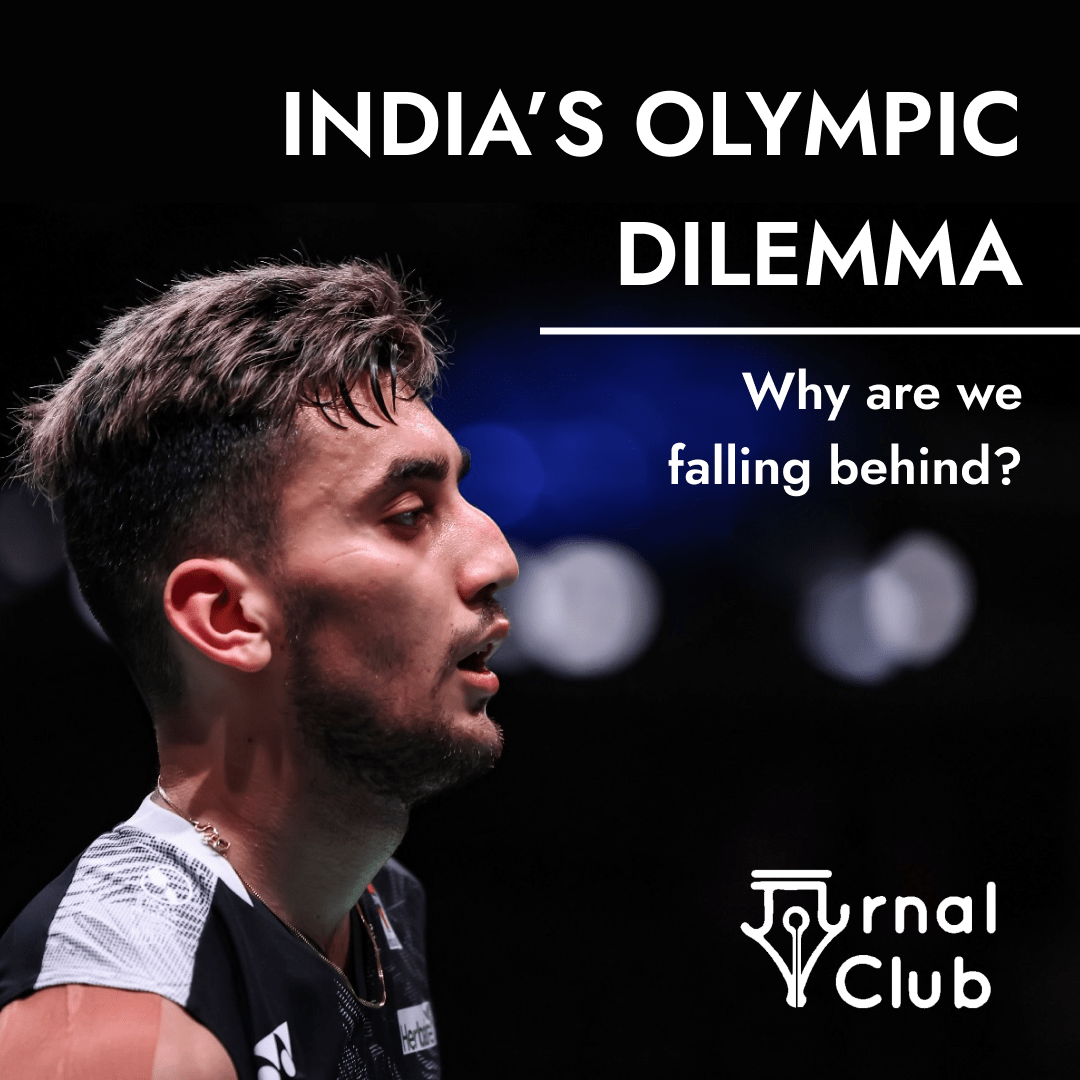
Finally, shifting our focus to a fan favorite sport—badminton. The medals in the Olympics that we have salvaged through this sport have always been India’s ‘copium’ in recent years. Be it Saina Nehwal or PV Sindhu, the athletes have always been fan favorites and cover stars and have also delivered, with silvers and bronzes. However, the last decade of success did not translate into the new one, as we went through the first Olympics since 2008, where the Indian badminton contingent did not win a single medal [6]. Satwiksairaj Rankireddy and Chirag Shetty, expected to be medal contenders, had a disappointing tournament along with PV Sindhu and HS Pranoy, who had early exits. The only positive note among a sea of negatives was the young Lakshya Sen, who became the first male shuttler from India to reach the semi-finals of the Olympic games. He fought valiantly against the reigning champion Viktor Axelsen in the semis, even taking the lead in both games before succumbing to the Dane’s unrelenting style of play. Further disappointment followed, as Lakshya lost to Lee Zii Jia in the bronze medal playoff despite outclassing him completely in the first game.
The performances drew strongly worded statements from Prakash Padukone and Sunil Gavaskar, who expressed their disappointment. They had harsh but fair comments about Lakshya Sen as well, where they questioned his mentality and pointed out that he threw away leads in both the semi-final and the bronze medal playoff. They further emphasized that the Indian players had access to all the required facilities and were provided with ample funds to compete, urging the players to take responsibility for not delivering results and to face the reality of the situation that the Indian badminton contingent is in a worrying state right now [7].
Phew, now that’s a lot of drama for six medals. We finished the tournament in the 71st position, out of a total of 84, who returned home with medals. Yeah, that’s pretty bad. Some of the countries above us? Cuba, St. Lucia, and North Korea [8]. Yup, that makes it worse. Also, just to put things into perspective, the population of Cuba is less than the population of Hyderabad. What about our history in this competition? 41 medals in 38 olympics, with only 2 golds in the last 30 years. So it boils down to why? Why do we underperform? What are we doing wrong?
Let’s talk about funding. We spent 470 crore rupees for the Paris Olympics [9]. Compared to the top performers, this isn’t enough. But six medals? The actual reason is simple. Most of this money is simply diverted into the pockets of those bald, pot-bellied politicians you see in caricatures. It doesn’t take a lot to figure out that this money needs to be invested in the grassroots. This model has proven to be successful in multiple countries. Search for talent in colleges and universities, invest in them, build them into world-class athletes, and watch them prosper. Surely the secretaries who have passed IAS exams can figure this out themselves.
Another route to succeeding is literally just ‘stat padding’. Invest in sports we have historically been good at. Wrestling, shooting, badminton—all are a few examples. Take China, for instance. You may not see Chinese athletes winning any medals in rugby or surfing, but they still end up being successful year in and year out because they specialize in what they are good at. African countries run away with all marathon medals, while Koreans just keep sending out shooters and archers. We too certainly are talented in some sports and need to improvise accordingly.
What about our population? Shouldn’t the most populated country technically send out the most number of athletes? Countries like the US and Japan sent out 600 to 400 athletes, while India had a band of just 117 [10]. But shouldn’t quality be preferred over quantity? Well, that would be a valid argument if we had the quality, and in all honesty, we don’t. We simply aren’t using our greatest asset. Imagine what a country like Japan would do with a population like ours.
So what are we Indians good at? Ding ding. Cricket. Cricket is the reason we underperform in all sports. The public only cares about cricket and genuinely doesn’t watch any other sport the entire year. Cricket is the reason young boys and girls pick up a bat instead of a paddle and imitate the best batsman in the world instead of a rower who didn’t qualify for the Olympics. Notice how ridiculous it sounds? Let’s come back to what a sport actually is—a form of entertainment for the masses. Imagine you are a regular citizen who has just completed his 9-to-5 shift and wants to watch a sport for some entertainment. Two football matches are being aired, one a local Indian club match and another an English Premier League derby. What should he pick? Sure, if he’s patriotic, he’ll pick the Indian game, but why should he be compelled to? He can watch the same sport with much better quality, tactics, and skill on display without compromising. The same goes to cricket. We are one of the best nations at cricket. The greatest players to have held a bat or ball are arguably Indians. We compete with the best and even prove we are the best by winning world cups. So why look down at it? Better quality gives a better perception among the public, which generates more views and revenue and sparks interest among the youth to give more quality again. If funds are an argument, the BCCI is a completely independent, private entity. The money it uses is through funds it has gained through revenue. Sure, it receives a bit of indirect support from the government, but this is literally the government investing in something it is guaranteed to gain from.
Moreover, the notion that cricket fans watch only one sport is downright just a silly assumption. Take the recent success of Pro Kabaddi, for example. The years when it was introduced created such a blaze among people that almost everyone started following it with a keen eye, even though almost all the viewers had probably never watched a professional Kabaddi match before its introduction—another case of good quality leading to a successful venture. In simple terms, ‘blaming’ cricket is simply a way of shifting your gaze away from the government, the real ones at fault.
So that brings us to our conclusion. We know why we fail and we also know what to do. So why doesn’t the thoroughly tested solution work in our country? Well, actually, it did work—for the Paralympics team. We finished 16th with a total of 29 medals! The athletics brigand alone got us 17 of those 29 [11]. Now, before we make any conclusions, keep in mind that these two events are completely different. They simply cannot be compared directly. The sponsorships, funding, public perception, and many other factors bring about a lot of changes. However, India’s performance has shown that doing well on an international sporting stage certainly isn’t just a delusion for our country. So what’s wrong with the Olympics? Simple—our mentality. The general public who aren’t into sports just don’t care enough. In fact, if you made it till here reading this article, you probably aren’t a part of that group. Every year the Olympics come around, people get excited, become self-proclaimed experts, point fingers, post a couple stories, and then poof it’s all over. Growth, in this regard, is for sure a gradual process. Unless the mental perception towards other sports changes, nothing will be reflected on the medal tally. It might be a long road, but it certainly doesn’t have to be a tough one, as long as we as citizens perform our duty.
References:
Sources:
Wikipedia – India at the Olympics: https://en.wikipedia.org/wiki/India_at_the_Olympics
Firstpost – Paris Olympics: Where Did India Go Wrong? | Vantage with Palki Sharma
Bibliography:
[1] Nag, U. (2023, April 9). ‘Dream of an Olympic medal keeps me going’ – Vinesh Phogat gets emotional after securing Paris 2024 quota. Olympics.com. https://olympics.com/en/news/vinesh-phogat-paris-2024-olympic-quota-reaction
[2] Economic Times. (2024, September 5). Here’s what Vinesh Phogat revealed to court about her weight issue at Paris Olympics. The Economic Times. https://economictimes.indiatimes.com/news/sports/heres-what-vinesh-phogat-revealed-to-court-about-her-weight-issue-at-paris-olympics/articleshow/112448835.cms?from=mdr
[3] Economic Times. (2024, August 29). How Vinesh Phogat’s medical team tried to reduce her weight: PT Usha and Dr. Pardiwala explain. The Economic Times. https://economictimes.indiatimes.com/news/sports/how-vinesh-phogats-medical-team-tried-to-reduce-her-weight-pt-usha-and-dr-pardiwala-explain/videoshow/112348203.cms?from=mdr
[4],[5] Singh, R. (2024, August 27). Rise of Pakistan’s Arshad Nadeem: From local champion to global star. The Indian Express. https://indianexpress.com/article/sports/sport-others/rise-of-pakistans-arshad-nadeem-9506115/
[6] ESPN. (2024, September 1). India at the Paris Olympics 2024: Grades for shooting, badminton, athletics, and more. ESPN. https://www.espn.in/olympics/story/_/id/40819724/india-paris-olympics-2024-grades-shooting-badminton-d-athletics-f
[7]Live Mint. (2024, September 2). Sunil Gavaskar rips into Lakshya Sen, backs Prakash Padukone’s comment: No coach can ever teach. Live Mint. https://www.livemint.com/sports/cricket-news/sunil-gavaskar-rips-into-lakshya-sen-backs-prakash-padukones-comment-no-coach-can-ever-teach-11723537243163.html
[8] Olympics.com. (n.d.). Paris 2024 medals. International Olympic Committee. https://olympics.com/en/paris-2024/medals
[9] CNBC TV18. (2024, September 3). Paris Olympics 2024: Sport-wise split of Rs 470 crore worth of funding on 16 disciplines in which India will be participating. CNBC TV18. https://www.cnbctv18.com/photos/sports/paris-olympics-2024-sport-wise-split-of-rs-470-crore-worth-of-funding-on-16-disciplines-in-which-india-will-be-participating-in-19446149.htm
[10] Olympics.com. (n.d.). How many athletes and countries take part in the Olympic Games? International Olympic Committee. https://olympics.com/ioc/faq/competing-and-being-part-of-the-games/how-many-athletes-and-countries-take-part-in-the-olympic-games
[11] Wikipedia contributors. (n.d.). India at the Paralympics. In Wikipedia, The Free Encyclopedia. Retrieved September 9, 2024, from https://en.wikipedia.org/wiki/India_at_the_Paralympics
 The Journal Club
Leave a comment