

An interview with Team JANUS, a part of SEDS that makes Cansats and represents our campus in the international Cansat competition every year. They team talks about their experience being a part of JANUS.
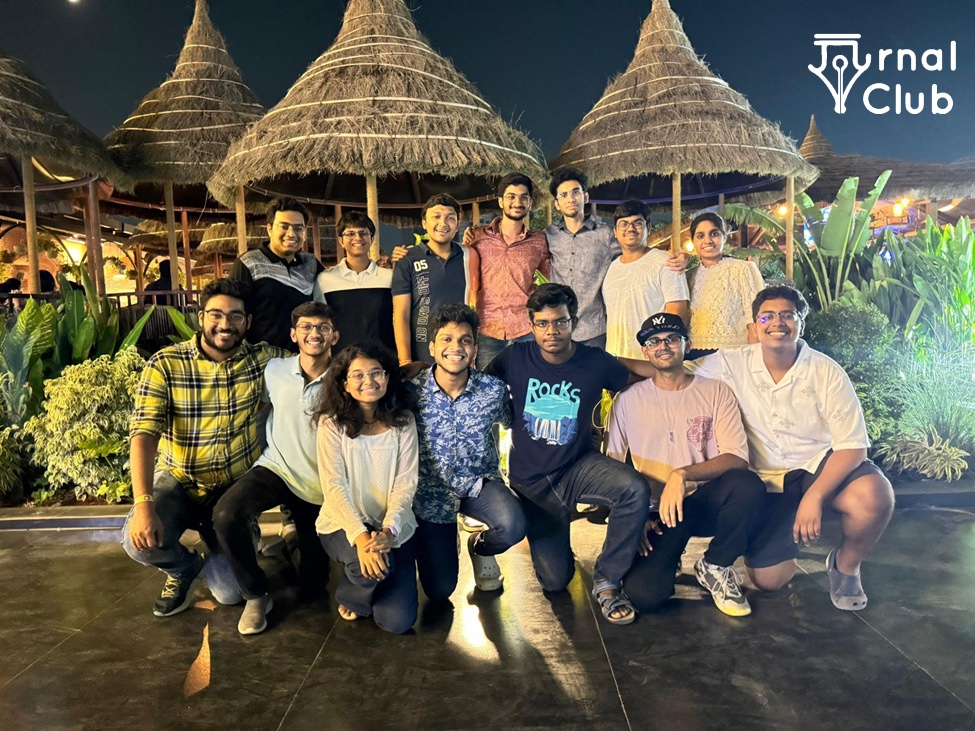
JC: Hello, guys. First of all, please introduce ourselves.
Team JANUS:
Hi, I am Sham (22 batch), from team JANUS, which is the CanSat team on campus, and I was part of the structure subsystem last year. I’m the current team lead.
Hi I am Anmol (21 batch), I was the team lead last year and I was in structures the year before.
I am Umang (22 batch), I was a part of the avionics subsystem last year.
I am Vishal (23 batch), I’m part of Avionics.
I am Kevin (22 batch), I was a part of Avionics last year.
My name is Rishi (23 batch), I am part of Avionics.
I am Vignav (21 batch), I was part of Avionics.
JC: What got you guys interested in rocketry and space? And how was it like joining Janus?
Umang: I heard of Janus because of Sham, so we wanted to join Artemis. I was like, okay, I also want to join Artemis. Janus had inductions at the time. So we thought we’d apply for Janus, we’d get in Janus, and then we’ll go to Artemis. So we applied for Janus, we got in Janus, and never looked back. When we first joined, I never heard of Janus. We thought it was so useless. Like, I don’t know what they even do. Me and Sham, we just wanted to join Artemis because we thought the idea was really cool like we have to launch rockets and stuff. Cansat, we had no idea until we saw the problem statement. I wasn’t even going to solve it. But when they came I thought the problem statement was easy only. I’ll do it. And then submitted. Done. Got in.
Kevin: SEDS was the first technical club to open the inductions. So I just applied. And then I got in. And then, I didn’t want to get into any technical club. Initially, I thought, this is like a club where people will give some random ideas and then forget. But then after a few meets and interacting with other members I realized that this club is the best.
Vishal: I got to know about Janus by our ex team lead, Anmol Bhaiya. He had a nose cone in his hand while he was walking out of Shankar Bhavan. Me and another one of the team, Dron, saw him and we approached him. I was like, “Bhaiya, what is this?”
“I am part of Team Janus. It’s a really fun club to be in.” he said. So, we joined.
Dron (23 batch): Yeah, actually we were having our freshers’ fair that day. So they were assembling last year’s Cansat in Sandboxx. So, we just met. And Anmol bhaiya was wearing merch.
Anmol: I was just walking and I think it was Dron who just shouted my name because it was written on the back of my shirt. They thought the team name was Anmol .
Umang: And then he asked questions. We were assembling and he started interviewing us. “Why are you using this board, why are you using this, this, this” At that point we thought he was very annoying. Okay, because the thing was, nothing was working. We were like, in 30 minutes we have to go to present our thing.
And nothing was working and he’s asking us questions, “why is this, why was that, why did this-” It was like, yeah, it was very messy.
Anmol: So from the beginning itself, I was very interested in this aerospace field. When I came to campus, my roommate was actually in SEDS. So he introduced me to it. He was in Artemis. So for, I think two, three months, I was in Artemis as an enthusiast. And after that, Janus launched their induction, I got into Janus. And, uh, funny story, my roommate left right as I joined SEDS. But during that time, Janus, I’d say just before our batch, was the first time that Janus went to the US. We were the second, uh, the 22 batch was the third, and now 23 will hopefully be the fourth batch to be able to go to the US and participate.
Team JANUS(seniors): We launched Inductions for 22’ batch for the second time, right? There were 84 people just for structures. Out of which 46 were qualified for the interview.
Vignav: Ours was the best problem statement ever for any tech club ever. It was a very nice problem statement. I liked solving it. They didn’t only ask Avionics even though I was applying only for Avionics, I applied for SEDS, they didn’t tell which team we’ll get into. Ah, for some reason, everyone had a perspective about oh Artemis is better, that this is better. I didn’t care, I didn’t know anything. Whenever an induction notice came, I used to apply and so far, the best problem statement I’ve ever seen was basically from SEDS. It was very fun and it also included an element from Structures.. It was very fun to solve. The next year, I wasn’t able to make such a good problem statement.
Team JANUS: This time we first released the problem statement, then after releasing the problem statement, there were interviews and then after the interviews, we held a hackathon we had in F103 I think. And compared to last year, before holding inductions we also showcased our CanSat because since last year we had something to show which also attracts a lot of people because they know what exactly we do
JC: Right
Team JANUS: When we came to the club, there was nothing to show. So that was an improvement over years. And whenever we give a problem statement normally we give all the resources required to solve the problem statement like YouTube videos you see this video you should be able to solve the problem statement.
JC: Right
Team JANUS: But the person has to watch the YouTube videos to be able to solve the problem statements. You can see the videos like if there’s PCB designer, for everything, there are videos underneath that we give links in the problem statement included. So that anyone can come even if they do not know anything they can learn.
JC: When did team Janus form?
Sham: Janus started in 2014, I think. For many years, we weren’t able to qualify for the rounds to go to the US. But the team right before us qualified and we have been trying to keep that up and qualify every year. The first team went in 2021. So for seven years, we weren’t able to qualify for the competition. There were breaks in the middle because, occasionally, everybody would feel, like what is the use of working if you’re not getting selected?
Anmol: So the team lead before me was Pratyush (Gupta) Bhaiya, and before him was Anand Bhaiya. He was the first team lead who was actually able to push the team to go to the U. S.
JC: So, did you go as well? The first time?
Anmol: No, not the first time. I went the second and third time.
Team JANUS : Just so you know, every year there are only two teams selected from each country, so that’s why there’s a lot of competition in India because many teams compete from India. The second team has been changing for the last three years. But for the past three years, we have succeeded in our PDR score. Basically, in the first round, our score has consistently improved. And last time we got a 100 percent on the thing . No one in the world got that.
Before us, there was only one college in the entire world, which was Massachusetts Institute of Technology, in 2000, to get 100 percent. Since then, only BITS Pilani, Hyderabad campus has got 100 percent .
Team JANUS: And the competition in India is actually increasing. Yeah. For example, uh, this year we got 100. The other team that got selected was IIIT Hyderabad which got 99.87. In the previous year, the percentages were lower, 99.1. The margins are getting extremely small, especially in our country, because many teams are participating. There are many older IITs who are not able to clear the first round. But we have somehow figured out how to make the presentation perfectly for the first team.
JC: When you guys first joined Janus, what kind of issues did you face?
Sham: I had to get a new laptop. In the structure subsystem, the major work that we have, it’s all on CAD. And the CAD software that we use is SolidWorks. But SolidWorks doesn’t support Mac. And I had a MacBook at the time. So then I had to get rid of the laptop.
Vignav: When we joined, uh, me and Anmol, and another person, Allen(21 batch), there was not a lot of knowledge transfer going on. The juniors were not being told what was done in the previous year. But we understood that without this the team could not continue for multiple years. Because the next year juniors have to know how to handle the team and also teach the coming juniors.
So from our year, we’ve been making sure that the juniors are involved a lot, and they do a lot of the work with our assistants, which makes sure that everyone knows what they’re doing, and when the next batch comes, they’re also taught. And the team that is going, always knows what’s happening.
Anmol: So what we have learned over the years is what the key steps are in making these presentations. As the team lead is always from the previous year, we know exactly what mistakes have been made in the previous year, as well as the core team who’s actually working on the project has already worked on another presentation the year before.
Majority of the people who are working in the team already know the mistakes that have been made last year. Which wasn’t the case before. So that was the major thing that our team didn’t start with. Before that, it was a little difficult because before Vignav and I started working, the team had a disconnect kind of thing. The team right now, we all are in, we all are together. But before us, everybody had to work on their own stuff after the competition was done, they had to go for their own masters, they had to go for their jobs. So that was like this disconnect kind of thing. That’s why we started this whole enthusiast program in which new enthusiasts come in, first year they are trained, the next year they go to the competition and the next, and then the next year they get a chance to become the team leader, hold the position of responsibility in the whole of SEDS.
The thing is because they know the entire scope of the project, they feel like they’re doing something for the whole team and because we have this team as such, we have this bonding that even though I was in structures, we had such a bonding with Allen that whatever mistakes happened even in the Avionics I knew about them. It was not like the structures and Avionics will work separately. Even when the meets are called, they are called as a whole team.
JC: So keeping a connection from batch to batch, do you think that helped the tech culture on campus?
Anmol: Yes, it has. Uh, so, currently the thing, at least, I’m not sure this semester what’s happening because I’ve not been there.
But until last semester, the thing was that everybody thought that making things look nice is going to be something that would improve the tech culture. I agree that making things look cool is a big part of it. But you should also know how things work and you should have that knowledge. See, everybody likes science. It’s like not everybody wants to go into science to do it for the rest of their lives. But science is something that is always interesting. So it’s just the way you present it to people and the way you make it seem interesting. It’s just based on how you present what you have. So, that is one way that we try to improve tech culture, we keep all these events. Because we ourselves are so interested in science, we know how to express our thoughts and how to express what we believe.
Umang: Right. So in 2022 there was Tech Week. Tech Week is usually very dead in terms of whatever workshop or anything going on. But during that time, Janus held its 1st workshop, which was on PCB design. And, the rest of the workshops, they got a max of like 2, 3, 5 registrations. There was just one hackathon with prize money of 15,000. It had 90 registrations, but besides that, every workshop had 2 or 3. Janus was the only one which got around 80 which is a big thing because during tech week, no one comes for workshops.
It was our first big achievement on campus towards promoting the tech culture.
Many people might find it boring. I’ve heard some of the people that are telling us that we just keep doing tech, tech, tech.
But the things that happen while we are working are not just very interesting but also dangerous. Not exactly dangerous, but take Avionics as an example. When we first joined there was no knowledge about Avionics or anything. We have BMS, battery management systems. So we were assembling it in Sandboxx. We tried out a couple of BMS boards. The first board that we tried, it smoked and it became red hot. And we were sure that the battery was ruined or it was short-circuited. And we had to leave, it was like 2am in the night. And this was a week before the competition.
We were not sure if the battery would blast or not. So in the Sandboxx, we cleared the whole ground. We kept the battery in the middle so that if it burns, nothing else catches on fire. And we left. And we didn’t get the recording inside because the cameras were down.
Vignav: When we went to the US, the launch was in the afternoon. We were working till midnight. We had to get to the US and then assemble the thing over there.
And then we had to leave our house. Everyone was doing whatever they could from their homes when only the 22 batch was still on campus. So they were printing as much as possible, and we had to take everything to the U. S. in parts, and assemble it over there. This is the second time we’re going to the U.S., and we didn’t plan everything properly. When we went there, we were assembling it the night before the launch. At 2AM, the batteries started smoking. I came into the room and they’re saying some smoke is coming, some smoke is coming. I just walked into the room because I went to some other team’s room to get soldering iron. So I just went and took some soldering and it was smoking.
The batteries are inside and we had to remove them before they started burning any of the plastic. The entire Cansat is made of plastic. So as I was walking out with the Cansat, where I was dismantling it, and the batteries started coming off and they were too hot, I couldn’t touch the wires, because they’re burning hot.
So I asked for pliers, I didn’t even look back, someone gave me pliers, I cut the wires off and threw the batteries out, outside the building. That time when we actually put up on the group of the Cansat team. And then we were like, ‘How do we dispose of the lithium-ion battery that has overheated?’ People were like, just bury it and hope you’re alive and well.
In the competition, there are a bunch of teams from different countries. For example, the Italian team had their parts manufactured from Ferrari or Lamborghini. Many of the countries have their teams made of masters students or even Ph.D. students. And we were second yearites. We are undergraduate students trying to figure out, and have no clue what we’re doing.
The teams over there are very nice. All teams are very cooperative. They keep helping each other whenever they can. Once we put that message, asking about the batteries, I don’t think we even asked if anyone had a spare battery or something. Someone texted, I think it was the European team. I went to their room. And then they helped us, they gave us two batteries, but they were not the same batteries as we expected to have. But we managed to make it work.
Yet, we forgot to turn on the camera. Like, the battery was powering a camera and we forgot to turn on the camera. So the batteries were useless.
But, we learned a lot. And the next year we made sure there’s a checklist. And we made sure that the camera was on. We didn’t make the same mistake and got the footage for the first time from Cansat.
Anmol: So there’s this micro-controller, Teensy, and the thing with Teensy is that it is very fragile. Umang had designed the PCB and we had to use it with a DC motor. So, uh, they used to burn pretty easily, and they burned a lot.
So for the next year, I planned in advance and I put four or five of these teensy’s in the budget. And, uh, we got all of them and everything’s working fine. I am like “Iss baar jalana nahi hai”. I had to buy 6 Teensy that year. And by the way, the cost of it is pretty high, around 5000. But we have learned and now we have decided to move away from Teensy.
JC: When you guys went to US, Virginia Tech, How did it feel to compete with other countries and to represent your own country?
Vignav: When we went, we made a lot of mistakes there, but we learned a lot. Before the launch, for example, I realised that the camera wasn’t switched on. And my friend, Allen, said the camera is not working. Did you switch on the camera?
I was like, um, no.
The countdown is going on.
It’s 3, 2, 1, and launch.
We can’t do anything about it. And some other things were not working. But after the launch, we actually felt very sad. We thought all hope was lost and did terribly, because we did much worse than what we expected. Each one of us cried.
After like an hour of crying, we finally went and talked to other teams. Because this was the only time we would get to interact with these people.
And it felt nice. Even they made mistakes. Although not as big as ours, everyone’s making mistakes. And all we’re doing is learning over there. Even what didn’t work for them, we can learn why it didn’t work.
Umang: This is where I think the team lead (Pratyush Bhaiya, at the time) is very important. Anmol bhaiya told me, There were 21 and 20 batch students, I didn’t go then. So they were sad and all. But then Pratyush bhaiya kept his composure somehow. And then he forced them to talk to other teams so they would feel better. And then once they started talking, they felt much better. And it was a good decision.
Vignav: But yeah, as he said, team lead is not just technical in general. Of course they come from the technical side. But then, once they become the team lead, they have a lot more. So, it’s not just about making sure that the thing works. Because everything breaks all the time, people lose hope and attention, or just wander off. But the team lead has to make sure that everything is fine. They make them focus. For example, many things stopped working and I started losing hope in the middle of a bunch of tests that we had to do. And then Pratyush bhaiya was like, it’s fine, it’s fine, just figure it out. Take your time. So I went there, and then finally got it to work. Had he not motivated me, I would have given up.
So the team lead’s job is not just about being involved in the technical stuff sometimes, it’s a lot of involvement in other stuff. To make sure that the team is together. In Janus, compared to any other tech club, I feel the bond is the strongest. We do not see that there are different batches. We have to meet every now and then, and after every other meet we go to the terrace of New Acads. And, we do not see that we are different batches. Juniors keep making fun of the seniors. Seniors keep making fun of the juniors. We keep fighting with each other. We keep playing around. Because of that, we are all connected.
JC: How did you find out about these competitions? And, I’m sure the older batches knew more about them. You said for seven years, you did not qualify, what changed this time?
Team JANUS: Every year there is a ‘Roulette Round’. If there are more than twenty teams that applied for a category, they have to narrow it down, so they will just have a random selection before even the first round happens and they will choose some teams that can participate in the first round and then they will go on and select another two teams that can go further.
Because the odds were not on our side for seven continuous years, we weren’t able to move to participate.
Umang: Throughout the competition, we were sleep deprived because of which we made many such small mistakes. Let me tell you about one such mistake.
I was supposed to put a reset pin in the flight computer. If you just touch the screwdriver, it should reset. For testing purposes it was there. So I was told to put it in, and I did. But in the main flight software, during the launch time, we had to somehow remove it, but we didn’t. We felt like it shouldn’t be an issue because no one will touch the screwdriver in the sky, right? But the issue was there were carbon rods and carbon rods are conductive. It’s a very obvious thing, but we didn’t realise it then. The carbon rods are conductive and the reset pin will reset. We didn’t think and now it’s in the air and continuously resetting, the calibrations and everything. So now it’s not deploying anything.
Team JANUS: But we still got all the data on the ground and a lot of things still worked. Even though a lot of things didn’t work, a lot of things still worked.
The things which were not dependent on altitude worked. The altitude was getting messed up and all the deployments were based on altitude. So, mechanisms didn’t deploy. We only got the temperature and other things.
Anmol: So it was basically an asteroid.
Rishi: Yeah, we made an asteroid.
Team JANUS: But the next year they fixed everything. EVERYTHING, the parachute deployed, the heat shield got released… We have a picture of it.

Team JANUS: Yeah, while it’s dropping, there is a fixed drag, right? We calculated the velocity on paper, that should be like five or something. In practice when we carried it, it was exactly five. There was an error of 0.1 metres, 0.1 or 0.2 metres per second. It was so perfect and then halfway, it’s supposed to deploy the heat shield and then once the heat shield is deployed, we can see the altitudes in as per the calculations.
It was so organised, it was just so good. But if we did not make the mistakes the previous year then we can’t succeed the next year.
Umang: The only reason is this time there was no reset pin. That was the biggest improvement.

Umang: Vignav wrote the first code for flight software and then next year, we used the same skeleton of the code. I just removed all the reset parts, removed all the pins, made some more data filtering which reduced the chances of error.
Vignav: Even the GCS (ground control system) all started two years ago and then the same thing was improvised later by Sanchay (22 batch).
Team JANUS: A couple years ago they burnt two batteries in the US and then one or two we burnt in BITS, like in sandbox. Last year, we burnt zero batteries.
Team JANUS: Also because of the fact that we don’t have certain equipment on campus to do stuff, we have to do a lot of jugaad to make sure the stuff works. To do that, sometimes, it might or might not damage the stuff we are using. But we have to do what we have to do.
Umang: I remember like last year CanSat, I was assembling some batteries in my room, and the last experience I had was when we assembled it, it burnt in the Sandboxx. This time I was in my room, in front there was a bed and a wooden desk. I had to sleep after assembling it at midnight and I was scared if it would burn or not.
Vishal: It’s because Lithium fire is hard to put out.
Umang: Yeah, there’s a fire extinguisher in the hostel, because even if you put sand, even if you put water –
Rishi: The sand will work I think.
Umang: I was in my room, where will I get sand? The worst part is that people were doing missions and they burnt all the fire extinguishers, so the authorities locked it up. So if it catches fire, I do not have a fire extinguisher. There is just a lot of burning material in my room. There is the bed and then the wooden table. I kept it on the floor and waited for 20 minutes. Nothing happened. And then I slept and it did not burn in the morning.
Sham: You know, I now realise how important it is, because I’m working with lithium batteries here and they have such a big box for such a small battery.
Team JANUS: When 21 and 20 batches went, because of the delay in manufacturing, we were doing manufacturing during our compres also.
Anmol: One day before I leave and the day Pratyush Bhaiya was leaving for home, we were doing another round of environmental tests, so we had to make the CanSat go through multiple tests such as the vacuum test, thermal test etc, So while doing the thermal test, our whole CanSat melted inside that thermal chamber and I am leaving the next day. I had my visa interview the next morning and I was leaving the next afternoon. Pratyush Bhaiya’s flight was in like 2 hours and he went to pack. Sham and I were looking at each other and we were so sad, we were like “ho gaya, aur nahi hone wala”. Fortunately, Sham was there on campus after that. I went home really stressed. When I reached home, I remember Sham was 3D printing the parts at campus and he was sending them home to me so that I could assemble them.
Sham: That was one of the most stressful times I ever had. Luckily we had Vignav in Hyderabad. I went halfway across Hyderabad and handed over the rest of the components to him.
JC: Now all this work that you’re doing and that’s a lot of work at the cost of our studies, all this, is it helping you in your future career goals?
Anmol: I will say yes, I got my PS2 just because of this.
Vignav: To be honest, you have some credibility when you talk to Professors. But the main takeaway is that you learn stuff that you can’t learn anywhere else. You can’t make these mistakes anywhere else. Like a first yearite is allowed to burn things and is allowed to make a lot of mistakes. No other club lets you just play around such components with such ease. Even if a first yearite makes mistakes we do not penalise them. I’m pretty sure Umang, when he was in his first year, might have burnt many things. Yeah, we learned a lot. Majorly, what we run is related to the field of embedded systems which is useful, but in terms of electronics, everyone is prepared for something else.
Umang: So besides the embedded system, there’s also a PCB layout. We also use a similar concept in Silicon design which is for manufacturing of silicon chips. I got one project because of this. In my first year, I did PCB designing and in 2-1 (2nd year, 1st semester), I approached the professor. In second year, professors don’t usually give projects. So he was actually impressed and asked me where I learned all this and he just gave me a project like that.
And in second year getting such an industry standard project was a huge deal. I was actually working with a third year student. It was a one year gap and it felt really good. So this way, it has helped, which indirectly has helped me for like my resume profile and stuff like that. So yeah, it has helped a lot career-wise. It’s probably the only Tech club which helps in placement, I can say with guarantee.
JC: Well, that’s all from our side. Thank you for the interview.
 The Journal Club
Leave a comment