By Athithan V (2024)
The Sun will soon set on the British Empire.
Initially, on October 2, 2024, British Prime Minister Keir Starmer and Mauritian Prime Minister Pravin Jugnauth jointly announced that the UK will be turning over their sovereignty over the Chagos Islands to Mauritius in accordance with an advisory opinion issued by the International Court of Justice back in February 2019; this was the culmination of nearly two years of intense negotiations between the two governments. However, after Mauritius ousted its incumbent government in an election held in November 2024, incoming Prime Minister Navin Ramgoolam rejected the provisional deal both parties struck, sending them back to the drawing board to hammer out a new deal amenable to all stakeholders.
But what exactly would this change? To whom would this change matter and why? For that, let’s wind back the clock and start at the very beginning.
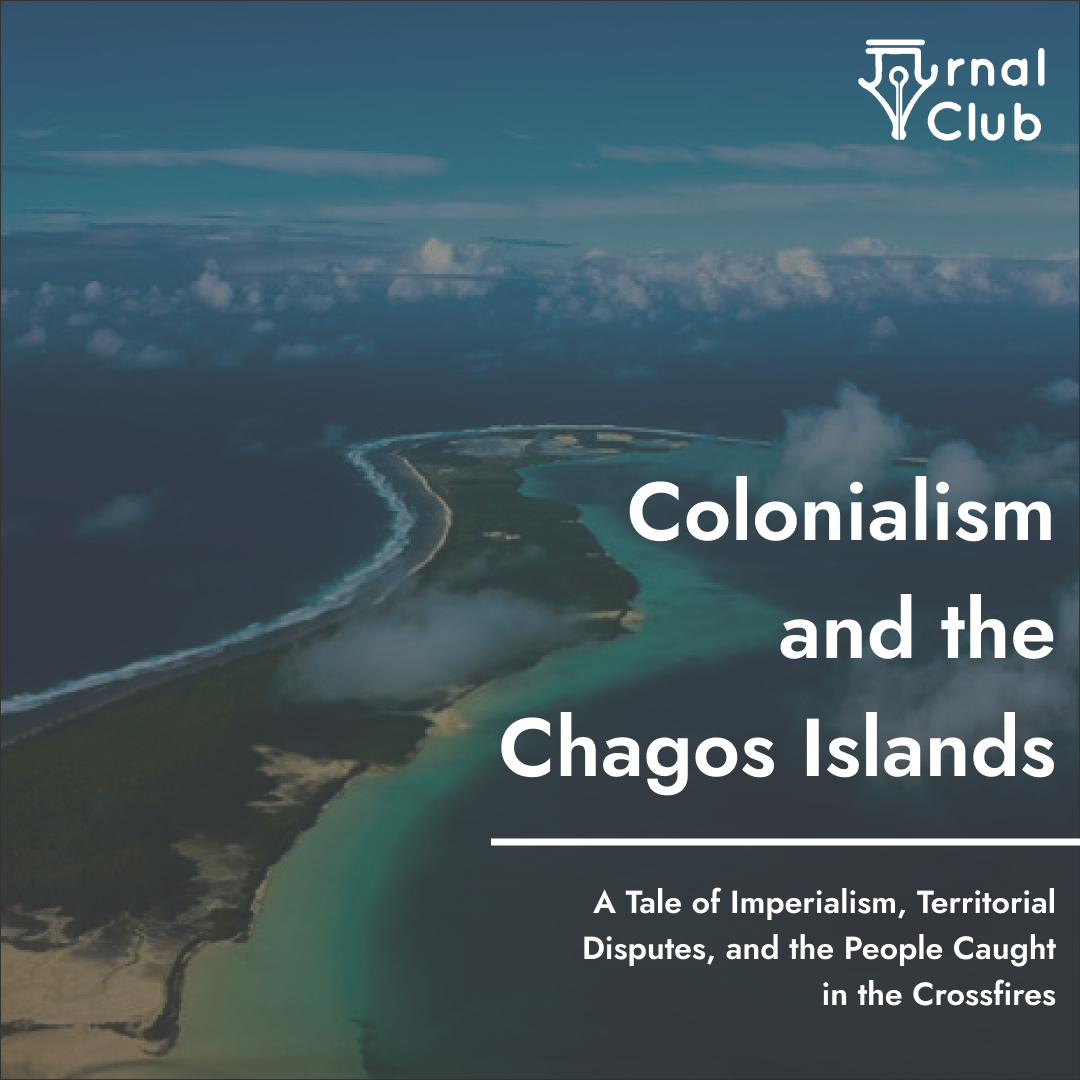
The Chagos Archipelago is a cluster of atolls located in the central Indian Ocean. Located around 500 km south of the Maldives and around 1700 km northeast of Mauritius, it contains the world’s largest atoll: the Great Chagos Bank. The major natural resources currently harvestable in the region include coconuts and fish, neither of which have been harvested after the territory was declared a marine protected area; the area might also be home to undersea mineral resources. Presently, the Chagos Archipelago is administered as the British Indian Ocean Territory (BIOT) and doesn’t possess a permanent population.


Though first discovered by Maldivian seafarers centuries ago, the Maldivians didn’t settle these islands due to their remoteness. Only towards the tail end of the 18th century did the French finally colonize the archipelago, bringing with them slaves from Africa and “contractors” from India to tend to the copra plantations they had set up on the islands. They ceded the islands to the UK as laid out by the 1814 Treaty of Paris, along with Mauritius and the Seychelles, as part of the territorial concessions France acquiesced to after the Napoleonic Wars. Those on the islands continued to work at the plantations as indentured servants after the British Empire abolished slavery in 1833. Neither these workers nor their descendants were allowed to own property on these islands.
Over the next few decades, the ethnically diverse population of workers mixed among each other, and from them arose the Chagossian people, a distinct identity held together by their connection to the land they worked on and the Chagossian Creole that evolved as a common language over time. By all means, the Chagossians were now practically the indigenous people of this previously uninhabited archipelago. But alas, the British government refused to recognize their rights over this land due to their colonial ambitions, as previously mentioned.
Over the 1960’s, two major events radically changed the trajectory of these islands and of the people who inhabited them. First was the proposed construction of a joint US-UK military base in Diego Garcia, while the second was the global decolonization drive that gave way to the impending independence of Mauritius and the Seychelles.
These factors compelled the UK government to create the British Indian Ocean Territory, an administrative unit that contained an assortment of islands in the Indian Ocean under British sovereignty, on November 8. 1965. A month after this sudden, forced, and illegal separation, the United Nations General Assembly passed Resolution 2006, which condemned this move and noted that this was against international laws as laid down by the Declaration on the Granting of Independence to Colonial Countries and Peoples, which stated the following:
“Immediate steps shall be taken, in Trust and Non-Self-Governing Territories or all other territories which have not yet attained independence, to transfer all powers to the peoples of those territories, without any conditions or reservations, in accordance with their freely expressed will and desire, without any distinction as to race, creed or colour, in order to enable them to enjoy complete independence and freedom.
Any attempt aimed at the partial or total disruption of the national unity and the territorial integrity of a country is incompatible with the purposes and principles of the Charter of the United Nations”
Next, the British government bought the many copra plantations spread throughout the Chagos Archipelago and closed them down in hopes of making them leave by depriving them of their livelihood. They then started the process of vacating not only Diego Garcia, but also nearby Peros Banhos and the Salmon Islands; nearly 1400 people were forcibly removed from the islands over those five years. The British government defended these expulsions by simply claiming that most of them weren’t “indigenous” anyway; this is apparent in an internal memo of the Colonial Office:
The Colonial Office is at present considering the line to be taken in dealing with the existing inhabitants of the British Indian Ocean Territory (BIOT). They wish to avoid using the phrase “permanent inhabitants” in relation to any of the islands in the territory because to recognise that there are any permanent inhabitants will imply that there is a population whose democratic rights will have to be safeguarded and which will therefore be deemed by the UN to come within its purlieu. The solution proposed is to issue them with documents making it clear that they are “belongers” of Mauritius and the Seychelles and only temporary residents of BIOT. This devise, although rather transparent, would at least give us a defensible position to take up at the UN.
In addition, any Chagossians who left their home archipelago, be it for work or medical reasons, found out that they weren’t allowed to return. However, the underhanded tactics the British used, like the expulsion of the Chagossians, did not garner much attention from the press. Even when two committees set up by the US Congress tried to investigate the whole debacle after a Washington Post article shone a light on the plight of the Chagossians, they were stonewalled since all information regarding the Chagos Islands and the military base at Diego Garcia was considered to be “classified information”. Both the Mauritian government and the Chagossians received very little compensation from the British government. In addition to this, the British government also declared the entire archipelago to be a marine reserve to avoid international scrutiny in the name of ecological conservation. Though what the British government did was illegal and inhumane, the fact that both the US and the UK, both of whom are running the military base at Diego Garcia, were influential global powers meant that they were able to sweep much of it under the rug with very little opposition. The point of this all, to sum it up nicely, was put very candidly in this memo sent by the Colonial Office to the UK’s UN delegation:
The object of the exercise is to get some rocks which will remain ours; there will be no indigenous population except seagulls who have not yet got a committee. Unfortunately along with the Birds go some few Tarzans or Men Fridays whose origins are obscure, and who are being hopefully wished on to Mauritius etc.
Over the 1980s, the Mauritian government began to consistently assert that the separation of the Chagos Archipelago from the colony of Mauritius was illegal under international law, as stipulated by the Declaration on the Granting of Independence to Colonial Countries and Peoples. The Mauritian argument hinged on the fact that the forced expulsion of the Chagossian people, along with the removal of the BIOT from Mauritius during independence, violated international law as stipulated by the declaration.
However, this isn’t just a matter of principle; Mauritius isn’t wrangling for these islands because they want to correct a historical wrong. In reality, there are a lot of economic incentives for Mauritius to take over the archipelago and, more importantly, the EEZ that comes along with it. Firstly, and most obviously, comes resource extraction. The extended EEZ that the acquisition of the Chagos Islands would provide Mauritius with waters that are teeming with marine life; this could result in a pretty big boost for the Mauritian economy. The central Indian Ocean seabed has also recently come under scrutiny for potentially vast rare-earth mineral deposits, and Mauritius has been making moves in this regard by amending its current mining laws. Even mere licensing, let alone exploiting the resources themselves, would be a game-changer for Mauritius. Additionally, many speculate about the potential ecotourism value these islands, which have essentially been left untouched for a half-century, may hold. Thus, to put it mildly, the Mauritian government has an enormous economic incentive to pursue the acquisition of these lands, even beyond the moral and legal argument.
On 20 December 2010, the Mauritian government brought forth a case in front of the Permanent Court of Arbitration with the assertion that the Chagos Marine Protected Area is illegal under the United Nations Convention of the Law of the Sea. As previously discussed, the Mauritian argument hinged on the fact that the creation of the BIOT was illegal based on the stipulations laid out by the Declaration on the Granting of Independence to Colonial Countries and Peoples, and thus, the British government did not have the right to declare the archipelago a marine reserve. They also pointed out that British Prime Minister Harold Wilson threatened then-Premier Seewoosagur Ramgoolam by threatening to withhold independence from Mauritius if they didn’t consent to the separation of the BIOT from Mauritius, which is a direct violation of the self-determination clause of the Declaration. The Court agreed with the Mauritian case and struck down the marine reserve as “illegal”, though the court desired that Mauritius and the UK resolve any potential issues amongst themselves and establish some agreement to protect the local ecosystem.
On 23 June 2017, the United Nations General Assembly recommended that the dispute be brought before the International Court of Justice in order to better clarify the rightful sovereignty over the archipelago. The hearing started in September 2018, with 17 other countries arguing in favour of Mauritius’ case. Mauritius brought forth the points they’ve put forth in previous cases, while the UK admitted to its wrongs with respect to the handling of the Chagos sovereignty dispute, but claimed that the ICJ did not hold jurisdiction over this case and that they wished that it would be solved by bilateral negotiations and not a court decision. In February 2019, the ICJ reaffirmed the stance taken by the Declaration and previous ruling and ruled that the separation of the BIOT from Mauritius was unlawful and that sovereignty over the archipelago must be surrendered to Mauritius as soon as possible. Later in 2021, the International Tribunal for the Law of the Sea, in a ruling regarding a dispute over the maritime boundary between Mauritius and the BIOT, ruled that the UK does not hold sovereignty over the Chagos Islands and that Mauritius holds sovereignty there; the UK disputes the ruling and their assertion that Mauritius hold sovereignty over the BIOT.
In response to all the rulings against the UK Government with regard to this dispute, the Liz Truss government opened a fresh set of bilateral talks regarding turning over the sovereignty of the Chagos Islands to the Mauritian government. However, the Chagossian people, arguably the most important stakeholders in this conversation, were not even consulted, let alone given a seat at the table.
This, to the writer, reeks of the same colonial mindset that split the colony of Mauritius in two in the first place and grossly fails to remedy the fundamental issues at hand. The Chagossians, the rightful inhabitants of the Chagos Islands, are not being given the voice that they deserve in these talks. Though it could be said that the Chagossians likely don’t want to return to a homeland that has neither the comforts they’re used to nor any opportunities for growth, it is their choice to make, at the end of the day, and a choice they are being denied by both governments. It is also important to note that the battle Mauritius is waging is not just one of righteousness, and their actions behind the scenes, such as the new mining law, show us that this is likely just a resource grab that happens to possess a shred of legitimacy; after all, if this were a battle of righteousness, then the Mauritian government would have fought to ensure Chagossian voices were on the negotiating table along with the British and Mauritian government.


To return to the topic at hand, the idea of returning sovereignty over the Chagos archipelago to Mauritius was an issue that obviously faced some contention, especially within the ruling Conservative Party. Leading figures within the party, like former Prime Minister Boris Johnson, Grant Shapps, and then Foreign Minister David Cameron, were said to be against the handover; speculation that the government would halt the negotiations were rampant back in December 2023. However, the government pushed through with negotiations and handed the baton to the Labour government that took charge in July 2024.
Finally, on October 3, 2024, UK Prime Minister Keir Starmer and Mauritian Prime Minister Pravind Jugnauth agreed on a deal to transfer control of the Chagos Islands back to Mauritius. Though the detailed agreement wasn’t released, we do know that the deal stipulated the transfer of sovereignty to Mauritius, the UK providing Mauritius with financial support and infrastructure investments, and a resettlement program for the Chagossians in the Chagos Islands save Diego Garcia. The US-UK military base at Diego Garcia, under the stipulations of the provisional agreement, was to be leased to the UK government for a period of 99 years, with the option of a unilateral extension of the lease by 40 years after consulting the Mauritian government.
The response to this newly brokered deal from the Chagossians was understandably mixed. While some were insistent on returning to their homeland, others were worried about their current status in the UK and ways to fix it. Many also were frustrated by the lack of Chagossian voices and representation during the shaping of the deal.
However, on December 17, 2024, incoming Mauritian Prime Minister Navin Ramgoolam rejected the deal, saying that it “wasn’t good enough” and that he wanted talks to be reopened. Based on remarks made by Mauritian Deputy Prime Minister Paul Berenger, the point of contention seems to be the financial support that the UK has pledged towards Mauritius. This has invited scrutiny from not only the Opposition benches, but from the government as well. Ed Davey, leader of the center-left Liberal Democrats, levied accusations of mismanaging the negotiation process and also questioned why the government was making “significant payments to Mauritius upfront at a time when winter fuel payments have been scrapped”. Other opposition parties have also put forth negative reactions, from Reform UK’s Nigel Farage alleging that a deal would set back US-UK relations to Conservative Party leader Kemi Badenoch calling it an “immoral surrender” and remarking that:
It is not in our national interest to give [them] away and pay for the privilege of doing so.
Even government insiders have mixed feelings about this deal, with one former advisor suggesting a withdrawal from negotiations saying:
We tried to be constructive, tried to support the rules-based order, but Mauritius has been completely unreasonable and now it will never be returned.
One party who seems to be surprisingly open to this deal is the Trump administration. Despite initial concerns that Washington would block any deal that surrenders British sovereignty over Diego Garcia, Trump shocked both governments by saying in an impromptu interview that he was inclined to agree with the current Labour government on this issue and that he feels that this deal will end up succeeding. However, it is to be noted that the US government has only given provisional and conditional approval of this plan; the plan can be rejected by Washington at a later date if the deal doesn’t suit them. This tacit approval from the Trump administration is expected to speed up negotiations, with both sides maintaining that approval from the US government is key to any final deal.
So, where does this leave us? As discussed, hints made by Mauritian government officials make it seem like they stalled the negotiations looking for better financial support, likely to fix a steep fiscal deficit brought on by the previous government. If true, it’s gravely concerning that the future of the Chagos Islands, as well as the Chagossians, seems to hinge on an authority that seems more interested in extorting more money from the British government to fix domestic fiscal mismanagement than to see a swift resolution to this long-standing issue. The Mauritians seem to be operating with a colonial mindset, claiming they represent Chagossian interests while not meaningfully making an effort to consult with the community at all. Both parties seem to be disinterested in and exclusionary towards the Chagossian people and their thoughts and opinions on what should be done with their homeland.
In short, like any typical geopolitical issue, all the governing bodies have an ulterior motive and act in a less-than-subpar manner, while the people who have the greatest stake are given the least floor time. Though the general thrust behind the potential deal sounds good, more care could have been taken in the provisions we currently know about to do right by the Chagossians and include them in the process. To sum it all up, this is a messy geopolitical situation, but one that fortunately has a resolution (though somewhat unsatisfactory) in the near future.
 The Journal Club
Leave a comment