

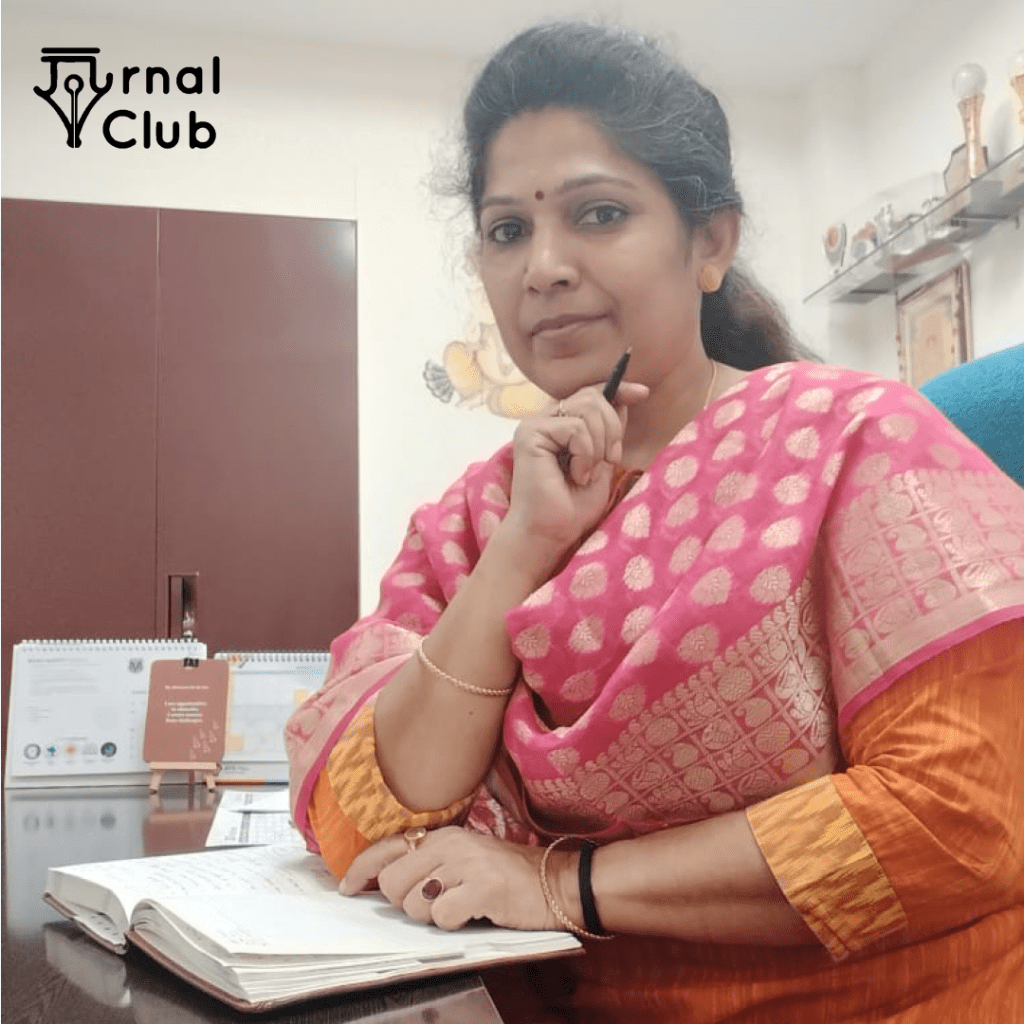
In conversation with Yogeeswari Perumal ma’am, Dean of Administration, Senior Professor of the Pharmacy department and founder of Yogee’s Bioinnovations Pvt Ltd. She talks about her journey with academia in the Pharmaceutical field, and how it has shaped her.
If you look at my academic interests during school, I was deeply passionate about physics and mathematics. I always aspired to become an engineer, largely for two reasons. First, I had a strong inclination toward these subjects—thanks in large part to my grandfather, who was a math teacher. His teaching style was unique and experiential; he often engaged me with hands-on projects that made learning truly enjoyable. Physics fascinated me as well, especially because of its mathematical foundation. Ironically, the one subject I never wanted to pursue was chemistry—and yet, here I am today, a professor of pharmacy!
Like many students, I had a bit of an aversion to chemistry—but for me, it was more about the teacher than the subject itself. I studied at TVS Lakshmi in Madurai, a large and well-known school. In 11th grade, we had two new teachers join—one for chemistry and one for biology. Around the same time, I was actively involved in sports, playing hockey and also participating as an athlete, which meant I often had to miss classes for practice or tournaments.
Since I had been in the same school from 5th grade, most teachers knew me well and never questioned my academic performance, especially because I regularly brought laurels to the school through sports. The new biology teacher was understanding—he even arranged special sessions after school for a few of us and simply asked that we complete the practice tests he provided.
Unfortunately, the new chemistry teacher didn’t share the same sentiment. He was often irritated by my absence and didn’t appreciate the time I had to devote to sports, which made it difficult for me to stay engaged in that subject.
We couldn’t skip lab sessions, though. So whenever I attended, I’d usually arrive late—and like any typical student, I was quite a chatterbox. Right from the start, the rapport between me and the chemistry teacher wasn’t great. He’d make things especially difficult for me in the lab as a result of my frequent absences. He’d often dismiss my work with comments like, “This is wrong, do it again”, repeating it over and over until it got really frustrating. Eventually, I’d get so annoyed that I’d just give up on the experiment.
Once, he even told me he’d give me a zero, and I remember thinking, “Fine, let him.” That was my mindset at the time—I felt the teacher was being unfair, and in response, I decided I wouldn’t study chemistry at all, not even for the exams. Looking back, I realize I lacked the maturity to understand that exams are for our own growth, not for the teacher or even our parents.
My father grew concerned because I wasn’t preparing properly, despite having board exams coming up. I would completely skip organic and inorganic chemistry, and only attempt physical chemistry, simply because it had calculations that I found engaging. In the end, I somehow scored well in my board exams—and from there, I moved on to the entrance tests for engineering and medicine.
In the Tamil Nadu State Board system, the +2 (higher secondary) marks play a major role in college admissions—80% of the admission weightage comes from your Physics, Chemistry, and Math scores, and the remaining 20% is from entrance tests. There’s a separate entrance for engineering and another for medicine.
I was quite casual about it all. Despite my laid-back attitude, I managed to perform well in my board exams. Most people thought I was always playful and not serious about studies, but I still scored well—70% in Chemistry, and above 90% in the other subjects. I was pretty confident I’d make it to an engineering college.
The entrance tests themselves were objective-type and only 50 marks each. I remember thinking, “Even if I score just 10 marks in the entrance, I’ll still get into an engineering school.” That was how sure I was at the time.
My father, a pharmacy graduate who ran his own pharmaceutical company, always envisioned me becoming a doctor. He’d say, “You’re bold and confident—you’d make a great doctor.” But I was very clear: “No way. I can’t handle blood. I’ll never become a doctor.”
Still, to respect his wishes, I agreed to appear for both the engineering and medical entrance exams—though I approached them very casually, thinking I’d easily make it to engineering. I was quite overconfident.
As expected, I hadn’t prepared much, and I scored only 26 out of 50 in the engineering test. Surprisingly, in the medical entrance, I scored 40 out of 50—I still don’t know how that happened! Even after the results, I remained casual about it all, and only then started looking into applying for engineering colleges.
Around the time I was preparing to apply to engineering colleges, a complaint was filed alleging discrepancies in the evaluation of the +2 board exam papers—particularly in English, Biology, and Chemistry. There were claims that errors had occurred in the correction process, and some even speculated that it involved corruption, suggesting that certain individuals may have bribed officials to manipulate marks.
This happened just around the time engineering admissions were about to begin. It was 1992—I still remember it vividly, and to this day, I find it hard to forget or forgive what happened. The Tamil Nadu government suddenly issued an amendment stating that, for that year alone, admissions would be based solely on entrance exam scores. I had scored around 26, while some of my peers—who usually scored less than me—ended up with much higher marks.
As a result, my chances were limited to admission in private institutions outside Tamil Nadu, which wasn’t something I had ever envisioned for myself. I was so disheartened that I told my father, “If I don’t get into engineering, I’m not going to study at all.” He tried to console me and suggested we try again in the next round of counselling.
Even though I could have gotten a seat in medicine, perhaps not in a government college but elsewhere, I had completely ruled that out. I was deeply upset. My father could sense the change—I had gone from being a cheerful, energetic person to someone sitting alone in a dark room, barely speaking, eating by myself. He kept wondering what had happened to me. I was just so shocked and confused—how could the government introduce such a sudden rule?
A month passed by, and July had begun. Back then, taking a gap year wasn’t a popular or encouraged option. Sensing my frustration, my father sat me down and said, “Let me give you a few alternatives—why don’t you consider disciplines like physiotherapy, homeopathy, or pharmacy? Medicine seats are already filled.” I responded honestly, “I don’t even know what pharmacy is!” (chuckles) Ironically, my father had a background in pharmacy, and my brother had just started his first year at a pharmacy college.
By August 1st, classes were set to begin. At one point, my father sat me down and offered two options. The first was to consider a pharmacy college that one of his B.Pharm classmates was opening nearby—we could visit and see if it felt right. The second option was to pursue engineering through a management quota, which would cost nearly 20 lakhs. He explained that choosing this route would mean taking out a significant loan.
At that time, I was feeling quite hopeless and had lost interest in everything. Out of empathy for my father, I told him not to spend the 20 lakhs on engineering. I said, “Okay, what is this new college you mentioned? Let’s go see it.” So he took me there—it was just a 10-minute walk from home. When I arrived, I was honestly disheartened. The college was located within a residential colony, still under construction, and it looked more like a tutorial center than an actual college. I asked, “Where’s the ground?” There wasn’t one. No space to play, no signs of campus life. Sports had been such an important part of my identity, and this felt like a huge compromise. My dad gently said, “You can’t expect everything to be perfect. Just give it a chance.” He had already done all the homework—got the background information and application materials ready. As I stood there, looking at the bare buildings, my heart sank. It was all very cramped. One building housed the pharmacy school, another the nursing school—both within that small area.Then my father shared one hopeful detail: a senior professor of his, recently retired and around 70 years old, was joining the college as an advisor and might also be teaching. That gave me a small glimmer of reassurance.
The first class I attended was Pharmaceutical Organic Chemistry. The second was Pharmaceutical Inorganic Chemistry. The third—Physical Pharmacy. From day one, it was all chemistry. I remember coming home that evening and telling my dad, “Just letting you know—I might fail as I hated the subject Chemistry (And you know why?).” He didn’t say much. He just listened patiently, but in hindsight, I now realize how much stress I must have caused my entire family during that phase. Gradually though, things began to change. I started making friends and even learned to ride a two-wheeler. That sense of independence helped shift something in me.
One day, in class, my dad’s former professor—now a faculty member at the college—walked in and asked, “Who is Yogeeswari here?” I raised my hand. He looked at me and said, “You’re Perumal’s (My father’s name) daughter, right?” I nodded, surprised. That was the moment I realized the reputation my father had built in the pharmaceutical world. Everyone seemed to know him—his work ethic, his passion, his legacy—and now they were looking at me as an extension of that.
As the annual exams approached, my father said something that caught me off guard: “This is my friend’s college, and everyone here knows me. You’re not going to fail, are you?” I was stunned. At first, I couldn’t believe he’d say that. It hit my ego hard. Then I remembered—I had told him, very casually, that I might fail. Still, his words felt like a challenge, and that lit a fire in me. I didn’t want to let him—or myself—down. I became very conscious about my studies and told myself—if not for me, at least for my dad, I should give it my best. Our chemistry teacher had a great sense of humor and made learning enjoyable. Even if we gave wrong answers, he’d smile and appreciate the attempt. That made a big difference. I started studying seriously, reading multiple textbooks, making notes, and staying focused. Even a week before the exam, I was still reviewing everything diligently.
What moved me most during this time was my father. He would wait until I went to sleep, even if it was 1 AM, and in between, he’d quietly come in and leave a flask of tea for me. Normally, it was my mother who managed everything in the house. But during that time, my father was doing so much—and I was genuinely surprised by how deeply everyone was concerned about me. It really stayed with me.
When the first-year exams came around, I went in feeling nervous but prepared. I wrote the first exam sincerely. Now, this was a private college, and the principal—who was my father’s friend—was under a lot of pressure. This was the first batch and the very first exam, and a central exam team had come down from Chennai to oversee the process. Even the Chairman was present. He gave us a pep talk and asked us to give our best. Halfway through the exam, a lady professor walked up to me and asked, “Have you finished Part A?” I said yes, and she asked me to hand it over. I assumed it was a routine check, so I gave it to her. A few minutes later, I looked around and saw that someone else was holding my paper—and copying from it. I was shocked. I walked straight up to him and said, “Ay! Give me my paper!” He said, “No no, talk to the teacher,” but I didn’t wait—I just snatched my paper back.
Only later did I understand what had happened. The invigilators were so worried that the students wouldn’t do well that they had quietly handed out answer sheets—correct ones—to copy from. And mine was one of them. I was tense and upset. How could something like this happen? And how could people just… copy? Everyone knew who I was—Perumal’s daughter. That made me even more uncomfortable, because I didn’t want to be seen as part of something dishonest. That day, something inside me shifted. I knew then that I wanted to carve my own identity—and I was going to do it the right way.
By the time I got home, my father had already heard that I was very upset about what happened during the exam. He quietly stepped in and made sure I wouldn’t be bothered in the following exams. By the third exam, it became clear to the chairman that the students were struggling. So, they allowed everyone to bring books into the exam hall. For the first time, I saw an open book system—something I would later encounter again at BITS, but back then, it was completely new to me. They even told me, “You can also bring books if you want.” But I didn’t. I was worried—what if someone got caught? What if the entire batch’s credibility went down? And more than that, I just didn’t feel right about it.
After the exam, I spoke to my professor—the same one who had once been my father’s professor. I told him, “Sir, I’m very upset with all this.” He listened, then said something that stayed with me for life: “Yogeeswari, if you feel you’ve done the right thing, stick to it. Hard work always pays off.” At that moment, I wasn’t sure if he was right. I was anxious—if everyone is scoring using the book, then what was the point of all the late nights, all the studying, all the discipline? But I kept going. I didn’t like chemistry, but I studied it. I gave my best in every subject. I went into the vacation with my fingers crossed. The results came—and to my complete surprise, I had topped the college.
Those who had used books had just barely passed. That was the moment it clicked—the professor was right. Hard work does pay off. It might not feel like it in the moment, but it adds up, it builds something deeper, something more lasting. From then on, I was more at peace. I had found my rhythm. I was happy. I made good friends. And over time, juniors started coming to me for help. I used to teach them, and that made me feel like I was slowly carving out a space of my own.
Phase II of my studies:
I’m from Tamil Nadu, and honestly, North India was never part of the dream. We were content in our little world down south—life was good, familiar. My elder brother, though, broke that boundary first—he went on to do his master’s at BIT Ranchi.
I’m the second of three siblings, and I’ve always been the rebellious one. I used to challenge everything—constantly talking about equality, equal opportunities for girls and boys. So naturally, I questioned my dad, “Why did you send him to other state for higher studies? I want to go too!”
He was calm, as always, and simply said, “Write GATE. If you get into a good college, we’ll send you.” My parents were actually supportive. But my grandparents? That was a different story. They were worried— “Don’t send a girl that far,” they said. “The culture is different up north.” For them, North India might as well have been another country. They even said, “If you’re sending her for a master’s, better marry her off first—at least there will be someone to look after her.” But I had other plans. Since my brother had gone far, I figured, why not me? Going far from home felt like freedom—a chance to explore who I really was. So, I gave GATE and cleared it. Got a seat in M. Pharmacy. Now, among South Indian students in pharmacy, there are three universities that are considered top choices: Kakatiya University, Banaras Hindu University, and BITS Pilani. These are the legacy institutions, and I had my eyes set on them.
My first interview was at BHU, Varanasi—and that’s where I completed both my Master’s and PhD. Whatever strength, boldness, or confidence I carry today, a large part of it was shaped by my time in Uttar Pradesh. Banaras, despite being a sacred and culturally rich city, isn’t the easiest place for a woman to survive—especially if you’re coming from the South.
It wasn’t just about safety, though that was a concern. It was also about how women were perceived. Intellectual women, particularly, weren’t always taken seriously. The prevailing mindset often reduced women to traditional roles—homemakers rather than thinkers or professionals. Living and learning in that environment taught me resilience, grit, and how to assert my space.
Just three months after I had moved to Varanasi, I got an unexpected call from my father. He sounded thrilled—turns out, I was the Tamil Nadu State topper and had won the gold medal! I was in complete disbelief. The Chief Minister of Tamil Nadu was going to present the medal, and my father asked me to book my tickets home immediately. I was over the moon and rushed back to Tamil Nadu. But things took an interesting turn. There was another boy who had scored less than me—technically, he should’ve been the silver medalist. But thanks to some political influence, he was also announced as a gold medalist. I was furious. I told my father, “You have to speak to the university.” We confronted the university board, but they kept insisting that it was fine. I even had a heated argument with that boy—ironically, that moment sparked a connection. He later joined BHU as my junior, and over time, we became good friends. Funny enough, even today we continue to collaborate—he’s now based in the US!
On the day of the ceremony, we were standing in line for the medals. He was right in front of me. My father was ready with the camera, but I couldn’t stop thinking about how unfair it was. I told him again to go raise it one more time. Eventually, after some back-and-forth, the organizers agreed and allowed me to move ahead in the line-up. That boy was definitely annoyed—but when I finally received the medal, seeing the pride and happiness on my father’s face made everything worth it.
Going to BHU was a turning point for me—had I not gone there, I don’t think I would have truly understood what research is all about. Until then, I was more of a bookworm. I used to score well, but mostly because I studied just for the sake of exams, unlike my brother who always focused on grasping concepts. Even now, despite having grown a lot at BITS, our debates often show the difference—he argues with practical insight, while I lean more towards theory. At BHU, that changed. A professor there played a huge role—he would come in every day, constantly pushing me with clear targets. It was during my M. Pharm project that I truly learned how to structure a research plan, how to look for answers by diving deep into academic articles and exploring the work of other researchers. That experience laid the foundation for everything that came after.
The university campus was massive, and honestly, I felt quite homesick in the beginning. But I didn’t want to step back—I had convinced my father to support this move, so I was determined to stick it out and make it work. Surviving in Benaras taught me a lot. First, the language—I had to pick up Hindi quickly. Second, the importance of projecting confidence, even if you’re scared on the inside. You had to appear bold to be taken seriously. There were definitely challenges during my time at BHU, but I managed to get through them. Our department was located at the farthest end of the campus, practically near a forest. From the girls’ hostel near the main gate, it was quite a journey—we had to ride bicycles to reach there since no other vehicles were allowed. But looking back, it gave me something valuable. I learned to speak Hindi—though my Hindi became quite authoritative and bold, shaped by the way people communicate in UP.
During my PhD, my guide would often encourage me to read the research articles of a renowned professor from a well-known university in Canada—we were working in the area of epilepsy. One day, I came across a study from that professor that directly contradicted our findings. When I pointed it out to my guide, he responded with excitement: “Exactly! This is how we should write the paper.” So in the end, our research actually challenged and disproved the conclusions of that acclaimed professor’s work.
Seventy percent of our paper focused on the work done by the Canadian professor—and we were able to prove it incorrect. While he claimed the compound targeted a specific region of the brain, our research showed that it actually acted on the brain’s central control center. My professor would always tell me, “When you present this, you must boldly state that you’ve discovered something critical—a real breakthrough.” Initially, I was nervous—after all, the whole world would be reading our paper. But I repeated my experiments over and over until I was confident in the results. Once the paper was published, I started receiving letters and conference invitations. For someone who once felt that just traveling from South to North India was like going abroad, it was surreal to suddenly be invited by organizations like the Canadian Society for Pharmaceutical Sciences and the American Chemical Society to present my work on global platforms.
As I was preparing to submit my PhD thesis, I received an interview call from BITS Pilani in December. By that time, I was already comfortable with life in North India, so I went for it. During the interview, I presented my PhD work and spoke about my dream of publishing in the American Chemical Society journal. The panel found it a bit too ambitious since, until then, all my publications had been in European journals. But I believed in setting high standards—I even encouraged my students later to regularly read ACS papers. The interview process at BITS was truly encouraging. I felt welcomed and genuinely excited to begin teaching. What stood out at BITS was the student culture—bold, expressive, and given full academic freedom. It was a refreshing change from the rigid systems I’d seen before. In BHU, for example, professors often relied on decades-old notes. Still, BHU gave me something invaluable—a deep exposure to research, something my undergraduate years did not offer.
At BITS, students were bold and enjoyed complete academic freedom—it was a big shift for me. I used to think teaching was just delivering knowledge, but here, it was interactive and full of questions. Initially, I wasn’t prepared, but I learned to say, “I’ll get back to you,” and would dive into books and papers for answers. That process gave me confidence and reshaped my teaching style. In my first year, I attended a teaching workshop where faculty were trained on delivery, pronunciation, and even using overhead projectors. With students from all over India, clear communication was essential. It was a completely new and transformative experience. After all that, the feedback was quite eye-opening. One panel member pointed out that I had said “right” sixteen times during my session. They also mentioned that even holding a handkerchief could distract students. I was amazed at how seriously the institute took the teaching process—even small things mattered. We were told not to turn our backs to the class for too long while writing on the board. It made me realize how much attention is given to ensuring students stay focused and engaged. Truly transformative experience.
Back in 2002, while I was on maternity leave after my son was born, something unexpected took shape—I quietly began working on a dream I had tucked away for years: to publish just one paper in the American Chemical Society journal. It felt ambitious, maybe even out of reach, but I saw that break as the perfect window to start. With one of my first PhD students—driven, full of energy—we dove into it, pouring hours into research, even adding computational modeling to strengthen our work. We studied ACS papers closely, learned their tone, and built our own step by step. I didn’t tell many people—not even my PhD guide—because honestly, no one believed it would happen. But I told myself, if this is my lifetime goal, I have to at least give it a real try. Rejection didn’t scare me—regret did.
I hand wrote every section, my student typed it up, and finally, after six intense months, we were ready. I sent the draft to my brother, my constant mentor, and his advice stuck with me: “Tell a story through your paper. And remember, Americans are brutally honest—they’ll say no without flinching. And Indian authors? They get scrutinized line by line.” The submission process was a battle in itself—my first online submission ever. Then came the wait. Forty-five days later, I got the email—your review is ready. It was past midnight. The internet crawled. I had to cancel my 8 a.m. class just to access it. What I found? A 14-page review—a monster, compared to the usual half-page. And with every paragraph, my heart sank. I wasn’t sure I could respond to all the comments. I wasn’t sure we’d make it. But that was only the beginning of what would turn out to be an unforgettable journey.
I read through each of the 14 pages carefully, and the advice I had received echoed in my mind: “Take every point seriously—either defend your work with evidence or make the change they suggest.” The revision and response process took almost another full month. It required reading, reflecting, rewriting—and most importantly—growing through every bit of criticism and insight shared.
I challenged myself. I used to be a little bit of a shopaholic (laughs). So I promised myself I won’t make any purchases. This was in 2005. One month goes by. Then the second month. And in the third month, finally, the paper was accepted. I was so happy. We even had a party. I never thought that this would happen. This was my lifetime goal. I finally went shopping as well.
Then my brother told me, this is just the first paper. Now write another paper, it won’t get as scrutinised. And from then on we also aimed a little higher, 2 papers in ACS. 3 papers in ACS. It was a part of every 5 year plan.
So far in my career I’d been known as a medicinal chemist/discovery scientist, but the Pilani curriculum gave me a lot of flexibility. I took on some students from the computer science department for a project and we started working on databases. In those years it was a very up and coming area. So I wanted to understand how a computer could be used for discovery with a project student of mine.
I introduced a new course on computational modeling just by learning on my own. As a fairly new professor, I couldn’t ask for softwares from the institute because when they do budgeting, they never ask junior faculty what they want. They don’t expect a lot of research either from the junior faculty. But because BHU gave me a lot of ideas, I started applying for projects. So I’d find softwares that had 15 day free licences available, and plan my course around that.
The course became very popular and departments started asking whether we could strengthen the course because many students were interested. Then I started developing a computer lab component for the pharmacy course. It was unconventional because everybody believed pharmacy doesn’t need computer science. Because of that one course, I got more popular among computer science students. They wanted to take up more of these projects. It even became a regulatory problem where the HOD would ask why we are giving these projects to computer science students instead of pharmacy students. I would fight back that it’s important for students to take this course because it is running based on the idea of it being interdisciplinary.
Pushing myself like this and working hard I was the first one to get a young scientist research award in the department and the whole institute started celebrating. They would say you can now get funding from the institute and from the government. This opened up avenues for research. Up until then, I was under the impression that teaching is all I should be doing.
A couple of things I learnt are- No matter what we do, it is important to envisage the outcome. On the way, there could be many things that go wrong. You should be ready to pivot your direction. Secondly, there is no manipulation. Even if you do, it won’t last very long. Thirdly, to cherish the excitement of ‘firsts’ such as ‘first published paper’. It’s a big motivator.
The topic I worked on from my PhD days until then was on epilepsy, but my PhD adviser did not approve of me continuing on the topics from his idea. He even rejected the paper when I put him up as an examiner for the ACS publication. I met him later on, when I had moved on to a different area of research- Neuropathy. Which means an injury in the nerve. In India, this area still stands out because neuropathy is chronic, the medicines do not provide a long term solution. So this research stands out in its own right. It is not an easy field for drug discovery. You have to do a surgical operation on an animal, expose the sciatic nerve, and put a silk thread suture. This is followed by a recovery surgery, no infection should be there. Fortunately a veterinarian joined the Pilani campus just then. She was eager to participate in the research and trained us on this entire process.
Every faculty initially used to have to be part of some institute management such as PS stationing or academic registration. After a few years of teaching and working here, when I was approached to do so, the Director himself asked them not to bother me as I was a researcher. My work was gaining importance and value. My time was protected.
Even though Pilani was an isolated place back then, we were still collaborating and publishing really well. Whatever goal points I had in research I was able to achieve because of the support system that was there.
The dean of PS, who was known as the founding director for this place- he knew me well and used to call me because since he was in PS, a lot of industry projects came to him. We used to meet weekly. Once he hinted at a BITS campus at Hyderabad. He asked me if I was interested in transferring. By that time I had become assistant professor and I actually had got a good name in the institute. But I still wanted to go for two reasons. One was the extreme climate every year and the second was my kid’s education. The Birla education society schools there were sort of drowning. Many good teachers had left the schools, and the rest were teaching English also in Hindi. Then my second child also was born, and I wanted to be closer to my hometown.
So, then in 2007, they declared that we are going to open it for faculty to apply. In between 2007-2008, a few of us from each department transferred to the Hyderabad Campus. At first we lived a few kilometers away from campus, but soon enough I became the hostel warden and could move into the housing that was designated for wardens.
A few years later, we had another student on board. He could perform a pinhole surgery, no bleeding. Like this, I trained from my students. We were the first one to publish a drug discovery project on this topic.
I started meeting people with neuropathic issues, this made me more empathetic and determined to work on this.
Another project we worked on was regarding a type of facial pain. For which, we needed to look into the animal’s skull. Which is a very painful process. We published a paper about using office tools like pens to check for pains and sensitivities in animals (like mice). The drug discovery research on this is what led us to the study of migraines recently, because there are some similarities. We worked on it through lockdown, and today we have around 8 – 9 developed models of what can cause a migraine. Next step is to go for drug training.
One problem with drug training is, drugs may not be effective for both the sexes. Women are more prone to migraines, and we wanted to know why. Usually when we test the drugs on animals, we do it for both sexes or we do it only for the males because females have an ovulation cycle and all, which will change the drug’s effect. There is a lady I met at a talk in Hyderabad, who tries to see whether the drugs available in the market are effective on female animals according to the stages in their cycles. Another problem is the drug market, whether the disease is common or not. If the disease is not common, it is hard to form a treatment group, a control group and all, it becomes costly and time consuming.
I worked on brain disorders because I still have passion for it. We were looking at different brain disorders and there was this project by the biology department. I stumbled upon cancer research by accident, it’s what started my startup journey.
They wanted me to collaborate for design competition modeling on Alzheimer’s, and I was helping them as a co guide. They were working with in vitro (in test tubes) models and I was only collaborating, I did not even worry about it much because I had a handful of other neuropathy projects. Till then I had no idea of how a patient actually looks and behaves like. I knew the symptoms, but I had never seen them in a patient. Then I saw the movie, Uri: The Surgical Strike where there was an Alzheimer’s patient and I saw someone suffering with the disease for the first time. This got me thinking, okay, anyway I’m doing this project, let me read some more. I saw that a company had some 5-6 patents related to Alzheimer’s and in India there were none. There were only very few papers for those drugs, so I read them and also used computational modeling, looking at simulations and working on drugs for it. Now, this worked as a proof of concept in the enzyme assay – it inhibited the enzyme. Before animal testing, we have to do cell based testing and most of the time, when you do cell based studies, it could be on bacteria also. Bacterial cells can express the target that we want. The drug is supposed to inhibit the growth of the cells, not let the numbers grow. Now, this is what changed my life.
I told my student to screen the drug, test it on those cells to prove that this works, and she came back and told me that the drug killed 70% of the cells. We wanted the cells to remain active, we did not want to kill the neurons. Even at lower doses, the cells were killed. I asked her what kind of cells she used, and she said that she used breast cancer cells. I have a lot of friends and students in the industry and I consulted one of them about this. He asked me, “Did you even think that these drugs are anti-cancer? When you research about one particular topic, you narrow it down to a particular area and not think about other diseases.”
I asked him how to prove it and he said, “There are different subtypes of each type of cancer. Only if you deep dive into the topic will you understand.” He asked for a 72 hour study to be conducted.
There are only three types of breast cancer, and the cells I tested on were triple negative breast cancer cells – the most aggressive form of breast cancer. And there isn’t a great understanding of this type of breast cancer either. So, chemotherapy is provided. And apart from that, there is no drug available in the market for this. When you are diagnosed, you are also given a maximum life expectancy of two years. And being a woman, this is daunting.
So through a lot of work, we connected high levels of Cathepsin D, not only to Alzhiemer’s in older people (present in high amounts in people over 60 years of age) but also to breast cancer.
First, patented our proof of concept around 2014. We got funding from Technology Business Incubator (TBI). The newly appointed manager of TBI knocked on every professor’s door looking for patents, and the freshly appointed patent was mine. This was very exciting. It’s a new area that I’m closely connected to now. Even today, I glow up whenever I’m asked to talk about this area of research. He suggested we start a company. Realistically it takes 20 years for a drug to come out into the market. But the manager was very enthusiastic. We went to ‘Startup Saturdays’ every fortnight in the city (Hyderabad). He drove us to different companies who would be interested in taking this drug up on a large scale. Out of those, one company asked us to return if it worked on animal studies. And another one directly said, if the animal studies are successful and the cancer doesn’t spread to other parts, I will buy your company.
In 2015, we registered for our company, for which there was no policy in the institute, So I wrote to the vice chancellor and director informing them that I am starting my own company and would require an NOC for it. Just to make sure that BITS does not have an issue with me running a company along with my career at BITS as a faculty member. Soon I was made Innovation Head for the universities.
I was finally about to get my company acquired by another company as I’ve planned from the start, when we found out that the contract with BITS said that they had to be made aware of any decisions being made with respect to the company. So this acquisition process got delayed too because the Vice Chancellors and Directors were changing. At one point, I took a stance to return the current patent, reworked it from scratch and came up with better results. Now we filed for another patent. This one is also almost through the US Patents and NATCO Pharma is interested.
Whenever I went to the government for funding, I was advised to have an oncologist on board. So I went to an Oncologist at a hospital. And I talk about Cathepsin D, the enzyme I’ve been working on so far. The oncologist didn’t know about it. He let me take a lecture on it at their institute. Since drug discovery takes around 20 years, we got started on the Cathepsin D detector. This attracted funding, because this enzyme was valid to detect around 6 cancers.
Through this I even learnt of the social stigma we have around diseases. If someone in the family has cancer, there are families that prefer not to marry their children into that family for fear of cancer being ‘passed down’. Cancer is always related to death too. It’s not so. So I feel more awareness is important.
I have school kids working on me for this awareness. Especially when they are enthusiastic, kids are given time to interact with great doctors as well.
So this startup has kept me humble.
Coming to Hyderabad for me was like a fish coming out of water. Though we were doing good work, coming here was a big eye opener, with respect to confidence building. When you meet pharmacy industry people, then you understand that what we are thinking from our research perspective is only so much of the whole picture. We might think we are doing ninety nine percent of what the world needs in pharmacy or research. But no, we felt very small. So we pivoted towards the industry’s expectations. Otherwise, that kind of transmission would not have happened. We still would have believed that within our four walls, what we are doing is best because we were getting good publications out. Coming here, it was a big test on whether what you’re doing is valuable to the industry. Industry does a lot of upscaling.
Because I came to BITS Pilani Hyderabad, my confidence built so much that we applied for foreign projects. The first sponsored international tour happened after coming here. We got an Indo-Swedish project and the government sponsored us to visit Sweden. My two boys, one was six and the other was two. After that, we used to visit two countries every year, and only had to buy tickets for my kids. Wherever I went, I took the kids.
My transformation throughout my career to all these positions happened due to exposure in Hyderabad only. I took whatever task was given. They asked, “Can you be the HOD?” I said, “Okay”, “Can you be the dean for R&D?”, “Yes,” I said. When the opportunity came, I didn’t know what I would actually do, because I was not trained. I took it as a challenge that I should learn, because I wanted to contribute. So whenever the opportunity was given to me, I grabbed it.
Even being Dean of Administration was never my cup of tea, to be honest. I was in a position because I have a startup. Since 2017, I’ve been thinking, “This year I’m taking a sabbatical. I’m working on my startup.” The minute I said, “I’m stepping down and taking a long leave,” they would give me something next.
They gave me the Birla Chair Professorship, which is a five year commitment. And this is a really special recognition; every year I’m getting extra salary from Birla’s family, which is a recognition, right? Though you don’t get a chair. People ask me, “Where is your chair?,” you don’t get one.
They had made me the Head of Innovation for all the four campuses back then, which was really interesting for me, because I could travel to all campuses and meet students. Even when I went to Pilani, till 11 o’clock, 10 to 15 students would be there in my guest house. I was trying to understand their ideas and help them. This was in 2020, during COVID, I said, “No, I’m going to work on my startup on leave. My startup is getting affected.” I wanted to be seen as a professor only.
Things went on like that and suddenly one day in January 2023, Professor Sundar called me while I was travelling, and he said that he could never find me on campus. I attend any and all conferences.I go to startup events too. He asked me to commit to the institute for some years. “If I give you this, you should commit”. I said, “What is that? Don’t give me any position.”
He said, “No, no, no, this is not a position. This is something which you deserve. Dean of Administration.”
I immediately said, “No, I don’t not know any administration. I know academics.”
Administration is everything, if you have a dog bite, I have to be there. You have a security breach, I am responsible. Gardening is not happening, I am responsible. I told him I didn’t even know what my portfolio was and I needed two days to think. He said “Whatever it is, come back and tell me you’re doing it.”
I went to the previous dean. He had recommended me because I knew everybody. From day one, even the guards, staff, everybody, because I was very social. I told him that just being social would not help. “No, no, you are reachable, you are very approachable.” My office is always open. So I thought about it and told Professor Sundar, “I do not know what I’m going to do, but I’m taking it as a challenge.”
The only thing which bothered me is that from Pilani, I’ve seen its culture, I’ve seen all bureaucratic people in Pilani and how I’d transformed my thoughts over there. Now we have come to a position where everybody’s opinions are taken into account. That was not there in 2000-2001. There was never a woman in this position before.
It’s not that nobody’s capable. When I was given this, initially I stepped back, thinking about my son who was in tenth class at the time. Usually women only step back, actually. Then I realized if I say no, then tomorrow somebody who’s also a woman, who is actually good, may not even be considered. She may not get an opportunity. So if I’m there, even if I don’t do the best job, I can give way for other women to come into leadership positions. So I took it.
The first three months I didn’t receive any mentorship. Professor Sundar wanted me to learn on my own. Two days after taking on the position, I went to the main gate to evaluate the security and safety of the campus. I asked how they assign the guards every morning, and if they were fit enough to fight against any danger.
Whatever the issue is, I go directly on site. That’s what entrepreneurship teaches you- to feel the problem and see it properly to solve it.
We even had women’s two wheeler training for the non teaching faculty on campus. We expected many to show up, but surprisingly not many did because of constraints with respect to money, family, inhibitions etc. After multiple talks, visits and finally forcefully pushing them to learn, we got almost 100 out of 111 to get their licenses! A startup even donated e-scooters. This was such a confidence booster.
Whatever I did for myself, fighting to go North for higher education and all, when you fight for women, for a change, it is very satisfying. So I enjoy being Dean, even though it sounds like a stressful job.
 The Journal Club
Leave a comment