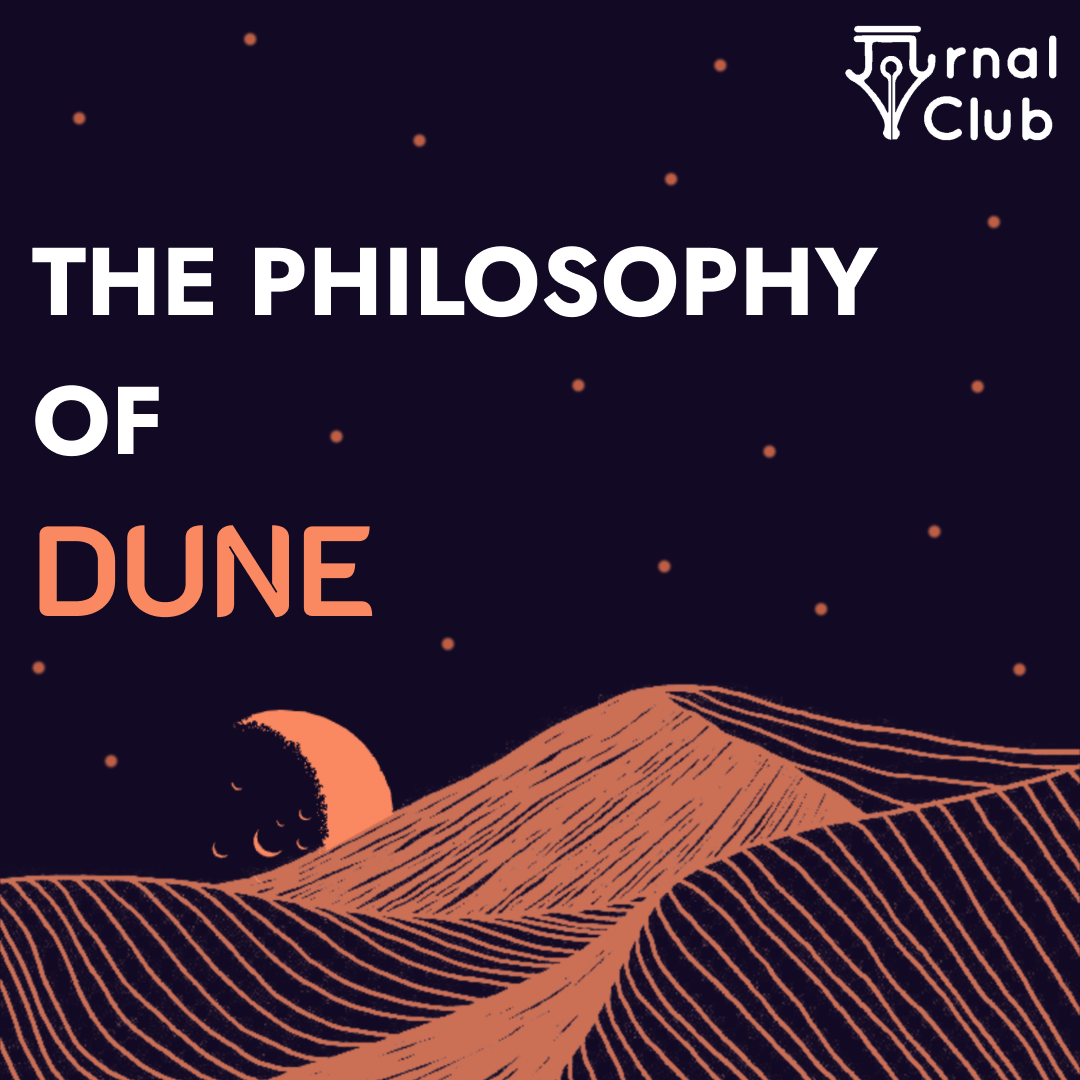
Dune. A word that instantly conjures up pictures of giant sandworms and endless deserts, subtle politics and dramatic battles, religious crusades and prophetic visions. It’s science fiction’s Lord of the Rings, a masterpiece that inspired generations of books. That being said, I’ll be honest. I could not get through it the first time I tried reading it.
I don’t remember exactly why I gave up on it, but the book lay forgotten in my cupboard, collecting dust for a year or two. Eventually, I picked it up again and this time, something clicked. Frank Herbert was a master of storytelling. He spun his stories together to create an enormous world that almost felt like a history book, filled with intricate cultures, deep philosophies and characters that felt both inhuman and intensely human.
However, Dune doesn’t read like a normal story. It’s very clear that the author has put in a lot of thought and effort to convey something. What is the point of Dune? What was the philosophy behind it? What was Frank Herbert trying to convey?
I thought of many ways of writing this review, but Dune as a series is just too vast for me to do justice to it in just a few paragraphs (people have written whole books talking about Dune, refer to *Frank Herbert’s “Dune”: A Critical Companion* by Kara Kennedy). Instead, I’ll talk about two topics and try to expand on them to the best of my ability.
What makes a human, human?
“You’ve heard of animals chewing off a leg to escape a trap? There’s an animal kind of trick. A human would remain in the trap, endure the pain, feigning death that he might kill the trapper and remove a threat to his kind.”
To me, it’s one of the most memorable beginnings to a book. Paul wakes up with a wrinkled woman staring up down at him, and he is as confused as we are. Within a few pages, we are introduced to the test. The *Gom Jabbar,* a needle with a drop of a deadly poison on its tip. What’s so special about this poison?
“A duke’s son must know about poisons,” she said. “Here’s a new one for you: the gom jabbar. It kills only animals.” Pride overcame Paul’s fear. “You dare suggest a duke’s son is an animal?” he demanded.
“Let us say I suggest you may be human,” she said. “Steady! I warn you not to try jerking away. I am old, but my hand can drive this needle into your neck before you escape me.”
Of course, the poison itself doesn’t determine who’s human and who’s not. Paul is made to put his hand in a box that causes him unimaginable pain. The test? To not pull his hand out of the box. To endure the pain, knowing that removing his hand would result in death.
“You will feel pain in this hand within the box. Pain. But! Withdraw the hand and I’ll touch your neck with my gom jabbar – the death so swift it’s like the fall of the headsman’s axe. Withdraw your hand and the gom jabbar takes you. Understand?”
According to the old woman, to be human is to endure pain and suffering, biding your time until the moment is right to turn the trap against the trapper.
The story of Dune is Paul, (and later his son, Leto) sacrificing himself to save humanity. What are they saving them from? Who is the trapper? Humanity itself is its own trapper. Some instinct is built into them, driving them to death.
Paul’s family are sent to the planet Arrakis (Dune) by the Emperor, a trap meant to end their house. But Paul uses this trap not only to win against their rival house, but also the Emperor and other important organizations.
Paul and later his son, Leto II, can see the future – humanity will slowly dissolve into nothingness. They are driven by a terrible purpose, to save humanity from itself. I call it terrible not because of how huge of a task that is, but because of the tragedies that need to happen for it.
Paul strives not only to save humanity from itself but to also save it from the terrible things he must bring about to do that. We’re shown how he tries every possible way to delay his jihad that would kill over 60 billion people, to avert it and to find another way. He even drinks the Water of Life, knowing that he will never be normal again, to find another way.
“Muad’Dib could indeed see the Future, but you must understand the limits of this power. Think of sight. You have eyes, yet cannot see without light. If you are on the floor of a valley, you cannot see beyond your valley. Just so, Muad’Dib could not always choose to look across the mysterious terrain.”
By becoming the Kwisatz Haderach, Paul hoped to rise to a greater height and spot a less bloody path. But all he realized was how necessary the jihad and his current path – the Golden Path – was.
This is made even more clear in the second book, Dune Messiah. He deliberately walks into a trap, even letting himself be blinded so that there is less suffering.
In the end, he shies away from what the Golden Path – the only way to prevent humanity from going extinct – asks of him. He abandons it and walks into the desert to die. Later, Leto Atreides ascends to become the God Emperor and takes on the burden that his father could not bear.
So, is that what makes a human? Self sacrifice for the greater good? I think that’s only part of the answer.
In the history of the world of Dune, still many centuries in our future, there was another jihad called the Butlerian Jihad. Humanity had been enslaved to thinking machines that it had created, and they only managed to free themselves after a very long struggle. We are told that humans tried to give themselves more power and freedom by paradoxically giving the machines more power. Eventually, the machines themselves took control, and all of humanity fell under their yoke.
The Orange Catholic Bible, written after the Butlerian Jihad, had this principle that became the highest law.
Thou shalt not make a machine in the likeness of a man’s mind.
However, the Reverend Mother specifically reworded it to the following,
Thou shalt not make a machine to counterfeit a human mind.
What is the difference? To counterfeit is not just to make a duplicate. It is to pass something off as the real thing. Something that’s not quite the real thing, something that is inherently flawed.
To understand this, we meet another character. Thufir Hawat, the Mentat of the Atreides family, who has served for three generations of Lords. Thufir Hawat is a Mentat, trained to use his mind to take up the role of computers that are now banned (in fact, the Mentats, Bene Gesserit and the Space Guild were all founded to replace the computers after the Butlerian Jihad). They are human computers, able to perform complicated calculations, remember vast amounts of data and infer the dimmest conclusions.
Consider how we are right now. There’s no need for me to detail how many ways we’re dependent on our computers. Even if we just use paper to make notes, we grow dependent on it and our own memory dwindles. I doubt any of us can imagine living in an oral culture.
Hawat, on the other hand, needs no computer or book to remember. The Butlerian Jihad forced humans to evolve. The three schools (Mentat, Bene Gesserit, Space Guild) were born to train these talents.
To the Reverend Mother, thinking machines are truly terrible because they hold people back from becoming truly human by removing the need for people to think for and make decisions for themselves. When you have a machine do your thinking for you, you have no need for a brain yourself.
Dune is about human potential, both about its limits and its infinite vastness. Just like the Butlerian Jihad, Paul’s jihad and Leto II’s long 3209-year long reign, force humanity to grow even further. Leto’s reign as the God-Emperor at immense personal cost is counterintuitively the ultimate rejection of stagnation. He culls humanity’s reliance on prescience and, with his death, scatters them so that no one religion, no one empire can rule over all of them ever again.
To be human is to be free. To not be reliant, to be able to serve the greater needs of your people when it calls for it instead of just looking to find your next meal.
Religion’s Role in Politics
When religion and politics ride the same cart, and that cart is driven by a living holy man . . . nothing can stand in their path.
Politics and religion are interwoven together so delicately in Dune that it’s hard to tell where one ends and the other starts. Both Paul and his son, Leto are revered as prophet and god. This is not a new idea or even an uncommon one. The idea that your ruler is like your god dates back to ancient times even in the real world.
Even today, politics in states like DPRK closely parallels religion, with dedicated followers and its own theology to justify the authority of the government.
When Paul comes to Arrakis for the first time, he finds it already ready for his arrival.
“Jessica thought about the prophecy—the Shari-a and all the panoplia propheticus, a Bene Gesserit of the Missionaria Protectiva dropped here long centuries ago—long dead, no doubt, but her purpose accomplished: the protective legends implanted in these people against the day of a Bene Gesserit’s need.”
The Missionaria Protectiva was a branch of the Bene Gesserit that sowed seeds of superstition and prophecy among primitive cultures so that the Sisterhood could take advantage of them once the seeds matured into legends. This “religious engineering” spread like an infection to allow the Bene Gesserit to cast themselves as saviors and protectors. These myths are used to exploit one of the most powerful forces in society – religion, and gives them a strong lever to control mankind. They were also used to prepare worlds for the coming of the Kwisatz Haderach.
So, Paul neatly fit into the Freman’s beliefs and becomes their unquestionable leader. But does he really control them?
“The Mahdi whose merest whim is absolute command to his Qizarate missionaries. He’s the Mentat whose computational mind surpasses the greatest ancient computers. He is Muad’Dib whose order to the Fremen legions depopulates planets. He possesses oracular vision which sees into the future.”
Paul’s shadow grew larger than him, larger than he could ever be. He didn’t control the Fremen. He was powerless to stop his followers from believing he’s a god, and powerless to stop them from doing what they think he would want them to. Paul himself was nothing more than a catalyst.
His government was said to be a bureaucratic monster, where questioning government edicts smelled of blasphemy. After Paul walks into the desert, things get even worse. His sister (controlled by the Baron Harkonnen) lets the religion grow more corrupt to suit the needs of her government.
When Leto II ascends to emperor, he too is worshipped as a Living God. Neither Paul, Alia or Leto believed in their own religion. They only ever used it to control, and the Fremen were particularly vulnerable. For them, there is no difference between religion and law, between sin and crime.
Were the people in Dune simply unlucky with their religion?
“Religion always leads to rhetorical despotism,” Leto said. “Before the Bene Gesserit, the Jesuits were the best at it.”
A religion might start with the best of intentions, but when it degenerates, it retains its holy authority, After the Butlerian Jihad, the leaders of all the religions in the world met together on Old Earth, on neutral islands. There, they composed the previously mentioned Orange Catholic Bible, as well as other books. They were led by Toure Bomoko, who later famously said the following.
We are daily confronted by the terrifying instability of all things human, yet we permit our religions to grow more rigid and controlled, more conforming and oppressive. What is this shadow across the highway of Divine Command? It is a warning that institutions endure, that symbols endure when their meaning is lost, that mere is no summa of all attainable knowledge.
The Bene Gesserit, for whom religion and politics were interchangeable, quoted the following in their Credo.
“Religion is the emulation of the adult by the child . . . And always the ultimate unspoken commandment is “Thou shalt not question!”
Religion encourages people to believe that all that can be known is already known, and such confidence is extremely dangerous. Those who believe they already know everything cannot be taught. Reasoning with people who think they’re right is useless.
One of the main purposes of the Orange Catholic Bible was to take the weapon of holy commandment from one group of people.
When religion becomes a part of government, it becomes an easy way to gain political power quickly, particularly when the people themselves see disobeying the law as going against their faith.
When the state itself believes it has divine support, it becomes overconfident. It no longer questions its own actions, no longer sees any need for restraint or reflection. Every decision becomes justified, every war righteous, every sacrifice necessary. Dissent is not just opposition, it is heresy.
“When religion and politics travel in the same cart, the riders believe nothing can stand in their way. Their movements become headlong – faster and faster and faster. They put aside all thoughts of obstacles and forget the precipice does not show itself to the man in a blind rush until it’s too late.”
Even Paul eventually saw the futility of it. He had thought to oppose the jihad internally, to slow it down. But the jihad itself would not let itself stop once it started. His army would rage on beyond Arrakis even without him. They needed nothing more than the legend that he had already become.
We see a disturbing pattern. Governments that are built with religion at their foundation are almost unstoppable. It cannot be questioned and cannot be restrained. However, the leaders of the government who started it do not hold the reins. Once started, it continues almost on its own, barely controlled like a wild beast.
Dune is a book of multiple levels. It’s a political game, a philosophical exploration and an amazing science fiction. But at its core, Dune is about humanity – our limitations, our potential, power and its consequences. It asks questions that has no clear answer, maybe no answer at all. It’s a very dense and challenging read, but that’s part of what makes it so rewarding.
 The Journal Club
Leave a comment