
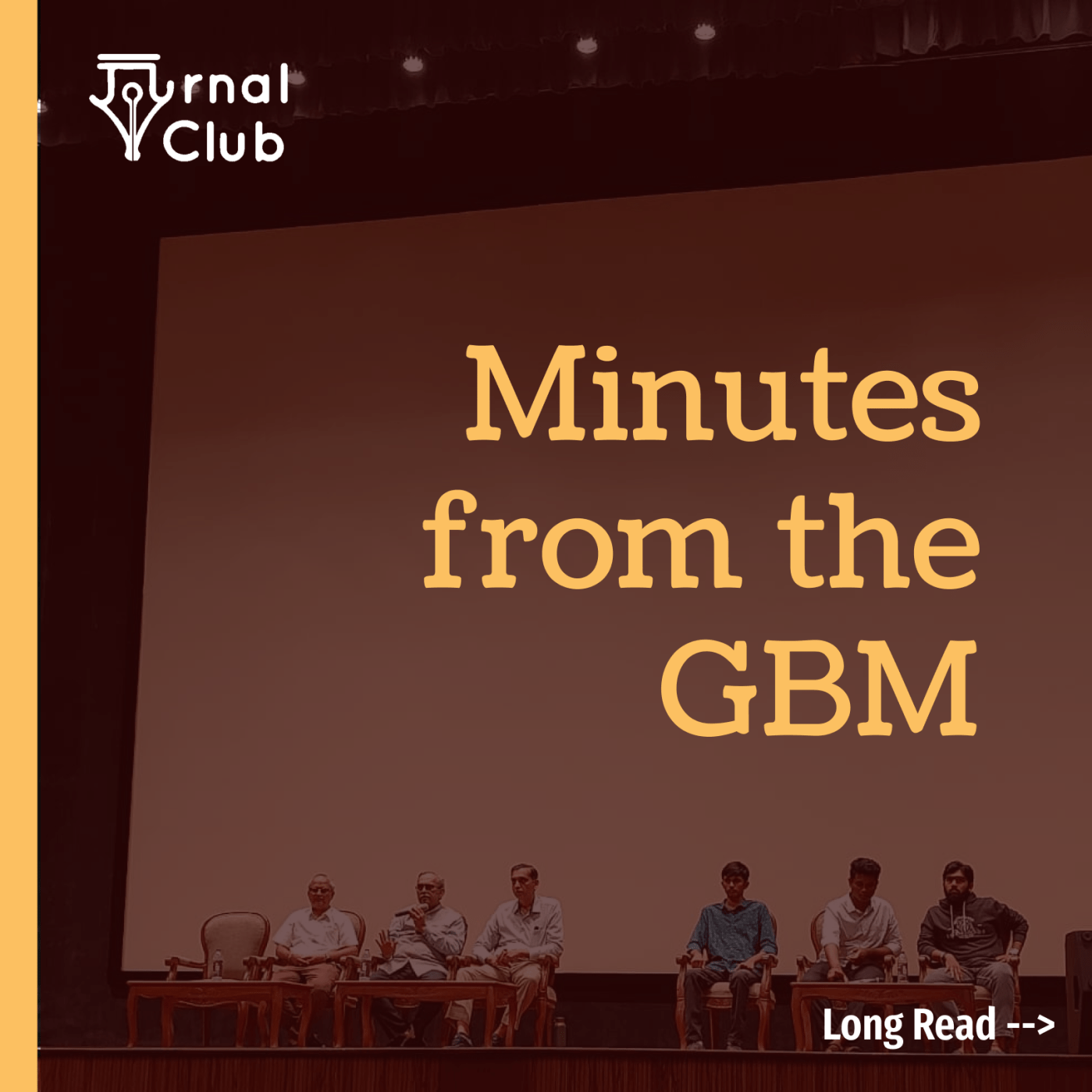
On 28 August 2025, an emergency General Body meeting was held in the presence of various figures from the administration like Prof. Soumyo Mukherji (Director of BPHC), Prof. Kannan Ramaswamy (Associate Dean, SWD BPHC), and Prof. CP Kiran (Chief Warden). The SUC President and General Secretary, along with an SMC representative were also on the panel.
The GBM, originally scheduled for 6 pm, started late at close to 7 pm as members of the administration had to honor commitments elsewhere on campus (i.e.) the inauguration of the new Dominoes franchise behind Mess 2.
- First, JC raised a question about the new student committee that was formed during the protests and sought a response on whether it was to be made official and, if so, why, considering that the SUC already exists.
Prof. Kannan Ramaswamy, the associate dean, provided clarification on the subject by informing the General Body that the five-membered group that was formed on 26th August, in response to the protest held at the Library Lawns, was a temporary measure. They were intended for the sole purpose of collecting and relaying the concerns and issues faced by the General Body. He also confirmed that there has been no talk about formalizing such an independent body or committee so far, and the General Body will be notified before any action is taken with regard to this.
- Then, JC asked about the removal of Impartus and why no information regarding Impartus has been released this academic year.
The Director, Soumyo Mukherji, confirmed that Impartus will “unfortunately” be staying as of now. He proceeded to call it a COVID phenomenon that extended its “tentacles” past its tenure, which now has to be “cut off”. He then stated that they did not intend to make Impartus completely unavailable for now and instead plan to limit its access to either the ComputerLab computers (via a booking system) or the Library Network.
Furthermore, he clarified that they were currently in the process of testing out restricting Impartus to the Library Network and will only release it for public use once they can disable the screen recording function, while hinting at possibly recruiting students for this (graceless attempt at humour). When questioned about the lack of space at the Library, he proposed extending the network to the Library Lawns.
Enquiring about the necessity of this decision, given that IIT also has NPTEL lectures available on YouTube, yielded no conclusive results as the director proceeded to give a long-winded lecture on the history and philosophy of adapting the learning process to the changing times (ironic), claiming to have input from foreign countries. He brought up the one-way nature of recorded lectures and how they are not the norm at other universities.
When asked about standardizing the distribution of lecture slides (he had proposed using them to remedy Impartus), he glossed over the subject by mentioning an academic policy revision underway and put the onus on students by questioning our “dependence” on these resources. (It’s also important to note that he also picked up a call mid-answer, an expression of his overzealous respect for the GB).
- Finally, JC asked about the administration’s official stance on attendance and the philosophy behind its implementation.
The director claims this to be a part of the Chancellor’s vision and also a sentiment that the Director echoes. He refused to acknowledge the existence of a zero-attendance policy in the past and said that the rules say ”make sure to attend”. He diluted the problem to just 10%, and stated that students would not be barred from midsem and compre exams for low attendance, effectively blaming students if they score worse. On the issue of implementation of class participation marks, he confirmed that it was up to the discretion of the ICs only to contradict himself a mere sentence later by dubbing the 50% attendance a preventive measure, meant to forbid the ICs from imposing 90% attendance. He then proceeded to shove the “Life is unfair” drivel upon being asked why students are being confined to their registered Lectures and Tutorials, while also conflating college and corporate settings.
At a later instance with regard to the restrictions imposed on the M3 lectures, he resorted to lamenting about the changing times and the rising prices of batata. When questioned about how we pay (an exorbitant fee) to avail better services, he drew comparisons to Ivy League universities. He also, rather patronizingly, said that we shouldn’t go down in our level, suggesting that the presence of Impartus makes our college inferior.
- Then, LawSoc started by asking about the various issues in the mess, such as sanitation, the mixing of vegetarian and non-vegetarian food, etc.
The director began by expressing his “deep” concern about the quality of the mess food. Immediately after, he returned to his usual standard of delivering ambiguous platitudes, including empty reassurances about “certain steps” taken by the administration whose results will not manifest “overnight”, an obscure 8 point agenda, the details of which have remained undisclosed, and dubious short term solutions, like installing insect catchers and cameras (an excellent pest control measure) and covering up exhaust fans. He also casually mentioned long-term plans to extend the kitchen and the drains, and cited construction issues for the delay; funding from the Chancellor or VC has not been finalized. He further shifted the blame onto the incessant rains and dedicated a significant portion of time to emphasizing the need for student cooperation and adjustment. One is left to wonder why the question of upholding legacy wasn’t raised, especially after such an audacious comparison to the Ivy League.
- Then, LawSoc asked about how the biometric machines don’t work properly, and what alternatives the administration has planned considering this fact.
The Director initially refuted any claims regarding the issues with the biometric scanner, only to switch tactics and promote the use of face recognition software. He also places the burden of designing such technology on the very students themselves. An alternative he proposed was the implementation of a ten-second code verification system to mark attendance.
- Then, LawSoc asked about the various debacles during course registration earlier this semester and brought up how AUGSD personnel and volunteers were “not responsive and not respectful”.
The director brushed off the first part of the question. In reply to the second part, he quipped that students in turn were not being respectful to AUGSD personnel and volunteers and that AUGSD personnel would naturally lose patience if bugged with the same issue multiple times over the day. He also issued a thunderous proclamation that students are henceforth not allowed to bug AUGSD about matters related to the attendance policy.
- Then, they pressed about the putting up of CCTV systems on campus without warning and raised privacy concerns. They also asked about how students aren’t allowed access to the system per emails.
The Director noted that surveillance only happened at campus and hostel gates. He noted how certain incidents could have been avoided/solved with the presence of a CCTV system. He also claimed that when police investigators come, they ask about the presence of a CCTV system. However, he did concede that certain CCTV cameras were improperly placed and will be changed.
With regards to being able to access CCTV footage, he said that one might have to write out a complaint and get it signed by various authorities (like the Associate Dean, SWD and the Chief Warden) and then be submitted. The institute will view the relevant footage and take action, and the student will not be allowed to view the footage themselves.
- Then, they put forth many concerns with MPower, ranging from outing patients, the prescription of strong drugs to patients, the general substandard care available, etc.
The Director said, “Student welfare is one of my passions,” and went on to talk about the various issues present with the current system. He said the location must be more central, both so that it’s easy to access and can be done so discreetly. He also agreed that counselling has to be confidential. He said that he and Prof. Sandeep Deshmukh are pitching a new program called BITSCare that seeks to overhaul the mental health systems across campus. He also noted that he and Prof. Suman Kundu (Director, BITS Goa) have been lobbying to make changes in the MPower system for a long time. He also said that he wants a 24/7 counsellor available on campus and that he has the infrastructure that would be necessary for the same.
When asked a follow-up on MPower prescribing strong drugs, he said that he believes that “90% of student issues can be solved by well-trained psychologists and counsellors,” and that he doesn’t like their over-prescription of drugs either.
- They then wrapped up their questions by asking about the lack of consultation with the General Body on the various changes made. This question was later echoed by a member of the General Body as well.
During a key moment in the meeting, the director asserted that the General Body (GB) did not need to be consulted on every institute decision. He gave an analogy: “If I consult my daughter about everything in my house, then nothing would get done.” He argued that constant consultations would hinder his ability to get work done and that the administration would only seek input regarding select topics, of which attendance was not one of them.
When a GB member pressed him on this unilateral approach, the director shockingly declared that the administration was, in fact, a dictatorship that forced students to attend classes. He went on to persuade the members of the GB to inform their parents about this “dictatorship”, indirectly ridiculing student authority on campus.
- A second-year student from the crowd then recollected the attendance debacle in General Biology last semester. First, 10% was allocated to class participation, which was dependent on biometric attendance. However, due to issues with biometrics, the CPT was reduced to 5% and it still resulted in various unfair situations for students. The Director was requested to comment on this matter and asked about biometric attendance again.
The Director reiterated that the current biometric system gives him shivers, going on to talk about how people with greasy hair twiddle with it, make their hands greasy, and then use the biometric system and leave it greasy and unable to record attendance for succeeding students.
He then said that they weren’t enemies and also didn’t like the current system, but somehow shifted the onus for change onto students again, saying that we should develop alternate systems, such as facial recognition (one is left to wonder about the host of issues that would lead to).
- A student then asked about the feasibility of the separation of veg/non-veg orders in ANC to avoid further mixups down the line.
He said that this is something feasible that could be done. This was the first straight answer he gave without trying to antagonize.
- A student in the crowd asked for further clarification on his statement that Impartus might be linked to the library’s local connection; he asked what students ought to do during inclement weather and when they are sick.
The director deflected this question by choosing to ignore the core issue. He prodded the GB to pick up a piece of paper, a pen, and attend class, disregarding the very valid reasons of sickness and inclement weather. He claimed that this would nullify the need for Impartus, thereby making the question irrelevant in his view. One is left to wonder how a student is supposed to attend classes when sick and how the director is suggesting something irresponsible as a viable course of action.
- A student then asked about surveillance on campus. He noted how, from when he leaves for classes in the morning until he comes back to his room in the evening, he is constantly surveilled on campus. He asked if these systems have resulted in a marked improvement in safety on campus and asked why no information was sent through official channels before implementation.
After being questioned, the director restated that the sole purpose of the new CCTV cameras was to improve campus safety. He explained that footage would be actively monitored only at the hostel and main gates. In all other locations, the footage would simply be recorded and reviewed only if a valid complaint was filed.
The director did not, however, offer a clear explanation of how the cameras would improve safety. He vaguely referred to past incidents that could have been prevented with such measures and mentioned unspecified court rulings that supposedly mandated the new security system.
- Finally, as the Director was leaving, a student asked if a student who doesn’t attend any classes will be at risk of getting an IC, considering that there is an academic policy that states that students who don’t attend any given part of the course’s evaluation components are eligible for an NC at the IC’s discretion.
(Where a student continued to remain registered in a course but gave the instructor inadequate opportunity to evaluate him/her by absenting himself/herself from quizzes/ tests/ examinations/other components of evaluation, or by appearing in the same for the sake of appearance without applying himself/herself to the task in hand or by submitting a blank script (answer book) this event will be reported as NC (Not Cleared) – clause 4.19 from Academic Regulations, 2023 edition)
The Director noted that such a situation won’t happen and that the 10% attendance component serves to only reward attendance; if a student missed every class, they just won’t get their attendance component marks. He said that missing every lecture cannot be grounds for an automatic NC for that course and that an NC can only be granted if a student falls under the minimum mark cutoff to receive a grade.
In conclusion, this meeting was nothing but a masterclass in obfuscation and distraction. The responses given to various questions by the Director, as well as the tone he took in said replies, left many in the GB rather unsatisfied with the outcomes of this General Body Meeting. This meeting just went to show how aloof and out-of-touch the administration is to the plight of students on campus, and how the only play in their gamebook is to obfuscate their lack of action on a variety of issues.
 The Journal Club
Leave a comment