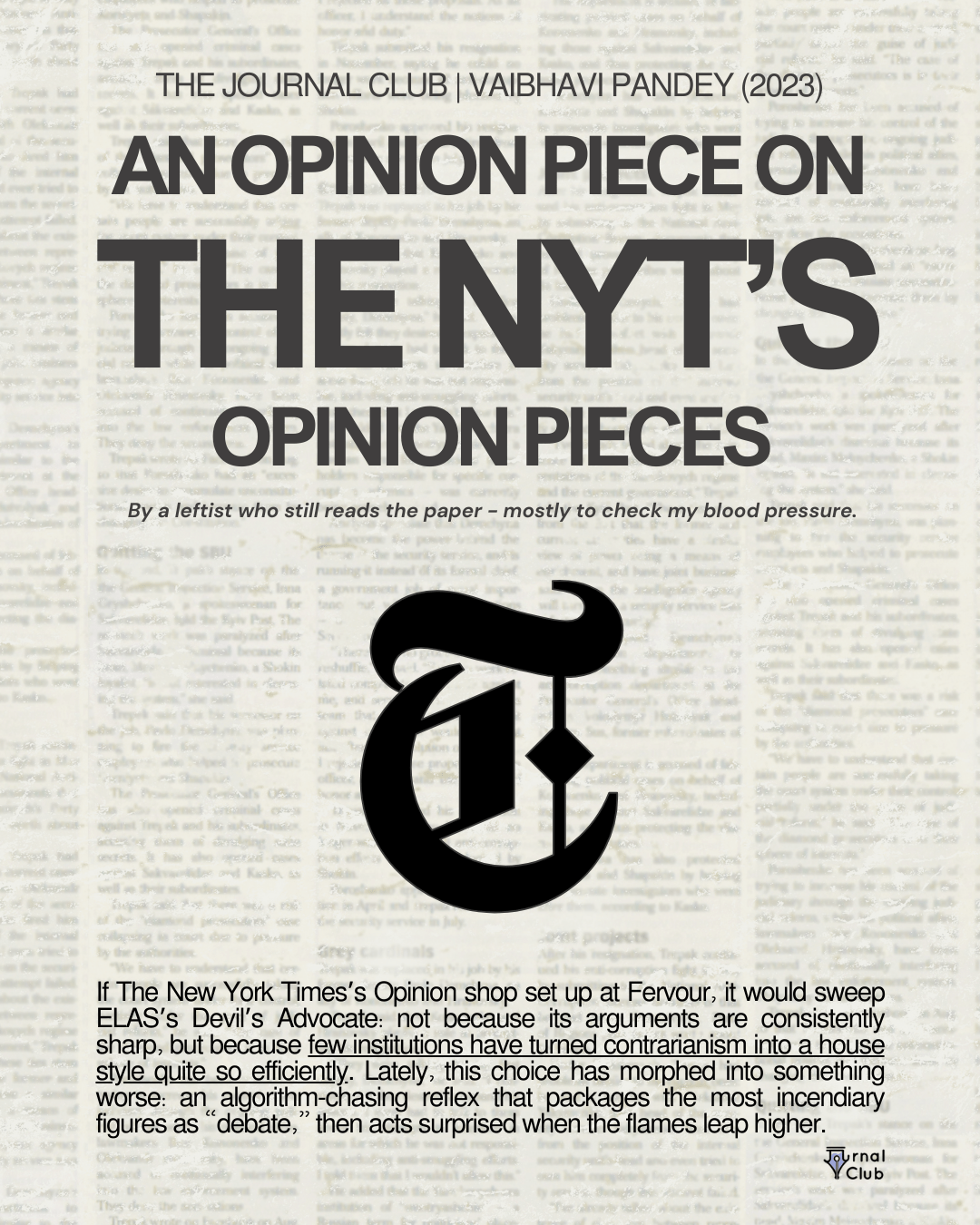
By Vaibhavi Pandey (2023), a leftist who still reads the paper – mostly to check my blood pressure.
If The New York Times’s Opinion shop set up at Fervour, it would sweep ELAS’s Devil’s Advocate: not because its arguments are consistently sharp, but because few institutions have turned contrarianism into a house style quite so efficiently. Lately, this choice has morphed into something worse: an algorithm-chasing reflex that packages the most incendiary figures as “debate,” then acts surprised when the flames leap higher.
Today’s @nytopinion Instagram posts around Charlie Kirk landed like a hymn. Maybe they’d call it “context.” To a lot of us, it reads like glazing. And this is not an isolated occasion. The section has a track record of elevating provocation first and only sometimes circling back to responsibility. Half the stuff reads less like opinion and more like positioning: “We enable orthodox debates,” “We challenge extremes” – except when it’s about people doing radical stuff on the Left, then suddenly “responsibility,” “balance,” “sobriety”.
The platform loves a spark (and knows exactly how to strike it)
NYT Opinion is failing in dozens of small ways that add up to a big betrayal – of its own claim to moral seriousness, of readers who want justice and not just “balance,” and of communities most affected by the policies it debates. NYT Opinion keeps choosing takes that launder harmful ideas as “a range of views,” while punching left when it’s politically convenient – and the receipts are not subtle.
Receipt #1: Polishing power on the right.
Charlie Kirk is the perfect example. The Times ran a profile this February calling him “the youth whisperer of the American right.” This is not a neutral description; it’s a coronation. They could have focused on the consequences of his politics – what those ideas do to people in real life – but instead they helped project his image into something sleek and mainstream. In a climate where political violence is rising (something even Times published experts have warned about), framing choices matter more than ever.
And now, following his death, the coverage (and the internet at large) has been drenched in eulogies and mournful reflections. Okay – no one likes death. But selective outrage is telling. Where is this flood of empathy when civilians die in Gaza? When queer kids take their lives under the weight of laws people like Kirk cheer for? The anger at those of us who don’t grieve him misses the point: we are not happy he died. We are just not sad either.
And that feels rational when you remember what he stood for. This is the man who said that if his daughter were sexually assaulted and became pregnant, he would force her to carry the pregnancy. The man who dismissed the very concept of empathy as a “made-up, new age term” that “does a lot of damage”. Who declared Palestine doesn’t exist and positioned himself as an uncritical Zionist while Palestinian deaths climbed. Who insisted that gun rights matter more than the lives lost to gun violence, once quipping that “it’s worth having a cost of, unfortunately, some gun deaths every single year so that we can have the Second Amendment to protect our other God-given rights.” (I must take a moment here to chuckle at the irony).
Charlie Kirk wasn’t merely “polarizing”; he was actively perpetuating violence, oppression, and disinformation. He used his platform to strip rights away from others, to make the world more dangerous for people already at risk. When someone like that dies, the job of the media isn’t to cushion their legacy with soft-focus mourning – it’s to tell the truth about the harm they did while they were alive.
Receipt #2: Kicking left when it counts.
In June, the Editorial Board announced that it was moving away from endorsing candidates in local races… and then immediately published an anti-endorsement of Zohran Mamdani, a DSA-aligned Assembly Member in New York. If you’re stepping away from endorsements on principle, why break the rule the minute a leftist’s name is on the ballot?
Receipt #3: A long pattern on trans coverage – especially in Opinion.
In February of 2023, more than 170 Times contributors, and over 100 organisations globally (including GLAAD) signed an open letter accusing the paper of treating gender diversity with “pseudoscience and euphemistic, charged language” and ignoring sources among trans or nonbinary people in stories. For example: a report by GLAAD / Media Matters (2024) found that 66% of Times stories about anti-trans legislation didn’t quote a single trans or gender-non-conforming person. And 18% of those stories contained anti-trans misinformation presented without sufficient context.
NYT’s response was to claim that the concern in this letter was “advocacy,” implying that the critics were biased, not the coverage. However, if your coverage is being used in Supreme Court opinions (as NYT articles have been), then how the hell you write matters. (See the case U.S. v. Skrmetti, where Justice Clarence Thomas cited multiple Times articles and editorials when siding with bans on gender-affirming care. One was by Pamela Paul, which was later shown to spread misleading or false claims.) The NYT is handing ammunition to people who legislate away rights.
Receipt #4: Selective moral urgency.
When Joe Biden stumbled in the 2024 debate, the Editorial Board immediately called for him to quit the race. That’s fine – hold those in power accountable, we’re all for it. But then why the velvet gloves for people like Charlie Kirk or Bari Weiss or Ross Douthat’s endless “just asking questions” pieces about whether trans people should exist comfortably in public? If you can tell a sitting president to quit the race, you can call extremist ideologues what they are.
Receipt #5: The NYT is removed from reality
When terrorists opened fire on a tourist bus in Pahalgam, killing 24 people, The New York Times described it as an attack by “militants.” The backlash was instant and global, with even the U.S. House Foreign Affairs Committee condemning the coverage. Their statement didn’t mince words:
“This was a terrorist attack, plain and simple,” the committee said, adding, “Whether it’s India or Israel, when it comes to terrorism, the NYT is removed from reality.”
This was a failure in framing. How the NYT, of all organisations, can take its words lightly is astounding and frankly beyond me. Words like “militant” carry a different weight than “terrorist,” and when the paper of record softens its language after civilians are massacred, it doesn’t just mislead; it erodes trust. The quiet headline change afterward read less like accountability and more like hoping no one would notice.
Tone-deafness ad infinitum
Maybe what makes this worse is the timing, the context, and the accumulation. These aren’t incidental lapses. They are built into the NYT Opinion DNA now.
- When public health crises or civil rights fights break out, readers look to the Times for clarity. Instead, it often hands the mic to the loudest contrarian, then pretends surprise when the piece fuels the outrage economy.
- The incentives are obvious: outrage boosts engagement, engagement boosts subscriptions. But that’s the exact moment when a publication with the reach and gravitas of the NYT should resist the pull – not lean into it.
- And while we’re here, yes, we noticed that the same paper that can’t bring itself to call a fascist a fascist had no problem putting WordleBot, the Mini, and Spelling Bee behind a paywall. Apparently charging readers to solve a 5×5 crossword is a matter of high journalistic principle now. It’s not the core problem, but it’s a perfect metaphor: squeeze the audience for clicks, dollars, and engagement.
- The language stays polite even when the subject isn’t: “polarized,” “misunderstood,” “debate,” “concerns” – a euphemistic shrug layered over ideas that target real people’s safety.
The consequences are real
- NYT op-eds and reporting are cited in legal cases to justify bans on gender-affirming care and other rollbacks of rights. Words that minimize harm aren’t just “opinions”, they are precedent.
- When the biggest paper in the big US of A treats left-wing candidates as dangerous radicals and right-wing provocateurs as “a side worth hearing,” it shifts the center of gravity in the whole media ecosystem.
- It alienates the very readers who most need rigorous journalism. People who are queer, trans, immigrants, Muslim, Palestinian, Black, or brown – people who live inside the consequences of these debates – read the Times and see that their safety is treated as fodder for intellectual warring.
A better standard – that still makes for great journalism
Here’s a simple yardstick NYT Opinion could apply tomorrow:
- When you profile someone like Kirk, lead with the harm their politics do – not their vibe, or the fact that they “would be comfortable in the campus mainstream, would be fun at parties, would be even a little bit cool” (in the words of columnist Ross Douthat in the @nytopinion reel posted today). If a figure’s core project targets vulnerable people (immigrants, queer and trans kids, Palestinians, Muslims, etc.), your frame should foreground that harm – not launder it as “normalcy.”
- When covering trans issues, always quote trans voices. Don’t use “balance” as an excuse to platform bad-faith actors.
- Separate eulogy from evaluation. When a polarizing figure dies in a violent, news-shaping way, grief posts shouldn’t smuggle in reputational rehab. Do the sober analysis: and if you choose to “humanize,” counter-weight with what their politics did to actual humans. (Plenty of outlets are documenting the new era of political violence; you don’t need to tiptoe.)
- Ditch the false symmetry. Space on your page should be earned by evidence, not by whether the take will go viral on Twitter. Sure, you might be reporting both sides, but repeatedly branding Charlie Kirk as “youth influencer” “voice of cause” “contributor to conversation” – these are not neutral descriptions . Meanwhile, when people aligned with leftist or grassroots politics do new or disruptive things – protests, new housing policy, radical climate action – Opinion regularly moves slower, asks more caveats, presents worst-case scenarios as if they’re inevitable.
- And apply the same moral clarity to extremists as you do to Democrats who misspeak on stage. If you can take a president out at the knees, you can call bigotry by its name.
The bottom line
The New York Times likes to think of itself as the referee of American (and often worldwide) discourse. But a referee who keeps letting one side play dirty while throwing the flag on anyone who steps left is simply rigging the game. When NYT Opinion treats devil’s-advocacy as a virtue in itself, other outlets copy the move. The result is media that keeps fueling a catching fire and calling the smoke a conversation – while the people most affected by the policies in question are told to calm down and debate politely.
And if they can’t tell the difference, maybe we should stop pretending their “range of views” is a public service. Sometimes it’s just smoke.
 The Journal Club
Leave a comment