
Year after year, one gets to hear of more and more students who decided it better to lay upon their lives rather than take any more of the academic burden upon their shoulders. The most recent example being the Goa campus, where it is the third time a student took the grave decision in just 5 months. IIT Kharagpur follows on similar lines, where a student became the second victim in a fortnight. Similarly, IIT Roorkee has seen the loss of a student’s life for the third time in a year. And the story echoes in different nooks and corners of the country. The numbers refuse to decline; rather, they have shown a continuous increasing trend in engineering institutions, especially the IITs. Sleepless nights, long working hours, unhealthy diet and sacrifice of hobbies and interests have now been normalised. And all for what? Results that don’t really suffice the unsaid expectations and burden placed on some of the most talented and bright minds of the country. Students who have outperformed themselves every single year, stumble down to being average in prestigious institutions and let their worth be decided by grades. It is a deep-rooted issue in the Indian academic system and reflects a lack of mental support, which is worth deliberating on.
What is the issue?
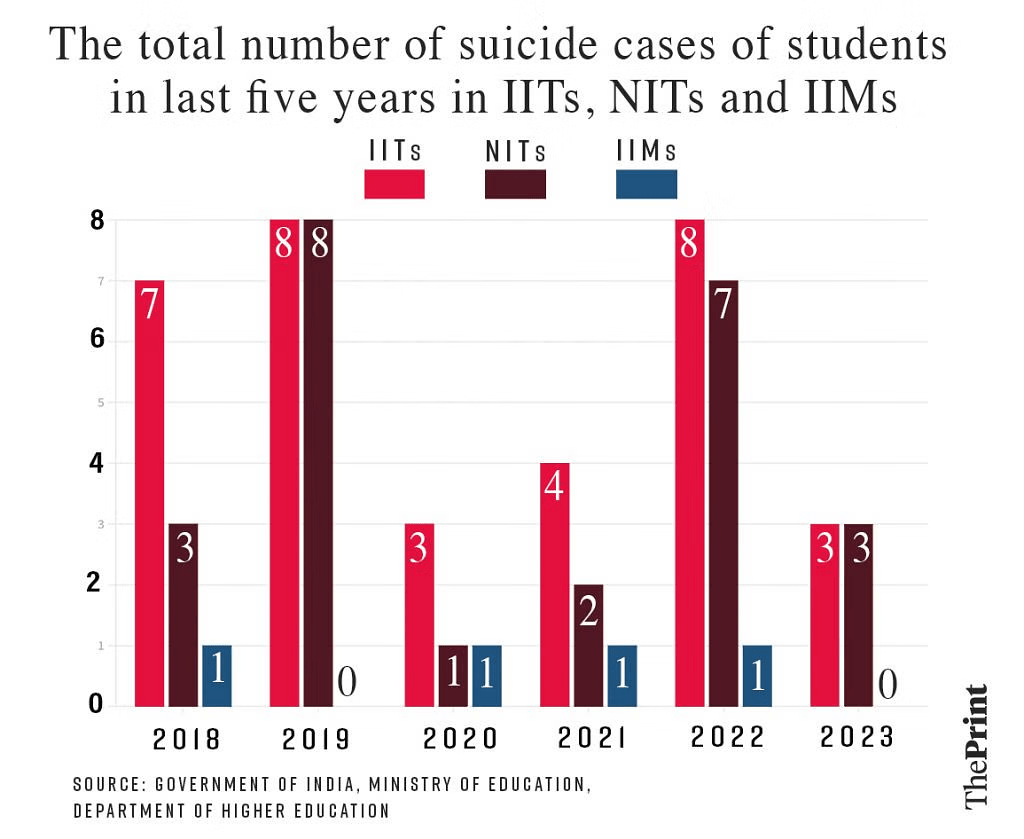
According to statistics, a total of 98 student suicide cases have been reported in the past 5 years in prestigious higher education government institutions of India. If we emphasise on the period from 2019 to 2023 alone, a shocking figure of 77 suicide cases is disheartening.
Coming to the BITS campuses, suicides had never been the trend. From a time when we had one suicide case in over 17 years, the recent developments show how dynamics have completely reversed. BITS Goa registered its third suicide case over the past 5 months. The three students were pursuing Dual Degrees. Our campus itself has witnessed a student taking their own life, when a EEE student took this grave decision in 2018.
What is the cause?
When we students arrive at our college, we come with a lot of hopes, aspirations and expectations of all we want to achieve through our tenure at the institution. One slowly starts understanding and adapting to the environment created by the campus and tries to thrive with it. People meet new people and interact with seniors, they make friend circles in their immediate environment, while trying to maintain contact with their family and old friends. Hostel life gives one the opportunity to build a home away from home, and start learning how to manage things on their own, both on a personal and professional front. But a lot of times, it becomes really difficult. Academic pressure, unending number of assignments, assessments and graded tutorials, a jam packed schedule of classes, and at the same time, keeping up with personal and mental well being, it does get really difficult, a lot of times. Studies by psychiatrist, Dr Virinchi Sharma have pointed out how struggle coping with academic pressure, unrealistic parental or societal expectation and lack of support from friends often lead to stress, depression and anxiety, which slowly become bottled up, and might result in students taking up the big step. Social life matters as well. A disturbing issue is when students face criticism from fellow batchmates or seniors in the form of ragging or bullying. Also, while some people easily manage to make friends and establish connections, some of them struggle to find their kind of people. A research chronicle by BMC, BioMed Central, highlights that often due to fear or stigma around mental health, people hesitate to approach for help. While some people are outspoken and have people to go to when they need help, some of them lack a support system when they might need one. For a lot of students, it is the first time they are away from home and figuring out how to navigate through college life might be confusing. Failed attempts to a certain task can be misunderstood as being a failure, not having friends can be misinterpreted as not deserving friends, and being unable to adjust to a new place and a new lifestyle on your own can be misconceived as not being independent. College is the place where they say our life changes, but does it change for the better or the worse?
Societal pressure, moving out to a new place for education and high academic requirements are things which are not unheard of, though, then why are the numbers on a rise? Various factors build up to such a situation. One reason is the reduced interpersonal connections and relationships, not despite, rather fueled by increased social media connections and the creation of an online network, putting the real world in the dark. As report studies by ScienceDirect rightly highlights, social media induces anonymity and lack of ‘cues’, unlike those easily found in live interactions and body language. Criticism becomes unrestrained and often turns out unkind and mean. Disconnection from society increases as one perceives negative feedback from peers online, which could be in the form of, apart from many others, ”unfollowing”, “blocking” or “unfriending”, and often has a detrimental effect on one’s mental health. The COVID-19 pandemic also played a role in making us slaves to our mobile phones. With its onset, it increased distance and screen time both. It largely changed how human relationships looked after it, in a negative manner. It took a lot of time for people to come back to normal life afterwards, and one could see how life had become different. For instance, it started another epidemic, the lack of touch. The International Journal of Indian Psychology points out that the loss of touch during the pandemic led to isolation, mood swings, depression, stress and anxiety, especially amongst college students. So COVID-19 has not just been traumatic in one way, but has caused infliction on the living dimension in multiple ways. Coupled with the above stated problems and lack of good communication skills, it is also harsh how education is slowly being viewed more and more as only a means to earn, not to learn. Be it anything, cracking an exam, a good CGPA or a job interview, everything is only being linked to financial advantages. Skills are no more being learnt for personal growth and enlightenment, rather it is to set oneself apart to land a dream job. And when all this effort still does not secure a high paying job or even an employment, it makes one look down on themselves. According to the Economic Survey 2023-24, only 51.25% of the youth is considered employable, including degree holders. A report by IJIRT (International Journal of Innovative Research in Technology) pointed out that during the period from 2017-18, a mere figure of 50% engineers from AICTE- approved institutes found jobs. The academic validation which students keep chasing, makes it all worse.
What impact does the academic system have on the student’s health?
Why is it that IITs record the highest number of student suicide? An internal survey conducted by IIT student organisations revealed that 61% respondents quoted academic stress to be the trigger for most of the students to take such a grave decision. A committee set up by IIT Delhi last year also points out how academic demands from post coaching burnout to a grading system imposes toxic competitiveness according to the study of institutional processes and environment in the same regard. High societal and parental expectations to secure good placements, little interaction with faculty topped with stigma around opening up for mental help are some of the reasons pushing IITians to the brink, as highlighted by students during interactions with an external experts committee created by IIT Kharagpur to look into the matter. Burdened by always performing well, students are unappreciated in case their grades are not the same as before. And the irony is, even though the effort or consistency put up by the student might be laudable, the results might not reflect it because as the degree of academic study goes up, the difficulty goes up as well. Confidence begins to be lost, people start giving up and enter a vicious cycle of self-doubt, insecurity and apprehension. It is the fact that young brilliant minds are often expected to deliver at every point in life, and every twist and turn is not the same as an academic challenge. There are various fields apart from academic endeavour, and achievements can be made in them as well, success stories can be built in careers considered unconventional by the society as well. Everybody has a right to experiment, and while one experiments new things in life, failure is bound to occur. Instead of normalising this, they are discouraged, sometimes pulled back by the fear of judgement, or by the fear of not being able to prove themselves time and again.
Coming to BITS, the academic system adds fire to the fuel. The problem arises when we students are burdened with an unending number of assignments, assessments and graded tutorials combined with a heavy schedule of classes. BITS has not been exactly living up to its zero attendance policy as well, with the concept of exit tests being introduced in our campus. It adds up to a vital component in the total marking, which creates a compulsion to go to classes. And top it all with the mastermind grading system, which can be a double-edged sword—when we succeed, we’re on top of the world, but a single slip can spark a cascade of self-doubt and insecurity about our capabilities. Unintentionally, one begins to equalise their low grades as being incompetent or lacking the ability to achieve what they aim for. We constantly live in a toxic environment where, right after escaping the JEE and BITSAT entrance systems, we enter a new world where there is a constant rat race to perform well in every subject, achieve top ranks and seal a good CGPA. Unhealthy competition amongst fellow mates may also arise and increase the tension. And a lot of times your performance sheet depends on our luck. It depends on how the grading is that particular year, or maybe even that particular semester, how the averages fluctuate, how in order to balance out the marks distribution examiners resort to setting the question paper to a difficulty level which is not aligned with the classroom teaching or the resources available for learning. Certain departments promote a good grading system while some departments make it unconventionally hard for a student to crack a good grade which leads to people despising subjects they like and are pursuing by choice all due to the arduous marking scheme. And the constant effort to deliver better grades sometimes makes us forget to love the subject we chose. Or maybe even if we didn’t choose it, we forget to enjoy the journey and embrace the learning, rather just involve ourselves in a rote process of syllabus completion by hook or by crook, which also often remains fulfilled. And when despite burning the midnight oil and giving in our best effort, we do not really get the desired output, gradually the spark inside us students starts dying. We feel burned out and unproductive, and even our old passions and hobbies do not ignite us anymore. And a lot of times students do not have anyone to confide our worries to, maybe because we failed to live up to the expectations we were carrying since we were young, or maybe because we feel that we failed in our life not just an exam, or maybe we just sort our problems on our own but this time it isn’t working that way. We don’t find the right support to open up to. Lack of communication, understanding and a broken self esteem gets built up over time and slowly pushes the student to take the wrong step. And this feeling of being overburdened, of failing at something we thought we would succeed at, is shared by most youngsters and students. It’s just that some of us succumb to it and it is only then that the issue is brought to light, which is a shame for the Indian academic system. It is a shame for the Indian mentality, the Indian counselling framework and the Indian support system because there isn’t any out there for students, at least not in adequate terms. And it takes three students to give up their life for it to dawn upon the authorities that maybe they were doing something wrong. It takes three innocent siblings, friends, sons or daughters, classmates to end their life for the system to finally break their silence and think about taking some action they should have implemented long ago. The process which is supposed to build character and strength is breaking souls. The process in the pursuit of producing capable individuals is crippling their ability to navigate the very process meant to cultivate strength. It is breaking more self esteem than it ever made, more dreams than it ever fulfilled, cutting more wings than it ever gave to fly. Is it really magic? Or is it just taking away all the magic we once had?
What is the solution?
What one really needs is an approachable support system, where people can confide and communicate when they need to. It can be in the form of a friend, a parent, a professor, a mentor or even a senior. I feel that just like freshers are assigned mentors for academic guidance, they should also be assigned mentors who have been trained to help them deal with anxiety or depression. It need not be a professional, just a student like us who has gone through the same times. Count in seniors as well. The best testimony being the Sunshine Buddy programme launched at IIT Hyderabad. It unites freshers with trained mentors to provide emotional support and guidance, especially during the phase where they transition into college life. An internal survey indicates that 85% first yearites felt more confident and supported through the programme. This model has also been adapted by NIT Trichy in their mentorship program where students have been provided mentors from senior and alumni batches to help them navigate college life. At the same time, expert advice and help should be made more accessible and engaging. The Counselling and Guidance Cell of NIT Trichy provides personal attention to students as well as staff and faculty with professional counsellors and claims of its services being extensively utilised by students. An online counselling portal has also been set up, yourdost.com, curated to foster mental wellness. It incubates online chats, video and audio sessions, awareness webinars and workshops with professionals. Following lines on similar tracks is the Jeevani Health program launched by the Kerala government. Counselors to enhance mental well being have been provided and accessed by over 2000 individuals in various colleges. The Ashoka Centre for Well Being also offers counselling and support for the same. Secondly, there should be a happiness survey, with parameters relevant to a college setup, like having someone to count on, freedom to make life choices, being able to pursue hobbies, health conditions, diet and sleep schedule. Steps should be taken to improve areas which need development, while the well performing areas should be maintained. The Kushal program includes a wellness survey website launched by IIT Madras to reach out to students and help find out areas where they have been facing trouble. It also offers yoga, meditation exercises and group counseling sessions to help out. A whopping 76 % reported an improved well being and sense of community after attending the sessions, marking the difference. Also, studies suggest how a lot of people remain unaware of the support options they could reach out to. Awareness regarding the existing facilities, like in our campus: the SWMC, psychiatry services, the Anti Ragging Committee, the Internal Complaints Committee (ICC), the Academic Counselling Cell (ACC) and the Queer Consortium should reach the intended student audience. New changes made to benefit students should be highlighted. For example, after the unfortunate loss of 3 students in BITS Goa, the administration has “expanded counseling services and improved access to professional support, including alumni mentorship and trained wellness champions in hostels” and created “a Student Wellbeing Dashboard for timely, individualized support”. Sometimes we just need somebody to hear us out, if not give suggestions. The Student Anonymous of our campus leads by example, where students can safely talk about their issues and feel heard. Measures like these will make students feel safe and heard when they need to communicate. Normalise feeling low or facing difficulties, promote reaching out when help is needed.
What can be done on an academic front?
Issues deep rooted in the academic system will take years, maybe even decades to improve. It comes with a change in mindset, evolved work ethics, prioritising human well being and focussing on grooming love and passion for a field, not just academic or monetary returns. It will require numerous steps in the short term to bring out the long term improvement.
Academic curriculum revision, reduced credit load, a more flexible attendance regime, accommodating timetables, strategic infrastructural changes and better mentorship ratios have been adopted by many IITs in the name of different policies, including IIT Delhi, IIT Bombay, IIT Guwahati, IIT Madras and IIT Kharagpur.
After losing three precious lives and several questions raised about the well being of students on campus, the BITS Goa administration has finally responded with certain steps it is planning to implement in order to help ease the mental stress and strain students are continuously facing. There are 5 main reforms it is planning to implement, quoted word by word from their post on Linkedin:
1. Curriculum reforms to ease academic pressure and offer greater flexibility
2. Normalised grading practices for fairer PS allotments
3. Expanded counselling services and better access to professional support. Alumni mentorship and trained hostel-level wellness champions
4. A Student Wellbeing Dashboard for timely, individualised support
5. Significant upgrades to infrastructure as part of a Rs. 1210 crore infra development plan to be executed over the next two and half years.
If implemented as promised, these 5 reforms are a boon in disguise. It is really important to align the curriculum with the degree and revise the syllabus in accordance to the desired output. Practical application and teaching which would enhance their performance in their future roles is the need of the hour. Normalised grading would reduce partiality and the role of luck factor in determining one’s CGPA by humongous amounts. Normalisation of grading refers to the awarding of a particular grade to the same number of students for the same credit courses; especially in the first year inter semester grading. This should be implemented in all the three sister campuses. In fact, it should be implemented across all departments and courses to ensure that the same percentage, and a reasonable one, gets the same grade in case their relative performance in the same credit courses is similar. They should design the courses in such a manner that classroom teaching and learning materials provided should suffice preparation and ensure a certain level of comprehension in the end sem examinations. For our campus in specific, Impartus facilities should be continued, rather extended to small classrooms as well, while exit tests should either be completely removed or at least replaced by a more practical solution uniform to all courses. People turn up to classes only for exit tests and do not actually imbibe anything from the lectures, rather just use ChatGPT in order to extract the solutions to the questions provided. More accountable and transparent communication with the Instructor-in-Charges and the AUGSD or other concerned departments is needed. Improved infrastructure is required to enable better learning and productivity. For example, lounges in the new acad should be renewed and made available for studying when the library gets too crowded or for the students who have continuous classes in the new acad. More charging ports and enhanced wifi connectivity should be made available in the library. A better timeline layout of the semester syllabus completion and the commencement of examinations to ensure a more productive study session to the students shall be appreciated.
College life can get hard to navigate, times can be rough sometimes, giving up might seem easier than going on sometimes. But sometimes the best we can do is just stay, not for family, relatives, society or somebody else, but for ourselves. When everything seems cluttered and nothing really makes sense, which happens to everybody, maybe just not doing anything is what feels right. Motivation doesn’t feel real at that moment, nothing really inspires you, nobody and nothing gives you the push in the right direction, because you haven’t really figured out where the right direction in life is. Maybe not heading anywhere is fine. Just letting life flow, giving it time to figure itself out is correct. Staying still is better than purposelessly trying to reach somewhere, halting at a stop feels better than trying to reach a destination which doesn’t even feel yours to begin with. We all are trying to run a race which a lot of us did not choose or were not ready to run in, so maybe it’s fine not being fine sometimes and letting time do the healing.
We need to normalise mental health talks, normalise feeling pent up or scared or confused. Reach out to people you trust, or reach out to your school or college counselors. With college life comes a lot of dreams, aspirations and expectations, and having questions or issues while trying to build a successful one is pretty much normal. It shows you are putting an effort to figure out life as an individual, exploring a new place and opportunities. Maintain contact with those at home, communicate how you truly feel. Seniors are always there to help, especially at BITS. They understand what you are going through, and even if they don’t, sometimes talking it out and having someone to listen fixes it all. In fact, that’s what roommates are for. Look out of the window and everybody here is fresher to be honest. It is their first attempt in figuring out a different life, a fresh start, a new outlook to how life would shape now onwards. Trust the process, and come out of it stronger, better and with a more confident approach to life. Trust life, after every hardship it gives, it gives you a chance to make it more beautiful, more meaningful. Trust yourself, you can sail your ship through every storm, every difficulty, every hurdle like you have always done so far!
Bibliography
https://bmcpsychiatry.biomedcentral.com/articles/10.1186/s12888-020-02937-x
https://www.sciencedirect.com/science/article/abs/pii/S0747563217302091
https://www.sciencedirect.com/science/article/abs/pii/S0190740923005480
https://www.nitt.edu/home/administration/annualreports/Annual_Report_2023-24.pdf?
https://www.instagram.com/acwb_ashoka/?hl=en
https://www.wired.com/story/india-kota-student-suicide-exams-institutes-of-technology/?
 The Journal Club
Leave a comment