
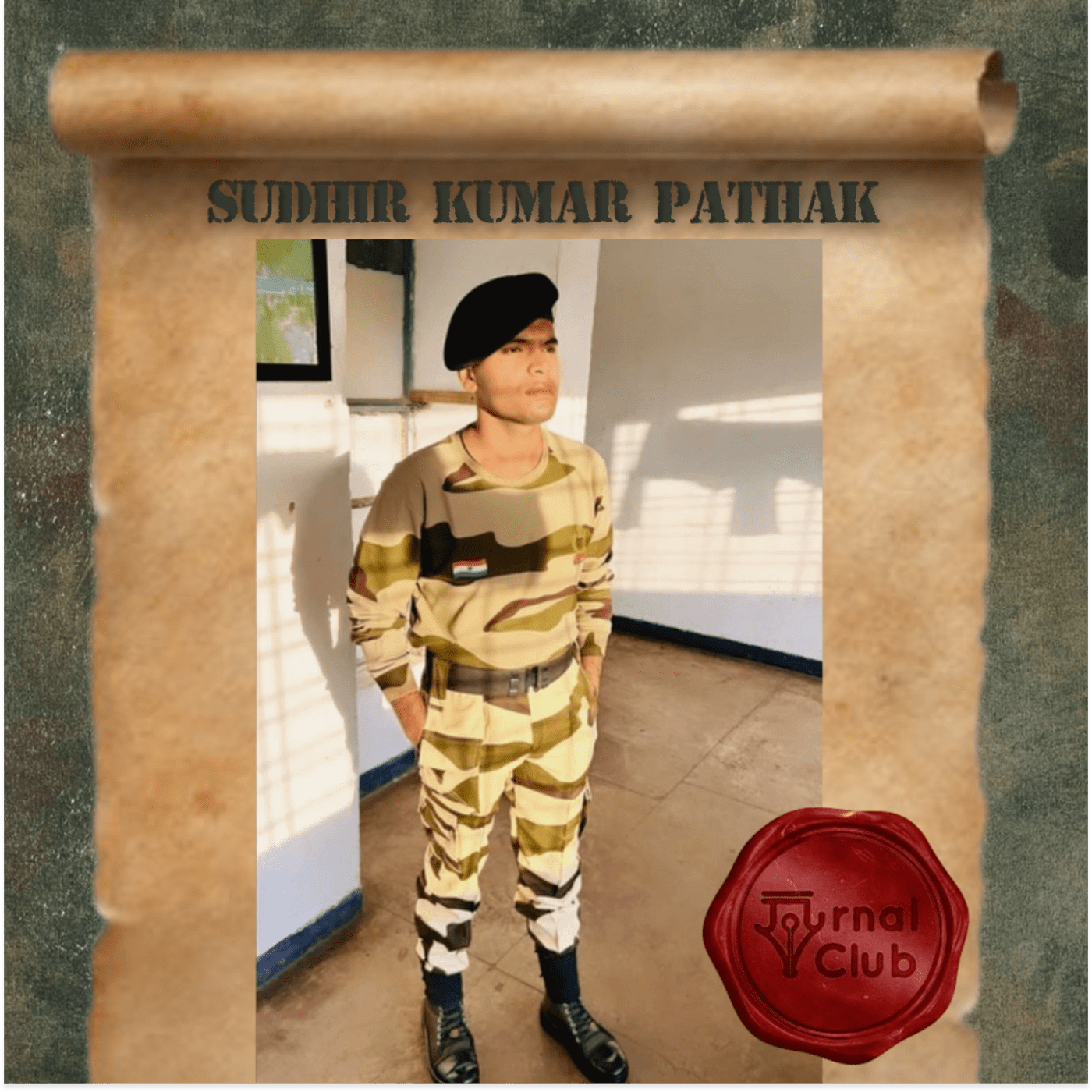
Sudhir Kumar Pathak is someone most of us have seen on campus. He stands near hostel entrances, walks the corridors at night, or sits quietly while students pass by, usually in a hurry. For a long time, he was just part of the background for us too. It took a conversation to realise how much life experience can exist behind a familiar face.
JC: Can you please tell us about yourself? Where are you from, what did you used to do, what was your journey before BITS and how did you end up with a job at BITS?
I am from Ballia, Uttar Pradesh. I am 25 now. I completed my 10+2 with PCM in CBSE. After that I did a lot of preparation. My dream was to get a job through UPSC – not for the civil services but rather for paramilitary forces. I gave the CDS exam, in which I qualified after the written exam twice but as I went on to the interviews, I would get screened out. CDS is given along with graduation. I completed my graduation with a Bachelor of Arts. After graduation, I thought that I was getting older, so I should do something. Then I started taking tuition classes. I used to take home tuition and teach kids.
From there, I gave a paramilitary force exam – SSC GD – and I qualified. After getting qualified, all the procedures happened, physical , then the all-India cutoff, and I got selected.
After getting selected, I joined CISF (Central Industrial Security Force). I was in a 9-month training period, and I had completed 7 months, after which there was a document verification. In the document verification, there was a mistake in one letter of my name. My name is Sudhir, and instead of the ‘i’ there was an ‘e’. Due to this spelling mistake, I was terminated.
I was quite nervous that my batchmates had gone ahead; I had gotten posted at Mumbai International Airport, but then I had to come back home. My older brother, Sushil Pathak, is doing a PhD in BITS in the Department of Mathematics, and he has just finished his pre-submission. He told me that there’s no use staying at home and to come with him and get a job. So I came with him and joined as a security guard in BITS.
Although I work as a security guard here, I am always ready to do any other activity. Like in the admin team, there is an internal vacancy at the Pilani campus, so I have put in an application for that. Now that I’ve filled that form, I’m also waiting for the court case matter of CISF. Along with this, I am doing an online data analyst course from Ameerpet.
JC: So the teaching that you did, what did you do, and did you enjoy teaching?
I didn’t enjoy teaching, but my family’s financial background had some trouble after COVID, so my brother (before he joined BITS) and I got together and started home tuition. I would teach 2-3 students, and he would teach 2-3 students. Then he got the PhD program here and left.
JC: You mentioned the data science course from Ameerpet that you are doing. How do you manage being on duty here? Do you go physically, or is it online?
No, it’s online, fully online. The person who guides me is a mathematics professor here – Prof. Nirmaan Ganguly. He guides me, so if I have something to ask, I ask him. My duty duration is 7 hours. After that I go to the room and study for two hours.
JC: How do you find your studies? Do you find it interesting and want to do more? The data science that you are doing, that is.
If I get a chance to go ahead – if the court case gets cleared – then I will go back to training, complete the training, and I will go to the Mumbai airport posting. After joining, if I like the course, because this is a diploma for 1 year, if that gets completed, then I can see ahead.
JC: So when will your court case be sorted?
Two notice periods have happened. The third, which is to come, will be in 6 or 7 months.
JC: How is your interest in data science?
It has now been 2 months. I have the most difficulty in the probability chapter. It’s interesting, but because my background was in arts, after doing this a lot of it is used in coding. So, I am facing some difficulty, but Nirmaan Ganguly sir and my brother keep guiding me.
JC: How did you get to meet Nirmaan Sir, exactly?
That was random. I had gone to the washroom, and there was a Computer Science PhD student, whom I was asking a coding question to in the washroom itself. Prof. Nirmaan Ganguly was right there behind and he asked me what I did. I told him that I had just taken admission in data science and that I was having some difficulty with it. So he said, “Come to my chamber, I will guide you.”
JC: How long have you been working with Sir? How did you find it?
2 months. The experience has been very good.
JC: You’re in security, so what all have you seen on campus?
It has been 14 months since I became a security guard. In 14 months I have seen that the environment here is very good. Apart from that, among the students that I have seen, I can see where their focus is. The students that study are focused, those who are in other clubs and departments are always doing other work.
I stay among the students, so I get to learn a lot, and it feels good. I never feel that I am a security guard. What my responsibility is, what has been given to me as security, understand as you want, but I fulfill those obligations. In the end I am in a good environment and I take different kinds of advice from people. I get to learn a lot.
JC: You did a bachelor’s in education, so you could have gone for a teaching job as well, right?
I could have, even now I have options.
JC: So why didn’t you? Did you not have interest there?
No-no, I have no interest in teaching. From the beginning my interest has been in becoming a soldier and many events have happened over time. However, if I still get the chance to become a soldier, I will take it.
JC: So after 6 months it’ll be cleared, and then after that?
Yes, after getting cleared. At most by October, I will leave.
JC: The other post that you said you are applying for, what is that? The admin vacancy that you mentioned.
The BITS vacancy that comes up is internal; outside people don’t get to know about it. Whoever has a reference in BITS, they get to know about it. In SWD, I was in contact with Ramchandar sir, and he told me about it: “Sudhir, you can apply for it, a vacancy has just come in at the Pilani campus, in the CPU department.” So I filled up the form, and the date for the interview is to come; I got shortlisted for it already, though.
JC: What is it like being on night duty?
I like it. I’ve been on night duty for 2 or 3 months now. I met these people, they make some robot and drone systems. I enjoy it, I sit with them and watch what they’re doing. I interact with those people and like that the most.
JC: Recently we got to know that you need a laptop to practice.
Yes, if I can get a secondhand laptop, it would be good. Now I’ve gotten one; I got it from Amazon.
JC: How does it feel to use all this technology? Earlier you wanted to become a soldier, you did ground training, whereas now you have to use technology.
I wanted to be a soldier from the start , but there’s a destiny in life, you know? So you have to go however life takes you. I believe in karma because what you do will come to you again. So, I believe in it because the way that I did, I got that back, and after that, I got ahead. With technology, I did have some difficulty. Because I wanted to become a soldier, I did a bachelor of arts, and after graduation I had some options to go into the paramilitary. I never thought that I would come to technology and coding, but now I’m here.
JC: So much has happened with you in so little time. How do you stay motivated?
I get motivated by my brother and by my father. My father is a farmer right now, and my brother guides me and says that I still have a chance. When he asked what I want to do with my life, I said that whatever opportunity I get, I’ll work for that and get it. I learn a lot from him and he gives me a lot of guidance. Also, there are really good students that I get to meet, and I talk and share things with them.
JC: You also said that you had interest in computers at some point, I think in 10th or 12th the elective that you have, you chose computers?
After Class 10 there was an optional subject, Information Technology. After Class 10, Hindi, the language subject, and Information Technology were two optional subjects. I liked Hindi because I can understand it and I like to speak it, so I chose Hindi. After class 12, I started looking a little at IT and got some interest.
JC: Since when did you want to become a soldier? What influenced you?
Since 4th grade. In 4th grade, the movie Border came out. I think till now I would have seen it more than 50 times. In 4th grade, I saw that movie many times and felt that it was all real; only later did I realize it was shot for cinema. That’s where I got my motivation from. Thereafter I knew that I wanted to join the army. After that, I joined NCC (National Cadet Corps) during graduation, and after joining NCC, I got to march in a parade at Rajpath in New Delhi. I was C-certified (the highest-level qualification for an NCC cadet). Soon after, I also joined the army attachment camp in Pithoragarh, Uttarakhand.
JC: So you’ve had some experience with the army. How was it when you first got your posting or training? Like you mentioned Rajpath, how was it?
NCC, about 50-70 percent, is associated with the army. In the army, the training involves physical activity, you learn how to use the rifle, how it’s opened, and how it’s fired. All that training is given as part of NCC. The first year of NCC is the academic year, where you get to meet people at the district level. In the second year, at the state level, you interact with different students and different cadets so that you can learn about each other’s culture and society. In my third year, I got selected for a 40-member group to go with the army and set up a camp in Uttarakhand. I went there, and I learned how to open an INSAS (Indian Small Arms System) rifle, how to open a 9 mm rifle, what technology is used in it, and the countries which are making the new technology that’s being used.
JC: In some countries it’s mandatory for everyone to spend 1-2 years. So do you think that India should also have that?
Yes, they have that in China and Russia. It should be like that in India too because if you are a civilian and you don’t know about your army, then in the future if there’s any attack, you would have to fight against that. However, these days we have cutting-edge technology, but even beyond that you need to stay physically active. So, it should be compulsory that you take training for the same. China and Russia have already done that. In my opinion, everyone should face that once, for at least for a year. Like how there is the NSS (National Service Scheme), the NCC should also be made compulsory. Along with the syllabus, it should be made part of the curriculum.
I say this because being part of NCC, I learned that one important thing gets developed within you — unity and discipline. In the army there is one rule; it was there even during my training period. When 90 cadets are given training for 1 year, if one person makes a mistake, the punishment is given to everyone regardless of who committed the mistake. Even in the 7 months that I trained for, I got disciplined frequently. After coming here, I have now become a bit physically inactive, but after going there, I will need to get up for training at 4 am and go to bed at 11 pm.
JC: Is being in the army like in the movies, is it like how they show it?
Yes, in the morning at 3:50 am, a whistle is blown. After the whistle is blown, you need to get ready in half an hour. After getting ready, when you go to the washroom, you need to have a habit of shaving. When I joined, I didn’t have the habit of maintaining my beard; I just liked to just keep my beard as it was. Back then during training, when you went to the washroom, you had to take the shaving kit with you. I got in trouble for not maintaining my beard many times. I realised that the discipline is very good. Your mindset becomes completely different from that of a civilian when you’re in the army.
JC: How was that discipline in the beginning?
The discipline, I think, is the best out of all other things. The discipline in the army is the best, from eating to living, from speaking to walking. If you observe any soldier, his way of walking, his way of speaking, and his way of living will be different from civilians. In my case, I did it for 7 months and came here, so it’s back to normal now.
JC: Do you have any inspiration now that keeps you disciplined in your life?
After clearing the exam, there are few procedures before going. When my all-India rank came, I was relieved that I could finally go to training because even before that I used to run, but I was not that physically active. After joining on 21 October, 2024, I joined the training in Indore, Madhya Pradesh. I saw that at 3:00 am they blow the whistle, after the whistle you have to get ready in half an hour, and at 4:00 am you have to reach the ground in your kit and sports shoes, and everyone has to fall-in at the ground.
You need to go on a run for 5 kilometers. After which they make you do different types of physical activities. Then you come back, and at 7:00 am you have your breakfast. After which, at 8:00 am, there’s another whistle, then you fall-in again. They then teach you what CISF is. At 10:00 am, after resting for about half an hour, you have a drill period. The drill period is as it happens in the army – salute from the front, turn right, turn left, turn back, and move forward.
This drill is done because if there are 4 people sitting here, and I give you caution, you will not do it individually. All four of you will do it together. That is the discipline. If the army says, shoot this person. The difference between a civilian and a soldier is that if I am told to shoot this person, this terrorist that has come in front, I wouldn’t be able to, because I would be afraid of shooting, of pulling the trigger. But if a person is given training for 9 months for doing this, then they would fire on the spot.
After the 2-hour drill period, there’s 1 hour of rest, then they teach us about weapons that we have in the army. You take those and go for a class to learn about it. For all weapons, like the INSAS rifle they make you open each and every nut in it. They make you open it with a blindfold on. With a blindfold on, in a few minutes or seconds, you need to assemble it. This is the kind of training that is given. Because during a fight if your weapons ever get damaged, no one will be there to fix it for you, you need to do it yourself. So, training is given properly for everything.
JC: You’ve left training for a while now, it’s going to take 6 months to get back to it at least, so do you think when you go back you’ll be able to catch up again, or would you need to start again from the beginning? As your lifestyle has changed a lot.
Yes! I’ll be able to catch up. My lifestyle has changed, but my mindset has not changed. Yes, the schedule of the training there and the schedule here have changed. There, I used to get up at 3 am. The most important thing in a human life is time. If you are not timely in anything, you will not be able to grow in anything. That’s why the army has the most focus on time and discipline (i.e.) how to do everything in a timely manner. That’s why I know that if I join in the immediate future, I will surely be able to catch up easily.
JC: Now after 6 months, in October when you join CISF, what is your goal? Will you continue in CISF, or will you study more?
In CISF, there are internal vacancies like CPO (Central Police Officer) and SI (Sub-Inspector) available, which are conducted by SSC (Staff Selection Commission). Suppose that my post now is of a Constable. After that comes the Head Constable, and after that comes the Sub-Inspector.
You get the SI post when you work for 4 years. An internal vacancy comes to the Constable and Head Constable for promotion to Sub-Inspector. You need to take another written exam and there is no physical exam for it. If you qualify in the exam, you get the post. If you get to Sub-Inspector, there will be an internal vacancy for Assistant Commandant. You can further go ahead in that direction by giving the exam. For these posts it depends on how active you are and how much you study. Like, if I join the post and don’t study, then they can remove me.
JC: You have been in the army, and you have the country’s respect for your dedication to serve the nation. Would you like to say something to the students, from your experience?
First of all, human nature has its merits and its demerits. So, I want only this from students. You study late at night, but I see a demerit here that in the morning, when it’s the time to wake up, they sleep. Waking up at night and sleeping in the morning. Studying is a good thing, but you need to give yourself 6-7 hours to sleep. At this age, I will say that this is your prime time. Do well in this age, focus on yourself, not just studies, in every activity, and keep yourself engaged in every activity. Most of all, pay attention to time management, what to do and when, and at what time. The best thing about being on this campus is that when I meet students, I am motivated. I will say that discipline and time management are important. If you manage these things well, then this is your prime time, and you will do well, even in the future, and that is my guarantee.
 The Journal Club
Leave a comment