
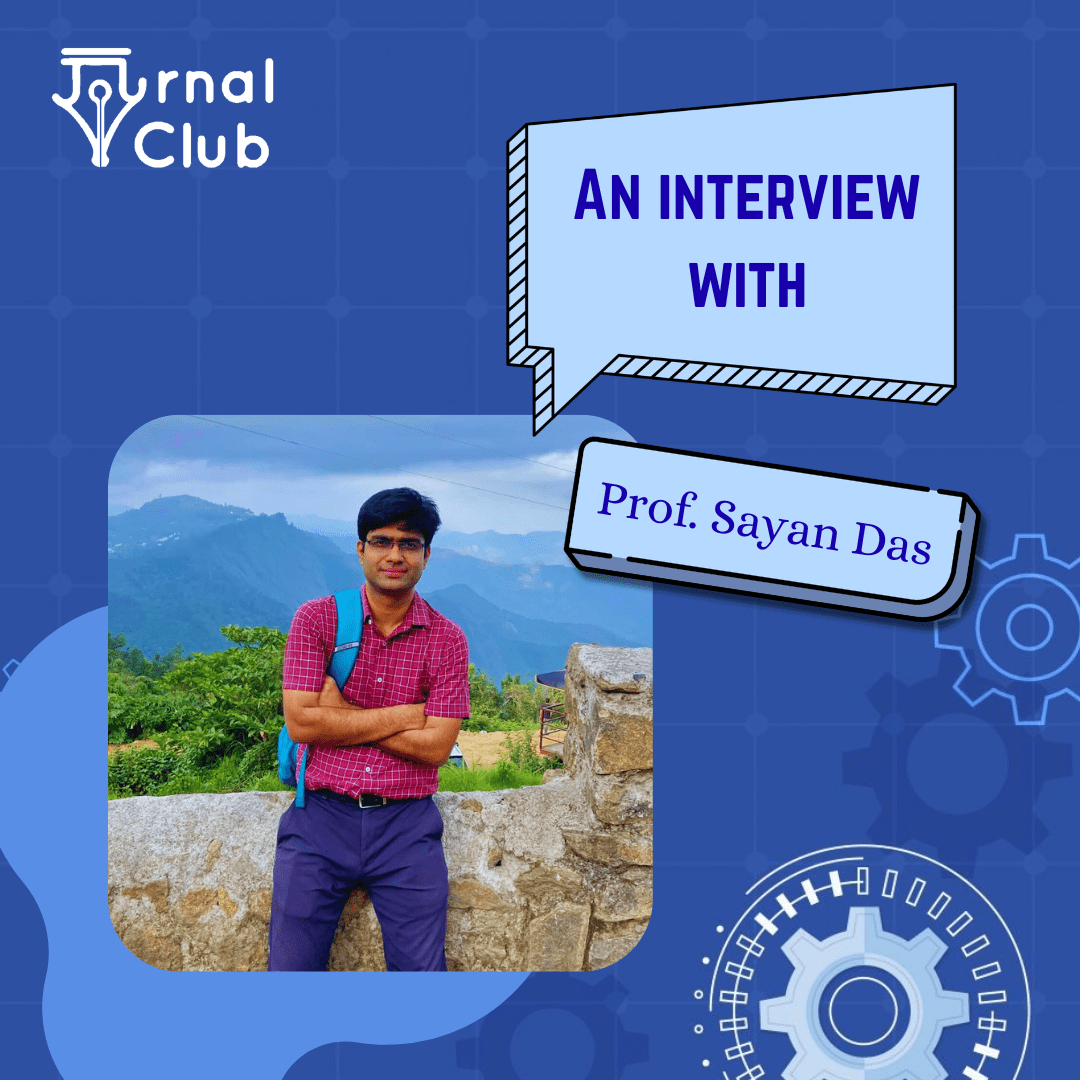
JC: Hello, sir. Could you tell us a bit about yourself, your background, where you’re from, your early journey, and how you ended up in BPHC?
Prof. Sayan:
I am basically from West Bengal. I did my schooling at St. Xavier’s, Haldia. It’s a small industrial town. I was there till class 12, and then I wrote the West Bengal Joint Entrance Examination (WBJEE) and got admitted into Jadavpur University. I was there for four years. I was quite a bookish guy till class 12, and in my initial college years, I used to just go to college, study, and come back to my hostel room. However, in my fourth year, I started enjoying life more.
Then I got placed in Maruti Suzuki, and I thought, “My dream has come true.” My dream was always to go into the automobile sector. My parents forced me to give GATE for higher studies, but I thought I would just take the job and enjoy life. I thought that was the end goal, so I studied as much as possible to get there. I worked at Maruti Suzuki for about one and a half years, but I got bored. I realized corporate life was not my cup of tea, and I wanted to pursue higher studies. Then I gave GATE again, qualified, and went for my Master’s at IIT Kharagpur.
I didn’t get my preferred rank. I initially wanted thermal engineering because I liked thermal, but I got the next best option and did my Master’s in aerospace. I studied there for two years. At that time, I wasn’t very inclined toward research. Initially, I wanted to go into R&D jobs. I did get placed, but the salary wasn’t great. So I thought of trying for a PhD. At that time, I had heard about Professor Suman Chakraborty at IIT Kharagpur. He was very good in fluid mechanics, which was my favorite subject. So I contacted him, and he said I could apply under him. That’s how my journey started.
During my PhD, I started working in microfluidics. It was completely new to me, but as I got into it, I found it very interesting. I gradually started working on droplets and related problems, and I finished my PhD at IIT Kharagpur. Then I did my postdoc in Germany at the Max Planck Institute for three years, and after that, I joined BITS Pilani Hyderabad Campus. In short, that’s my entire career journey.
JC: Okay. Follow-up question, you said you spent some time in industry when you worked for Maruti Suzuki. How was that experience for you? Could you elaborate more on that, like sharing some takeaways?
Prof. Sayan:
Yeah. Everything you’re studying in academics is more of the theoretical part, right? So when you’re going into the industry, what you are seeing is the more realistic scenario. That is the good part. What didn’t suit me was the communication and manpower management part. At that time, I wasn’t very good at managing people. I liked the technical work, but the implementation required managing teams. I was a shift in-charge and had to manage many people, most of whom were around my father’s age, while I was just 21–22 years old. So for me, it was a very difficult task. I was the kind of guy who, if you gave me a computer and asked me to work on code, I could do it very well. But when you asked me to manage people, I was more on the introverted side, so it wasn’t really my cup of tea. So that’s the part I didn’t like. But I explored a lot of things which I had studied in books, like how IC engines work. So the interface was very good when practical things worked well. So maybe if, on the other hand, I would have gotten an R&D job or something on the research side, maybe I would have liked it, but that didn’t happen. So, I learned a lot about the real-life interface.
JC: Okay, did you always plan to do a PhD or is it because of your experience with the industry that you decided to change?
Prof. Sayan:
It was quite the opposite. I had never intended to do further studies. As I was telling you, after my BTech, I wanted to go for a job. Then I learned the hard truth; I didn’t like it and I left it. And I thought that maybe I didn’t like it because I was on the shop floor and not in R&D. So my plan was to do an MTech, and then let’s jump into R&D. But things didn’t go that way, and I ended up in a job. I mean, I got a job which was not paying me very well. So, I had the option to do a PhD. I thought after PhD, I might get a better option. So, when I started doing the PhD, I started liking research, because of the fact that I had a lot of freedom. I mean, nobody was telling me, unlike the other jobs, that you have to do this, and after you do this, you have to do that.
So I had my own way to approach a problem. I can take this approach and I can take that approach. For example, I’m teaching fluid mechanics in class. There is no one to tell me that you have to teach this topic after this, after this topic. I can choose the way I can teach….Or for example, there are these SOPs or DOPs, different project-type courses. So I can choose any topic and give it to them. There’s no one to tell me. That’s the freedom I’m getting.
In corporate jobs, there’s a boss over you, and since most of them are profit-driven organizations, they won’t let you experiment. I’d like to give you an example: suppose you are joining the automobile sector and you say, “I have got a very good design. I want to design this car, which is aerodynamically very efficient, and it’s fuel efficient.” the company would not like to spend so much money on your idea. If it is not working, then it might be a loss for it.
So ideas are encouraged, but not on a big scale. But here you see people like Jayant, right? He’s doing such big things. The kind of support you get from academia is quite huge. You have a lot of freedom in academia, which I liked, and then I made a decision: I want to go into academia.
JC: That sounds good. Could you describe your PhD journey in IIT Kharagpur, how long it was, what your experiences were and what challenges you had faced?
Prof. Sayan:
Yeah. So I joined IIT Kharagpur in 2014. I was working initially in mechanical in my bachelor’s. Then I shifted to aerospace. Once I shifted back to mechanical, I had almost forgotten so much of it because aerospace is not exactly mechanical, right? And microfluidics is all about fluid mechanics. So then I had to revise all these concepts and so much stuff. That took some time.
My supervisor, Prof. Suman Chakraborty, is the director of IIT Kharagpur right now. He was very friendly, and he gave me a lot of freedom to explore. In the initial year, I kept exploring, and I was hitting dead ends. Then, there was a senior of mine, who is a friend of mine now. His name is Subhadeep Maiti. He is a professor in IISc. With him, I published my first paper, and he basically guided me on how to write a paper and all of these things, and that’s why I got interested. I struggled a little bit, but once I got the feel of it, from my second year onwards, I dove directly into the research part, and I started exploring both experiments and theory.
One thing I liked in our lab was the group work. We worked in teams, and we did a lot of brainstorming, and so many new ideas came up, and I finished my PhD in almost three and a half years, and I defended my thesis in around 2019, I think. Overall, the journey in PhD was quite beautiful, I would say.
JC: Okay. Sir, you said that you did your masters in aerospace and moved into microfluidics. What specifically brought upon that pivot? Because they’re kind of different fields.
Prof. Sayan:
I will tell you about my thoughts at that point of time, why I shifted back to mechanical. One aspect was, at that point of time, (I’m talking about the point of time when it was 2014), the job prospects at that point of time in aerospace were not that great. And the second thing, uh, what, what I thought is that the colleges, those- I mean, if I have to go to academia, then I have to join an institute which has aerospace engineering, right? So the number of colleges which offer aerospace engineering at that point of time were very less. So it would have been a bit of a risky move if I would have gone to aerospace. Those were the main reasons I didn’t go to pursue my career in aerospace.
I shifted to microfluidics, but why did I shift? It was not microfluidics that I was after. It was after Professor Suman Chakraborty because I knew him. At that point of time, I had no idea what microfluidics is, but I had listened to a lot of his lectures in fluid mechanics, and I got fascinated, so I wanted to work with him. Uh, and I love mathematics, by the way, and so the maths part I liked, so that’s why I wanted to work with him. And then gradually started exploring microfluidics, and I loved it actually.
JC: How was the day when you found out, like you said, you followed his lectures and one fine day, you found out that your application has been accepted for the PhD?
Prof. Sayan:
What happened was that he was finally taking me, but then I had to give the examination, the PhD qualifying examination, to get admitted. But when I got admitted, I was very happy. This is something which I have wanted, and I was afraid that if I don’t get it, what will happen? Because there was no backup plan for me. I had already left the job which I had got. So I was very happy, and I was thrilled to pursue this because this is something which I have wanted, that I will work with him.
JC: A bit of a sidetrack, sir, but how did you convince your parents that you will leave the job?
Prof. Sayan:
Oh, that’s a very good question.
JC: Because, even though I’m pretty sure West Bengal would have a higher preference towards attaining higher education.
Prof. Sayan:
You are talking about leaving the job and going to pursue a Master’s? Is that what you are talking about?
JC: Yes
Prof. Sayan:
So I will tell you. What happened is, I started hating the job after, [chuckles], after 1 ½ years. I was determined that I’m going to leave it. The moment I told my mother and father, they got very angry. You won’t believe it, They called my boss.
He was a Bengali guy, so my father talked to him, and he said, “My son, he’s childish. He has hot blood, he is not thinking through.” And my boss started to convince me, “Please give it a thought.” but I was very determined. I was just twenty-two years old. I was quite young, and I wanted to explore so many things. And I hated the job because I was not enjoying it at all. I mean, every day, day in and day out, it’s like I’m just working to get the money at the end of the month. I literally fought with my father and mother.
There was a tradition: If you’re leaving the job, your boss will take you to the managing director of the company, and they will ask you why you want to leave during the exit interview. I literally told the managing directors that I’m not enjoying this. I want to go for higher studies. When I left the job, my father and mother were not happy for almost a year, unless and until I started showing some results. So if you love something, if you are passionate about something, you have to make a risky move. Your father and mother, your parents, want to protect you. It’s not bad. When you make a risky move, they are very afraid. Because of this fear, they will scold you. But when you show them that you are successful in whatever you are pursuing, you’re good. You have seen this movie, right? Three Idiots?
So there was this character of Madhavan, right? His parents wanted him to pursue a regular life, which is safe. But being a wildlife photographer is a risky job. Not everybody is successful. Once you start showing them success, then they cannot say anything, and they will be more happy than you can expect. So that’s what happened to me. When I went to Germany to do a postdoc, I asked my father: “Father, are you now happy that I made that decision?” He was so happy, that he was saying, “If you would not have left the job that day, probably you might have not gone abroad also.” [smiles].
I was passionate about academics. I loved it, so I made a big decision. But maybe whenever you guys are making a decision, I would say that you need to consult a lot of your friends, your seniors. Don’t take any random decision.
JC: You did your postdoc in Germany. How was your postdoc experience in Germany? And what challenges did you face?
Prof. Sayan:
Just like you guys have to apply for PhD, you will apply for it, you will have to write mails. That’s the same approach on a higher level. Basically, I have to write a statement of approach in a more elaborate way because I have done a lot of research work in my PhD. The approach is basically the same. So when I got a reply, “Yeah, I’m interested,” I was ecstatic. So I was writing mails, almost ten, twenty mails I’d written. So, I got this reply from Max Planck Institute of Intelligent Systems in Stuttgart. So they wanted to take an interview. Usually, they take an online interview in most cases. But, I don’t know, maybe Max Planck has a lot of money, they said, “You come here, we’ll sponsor your travel, and you have to give an offline interview.”
I was happy that even if I don’t get to visit Germany, there is no loss for me. I was happy, but at the same time, I was very nervous because I knew whatever work I’ve done in PhD, I had to present in front of them, and they will tell me whether I am selected or not. Thankfully, everything went well, and they had a requirement, and I got selected. And when I was coming back, I was so happy. I mean, maybe that was my happiest day. That day, I was not happier than the day I got selected in BITS, but I was very happy because life was very beautiful in Germany.
JC: Which year was this, sir?
Prof. Sayan:
This was in 2018, July.
I went for the interview, and I got selected. They wanted me to join as soon as possible, and unfortunately, my PhD thesis review took a lot of time. Why? In Kharagpur, what happens is that once you write your thesis, it gets reviewed by one professor in India and another professor abroad. So the professor from abroad who was supposed to review my thesis, broke his hand due to some reason, and he was not able to review it, so I had to wait nine months. Now they were asking me, “You come, and we’ll give you some minimal amount of stipend.”
I joined there in November 2018, and I still remember it was so cold. I’ve never gone to Germany, I was sitting like this [mimics shivering, sitting huddled up], and then some lady came to me. She was asking me, “Are you well?” She is used to that environment. I was literally shivering. Then I said, “No, I am fine, I am fine.” That’s how my journey started. Life in Germany was very good. Why? Not only because of the facilities, it’s very clean and the way the people talk to you, you will really love it. When you are walking on the streets, suppose I don’t know you, I will not smile at you, right? But over there, suppose you are standing with a guy in a lift, he will greet you, “Good morning.” The culture is so good that you will love it.
JC: Did you learn German?
Prof. Sayan:
I started learning German at the very end. Initially, I was skeptical about staying for a long time, then I started loving it, okay. But unfortunately, COVID came at that time.
I started learning German and I wanted to apply for jobs there, but what happened is, I was seeing bad news everywhere, and my parents were alone, so I got very afraid and insecure. Then I thought, “I should go to India.” That’s why I didn’t continue. Otherwise my plan was to learn German fully and then get a job there.
JC: So now, have you considered going back?
Prof. Sayan:
No.
The thing is that I am happy here. I will give you an example. Suppose you have a very rich friend, okay? He’s a very good friend of yours, and he will never mind if you stay in his home permanently also. And he is very rich, and you are not that rich. So you have been staying in that friend’s home, but after all, it’s not your home, right? That’s the kind of feeling I used to have. In Germany, it’s very good. There is everything for you. Medical facilities are free, but after some point of time, you feel that it’s not your home, and if you have to go to your parents, you have to cross so many seas, I mean, a lot of distance to cover, right? So that insecurity was there. Then I came back to my home…. India. [chuckles]
JC: That’s an interesting journey. You basically did research both in India and in Germany. So what, what would you say are the differences between the two places?
Prof. Sayan:
Okay, the difference is in work culture? I will tell you. Throughout the semester, we’ll play, there is nothing wrong with it, and just before the exams, we will study. Late at night, we will study. In Germany, they are very disciplined. Every day, whether there are deadlines or not, the German people used to come exactly at nine, and leave exactly at five. So why I’m saying German people is, there were Chinese people, there were Indian people, there were people from Bangladesh also. For European people, I can say, they do not do any kind of overtime. Indian people, if they are having a deadline, they will stay up late at night.
No matter what happens, the Germans will leave at five, and they will go to play football or something. They enjoy their personal life. Their life was very balanced. They do not sacrifice any of their personal time if they have some professional work. That is the thing I loved. Sometimes I used to go on Sundays, and I would see all these Chinese guys or these Asian guys or Indian guys like us, they used to work hard like anything. The good thing is that they will never poke you. In India, if you go to any work center, there is a little bit of jealousy and all these uneasy emotions. There are no such things there. The work culture was very good. If you want to enjoy work-life balance, it’s the best place. I’m only talking about Germany, I don’t know about any other place. But in Germany, the work-life balance is very good. Saturday and Sundays are holidays. Every Saturday and Sunday, they will go for some vacation. Of course, the salary is also good. The only thing which was expensive in Germany was the rent. Uh, if you can somehow manage the rent, then everything is good.
JC: Okay. Suppose a student wants to go into aerospace modeling. Should they prioritize strong physics, strong programming, or strong numerical methods, from an academic point of view?
Prof. Sayan:
That depends. I was afraid of doing experiments. Why? Experiments are something which you cannot do alone. You have to work with two to three guys, or maybe one or two juniors. Suppose I’m doing an experiment, I need something to be fabricated. I have to contact a guy who can make this.
Have any of you seen this movie, October Sky? In this movie, they wanted to make a small rocket. I think at that time, they showed us Sputnik, I think- 1 or 2. And it’s a true story, actually. So this guy wanted to make a rocket. He was a child, thinking “Let me make a small-scale rocket. I want to make it fly.” One night, this idea came to him. He started building things, getting things, but he had so many hurdles. He had to go to this person to make a part. He had to go to that person. What he wanted to do is basically a kind of research, but he wanted to do it experimentally.
So if you have to do experiments, you have to have a lot of contacts. That’s the thing I didn’t want. I wanted to do numerical and theoretical work because I am good with computers, and maybe I don’t want to depend on a lot of people to do my work. So that is one of the reasons I was more into research, and I loved mathematics. It depends on the perspective. If one is really good at coding, he can do numerical or theoretical research. If he wants to go do experiments, then he has to connect to the proper lab. For example, if you want to do experiments in BITS, you don’t have as many facilities. You have to go to other places, like some IITs, where you have to do it. You have to do a reality check of what is available, and based on that, you have to decide.
JC: Is there any other advice that you would give to a person who is planning to go into aerospace or microfluidics in general?
Prof. Sayan:
One thing I would want to tell students is, make a strong decision about what you want to do. If you are not interested in doing a PhD, but you want to go into the R&D sector and you are okay with staying abroad, then one thing I suggest to students is do a bachelor’s here. I have been to a lot of colleges. I have been to IIT. I’ve stayed in IIT Kanpur for almost 7 or 8 years, and I’ve been to other IITs, but BITS is very good as far as students are concerned. The kind of freedom you get, I don’t think in any college in India you get that. In PS2, you are getting the freedom to go to any place you want for doing a thesis or an internship. That is something you will never get in any IITs. If you want to do a thesis there, you have to do it in the IIT itself. There are so many other points. Go into further studies. Start applying for master’s. In PS2, you can go for a thesis and build your network. That network comes in very handy when you start applying for master’s, and when you apply for master’s. I would give preference to Europe because I was in Europe. I don’t know about the condition in the US, but if you are in Europe, then what will happen is that the only barrier is the language. If you know the language, then you will have so many opportunities to apply for jobs in Europe. I mean, in Germany, if you are talking about the automobile sector, all the big companies are in Germany. Mercedes, Porsche etc. The salary is very high, and some of the companies even have four and a half working days. Two and a half days you can enjoy. That kind of work-life balance is very good. That’s a beautiful life you can enjoy. Suppose you want to go for research, then also you can try doing a master’s outside. I personally knew a student. His name was Atharva. He was working under me. He did a thesis. He was a physics dualite. He did his thesis in KTH Royal. And there he built his network. Right now, he is in Michigan.
He is doing his master’s in Michigan. I asked him one day, “Why are you going to Michigan? You could have gone to ETH,” because he was also getting ETH. So he said, “Let me work in Michigan, then probably, I will go for a PhD in MIT or a similar college.” So, uh, see, what happened with him is that if you apply for a master’s in the US, there is almost zero percent chance that you will get a stipend or scholarship. But he got a scholarship in Michigan. Why?
Because he built his network. And of course, his profile was also very good. His CGPA and all these things were there, but the network also helped. So what I’m telling you is that since you have so much freedom, freedom as a BITSian student, use that freedom. For example, you go to places in PS-I, in PS -II, to do internships. In the summer vacation, people go for summer internships and start building networks. I’ve seen many students choose various areas for projects. It’s good if you are exploring things. Till second year, it’s fine. In the second year’s second semester, I tell the students that you have time. Right now, explore. But after second year, you don’t explore anymore because what happens is that this exploration dilutes your profile.
For example, say I’m a third-yearite doing a project in manufacturing, and since I want to just make my CV big, I take another project in fluid mechanics. Those two are not at all related.What happens when you are finally making your CV and applying for a master’s position, you have to build a story. It’s all about a story.
You have to relate that manufacturing project with this fluid mechanics project. If you are able to relate, it’s fine, but usually that does not happen. Just for the sake of doing ten projects, you should not take ten projects. You take ten projects, but those ten projects should be related. That way, you will be able to build a story that will help you in your application.
JC: So we ought to prefer quality over quantity?
Prof. Sayan:
I’m not saying, “Do the same projects under the same professor.” Choose areas which are related, and you choose your fascination area. Suppose you are interested in robotics, then you can do one project in structures, because structures have something to do with robotics.
JC: As you know, sir, mechanical is a very large, expansive field. One of the questions a lot of people I know have is, how do you decide what you should do? Should you eventually go into one specific sub-domain? How do you branch out and then converge?
Prof. Sayan:
As far as I think, for the other courses also, this is applicable. The first year is generic. In the second year, what we usually do is that we start introducing the CDCs. For example, in mechanical, in second year, first sem, you have fluid mechanics, manufacturing, you have mechanics of solids, and what else do you have?.
JC: We have Applied Thermodynamics.
Prof. Sayan:
Thermo. Thermal and materials science. In mechanical engineering, there are three pillars. One is fluid engineering and thermal engineering, and one is manufacturing, another is design. You get a feel of this in the second year, first sem, What I encourage the students to do is to start. The good thing about BITS is that most of the professors are quite welcoming. So if you go to any professor, they will not kick you out.
If any student comes to me, I welcome them. Maybe he’s not coming to do a project under my guidance, when coming to talk to me. He wants to know what kind of projects I’m offering.
That’s why we, this time in Mechanical,we started the “Coffee in the Lab” initiative. It was initiated by the HoD to make the students aware of what kind of research we are doing. And that actually helped. So people got to know that in fluid mechanics, people are working on macro fluids, sensing, and so many other things, and they started approaching different professors. So that’s what I want you to do. In the second year, you should talk to professors, get to know the different projects that are being offered, and then make a decision, “Is this what I want to pursue?” That decision should be made by the end of second year. In the third year, you should finalize what you’re going to do.
JC: Yeah, so my question is, you’ve done so much research in so many different places and you have a good industry network also. What do you think is different about research culture at BITS as compared to maybe IITs or, or other Indian colleges?
Prof. Sayan:
Okay. Suppose you are doing some kind of research in an IIT. First of all, the student-teacher interaction in IIT, in my case, was a bit less. When I was doing my Master’s, I had to approach faculty, I did not do it as much as the students that I see approaching me. At least I can say that about myself. I quite encourage having random discussions. So whenever a student comes, if he’s debating with me, I’m very happy. That’s what I was not able to do. Maybe it was a generation gap because I don’t know what is happening in the IITs right now, but during our time, we were very afraid to approach a professor. There was no icebreaking between the professor and the student. You understand what I mean when I say icebreaking, right?
What I try to do is that when I first meet a student, I try to crack some jokes so that we can have less tension between us and maybe more of a pals kind of thing going on. When that is happening, if he’s coming with a doubt, he will try to debate with me, which is good, which is just like you guys do among yourselves, right? That tension has to be brought down. Which I didn’t find in IIT. In BITS, what happens is that the brainstorming and the student-teacher interaction is on a very good level. That’s what I found.
JC: And is there something that was better about IIT in terms of research as compared to-
Prof. Sayan:
In IITs, the discussions among the students were very rich. So I don’t know here how many productive discussions happen, but as a student, when I was in an IIT, I learned so much from students. I learnt from faculties also, but a majority is from students or my seniors or my friends while having discussions. Those discussions over chai or over canteen food used to be very fruitful. As a faculty also, I have such discussions here, but I don’t know whether among students that is happening or not.
JC: We do have club discussions–
Prof. Sayan:
When you say club, you are basically talking about official discussions. You are making it very formal. I’m telling you about informal discussion.
JC: We do have both informal and formal discussions which are rich. For example, there’s SEDS: the Space and Development Society. There are teams in it which work on rocket fuel design and propulsion systems. So they have meetings as well as when they’re just randomly having discussions, they are rich.
Prof. Sayan:
In IITs, we did not have those kinds of active clubs. We just randomly met each other, and just started discussion over there.
JC: When people approach you for research collaborations, what kind of students stand out to you?
Prof. Sayan:
A guy who is having a nine pointer CGPA, is not always considered to be a good researcher. I found this to be true. I will not name any particular student, but I have seen it many times. When I first came here, I did not know how to guide a student. I used to blindly write when this GOP comes that I will take students only above 8.5 or something. I used to think that he is the topper in the class, so he’ll do good.
What used to happen is that a student who is having a nine pointer, for most of the cases, is a guy who I have to spoon-feed. Research is just the opposite. I mean, I have to do minimal spoon-feeding because you have so many facilities, you have ChatGPT, you have so many resources. Suppose the student is getting stuck, I had a student who was a nine-pointer, and I had a student who was a seven-pointer.
And trust me, the nine-pointer guy, he came to me, “Sir, what to do next?” It is a good thing that he came to me, and I will tell you the answer. But the guy with the seven-pointer, who got stuck, tried to solve it himself. Research is something where you have to take your initiative. If you are getting stuck, failures will happen, but you have to try to solve it. That’s how research is done. If I spoon-feed you everything, then it just becomes an assignment. So the seven-pointer guy went to ChatGPT, and one day he came to me, “Sir, I got stuck, and I found this here and this there…” and I got to know so much more. It’s something which even I didn’t know. That is the thing I look for in students, an approach to research. When I said to the 9-pointer “Yeah, you have to do this.” He said blindly, “I will do it.” Even if it is wrong, he will say, “I will do it.” The student should be debating with me and he or she should come up with ideas.
JC: So you look for inquisitiveness?
Prof. Sayan:
The CGPA is not the deciding factor. Initially, I was wrong. Initially, I was just going to look for guys with good CGPA, but right now I don’t look for CGPA. I just have interactions. Luckily, I have a field mechanics class. We have this project in field mechanics, like a course project.
We do it every time. So the entire process is quite a hectic process. For mech students, fluid mechanics is a CDC. I have been taking that course for the last two years. In that, we do project-based learning. So in that, they have to make very basic models. Something which you have learned in class 11, 12. Heating without boiling was one topic, where you reduce the atmospheric pressure, and the water starts boiling. Very simple experiments like that. Then, say, surface tension.
What I do is I take weekly evaluations. These are two hundred students I’m talking about. Five per group, so almost forty groups. And before the mid-sems, I evaluate ten, twenty groups. After the mid-sems, I evaluate twenty groups. If I leave the students, saying, “You do this before the exam.” I know no one is going to do it. I tell them, “You will have weekly consecutive evaluations. In three weeks, the project will be done for one group.” Like this, we evaluate forty groups. So it’s quite hectic. You can just imagine going through all this process.
But the good thing was, by doing this, I was able to know most of the students. It would not have been possible if I had not done this. In the classroom, hardly anyone interacts. I interacted with people who would have never come to class. And this way, I got to know that this guy has a lot of good ideas, even though his CGPA is less. And finally, we had an exhibition where this time we even called the community members from the college. Luckily, on that day, I think some school visit was going on, and all the students gathered. They were class 11 or 12.
They were asking so many questions to the guys. It was very interesting. I got to know a lot of students. Then in the next sem, if they are applying for SOP, I go for students who are more inquisitive rather than students who are having nine points of CGPA.
JC: So you started as a student who was interested in mechanics, then you navigated into corporate life. Then you went into academics again, and now you’re back to teaching. So how was navigating teaching for you, and do you feel you connect with your students the way you connected with your professors?
Prof. Sayan:
Okay see, one thing is that there is no training institute for teaching, right? There is a training institute for research. We are getting a PhD, we are getting trained for research. If you join any industry, there will be one-year rotational training. There is even training for that. But there is no institute where they teach you to teach. Teaching is something where you want to express how much you know to people. So how can we speak plainly with people? There can be professors who have a huge amount of knowledge but a few are not able to deliver. So they are not good teachers, maybe they are very good researchers. People who have not done that much of research, but know the basics of subjects. Fluid mechanics is a basic subject, but they are teaching that so well that the students love them. Teaching and research are totally different pillars. Yeah, of course, if you are good at both, then it is very good.Initially, when I came to BITS, I was very nervous. Right now, they have split the fluid mechanics class into F107 and 108, so it’s a hundred. When I first came, it was just after COVID, and it was in F103. Suddenly, I’m seeing that two hundred students are sitting, and the first day, usually, it’s a full attendance class.
So, I was stammering. I mean it’s my first time talking to two hundred students, maybe they will joke at me, they will test my knowledge, so many things. But gradually, then what happened is that I tried to cool myself down, and I started talking to students, interact in class. It happened gradually.
It was a shock for me, but gradually, when I started interacting with students, I got nervous in front of the class. Sometimes, some students ask me questions. I’m always confident about it. But at that time if I answer this, another guy is going to tell me. If that guy comes to me personally and asks me, I’m pretty confident, but there’s stage fear. So even now, that sometimes happens, but it’s a gradual process. When I’m teaching in class, I’m confident, and some students ask me a question, I answer him, and then this batch was like this. So this particular batch, we had a lot of debates in the class. Initially, I used to get a lot of nerve- nervousness, but then gradually, we became very healthy, and we used to have a lot of interactions in class. It was a gradual journey. Now, I’m quite comfortable with teaching a huge class.
JC: Also, sir, I had a question. There are a lot of students who want to do research. They enjoy doing research and, you know, practical applications, but oftentimes, because of the money factor, they have to get into corporate jobs.
Prof. Sayan:
No, so that’s not true, I would say,
When I was doing my bachelor’s, most of the students who got into Masters were not very rich, and all of them got scholarships. In the US, I can tell you. All of the students, all of my friends at that point of time, applied to the US. I don’t know about the scholarships in Europe, or how it worked at that time. Two things matter if you want to get scholarships, for students who are not that rich, at least. I think three things.
The first thing and the most important thing is networking. Suppose I am a professor, and I have a very good friend who is a professor in the US. You are doing some BTech projects under me, and you are interested in applying for master’s. You have a friend and he is also working in the same domain, but not under me. Now, both of you apply to him. So he will select whom? He will select you. Why? Because I will vouch for you. Maybe the professor under whom he is working is even more brilliant than me. Even if he is, suppose your friend has published a paper, but the professor in the US doesn’t know him. Networking comes in and plays a major role. A good network will overshadow you. That’s why I tell students that starting from second year or third year, summer internships, don’t waste any time. Go to IISc or IITs, because most of the professors abroad know people who are in some IITs or IIScs. Once you go there, ask them whether you have any contact. That’s why you start building a network like a spider’s web.
The second thing is your CGPA. CGPA matters, but it is overshadowed if your networking is very strong. Suppose your CGPA is very bad. If I tell that professor why it is bad, he will take you. If you have a good CGPA, it will be an added benefit. Third, you get a publication. Taking all this together, if you apply for master’s, then probably you will get a RAship or a TAship in the US, I can tell you. Most of them got some, maybe not a hundred percent, they got at least some partial RAship, and they used to do some part-time jobs in the US. There are a lot of part-time jobs available. That way they managed.
JC: What is an RAship?
Prof. Sayan:
Research assistantship, and then there is TAship, that is teaching assistantship. They pay you for that. Just like we have teaching assistantship, the PhDs are doing this.
But the professor has to agree. Why should the professor take you as their TA? Because I will recommend, “Yeah, he’s a very good student.” That’s why networking is very important. So start building a network.
JC: All right. Lastly, sir, what made you choose BPHC after your long journey?
Prof. Sayan:
Initially, when I was applying, I applied to all IITs for every faculty. That’s true. It’s not that I–
JC: Same sir. [laughing]
Prof. Sayan:
Joint entrance, right? I also applied for IITs because it’s a government job and so many things are there. I will tell you the truth now. Somehow, it didn’t work out. I entered BPHC. But we have, we have seen a lot of faculties who will leave BPHC. I was very strong that I will not leave BPHC. After one year of my job, I started liking it very much. Why? Because of the freedom I got. I enjoyed the freedom. I think people don’t get that in the IITs. From the second year only, we are doing projects. In a formal way we are doing projects. In IITs, I don’t think there was any formal scenario of taking a project. There is a trade eligibility. So if I want, I can make the student work because they are afraid of the grades. So that is a good thing because I was getting manpower from students, and of course, students who are interested, they take it in a very healthy way.
The second thing was setting up labs. There’s a lab which is a Soft Matter and Microfluidics Lab. You can go to the lab. It’s a lab we built from scratch, and we got a lot of help. The kind of help that I got from the institute, maybe they get that in the IITs also, but I really enjoyed the freedom and the help that I had got from the institute while building the lab. So much collaboration is possible. If I approach any faculty that I want to work with, they will open-handedly say, “Yeah, let’s work.” That kind of collaboration, I really liked. It was like a family to me. After a year, there were two applications, one in IIT Roorkee and one in IIT Gandhinagar. They asked me, “Come and give an interview.” I said that I’m not interested, I’m, I’m fine here. [laughing] I was well settled after one year. Then I thought that it was a good decision, coming to BPHC.
Of course, another factor is that the location of Hyderabad is also very good. I’m living in a city, so whenever I want, I can go to Hyderabad city. I enjoy that. In most of the IITs, leaving out IIT Chennai and Delhi, I think most of the IITs, even IIT Kharagpur, are away from the city. But living out of these three, four, even IIT Kanpur is away from the city. Hyderabad is basically a big city.
Collaboration-wise also, Hyderabad is close to IISc, IIT Hyderabad, and there is not much difference between BITS and IIT. I have visited a lot of IITs. If you consider the second-tier IITs, it is much better than that. Um, I mean, from a technical point of view, if you see the clean room, we have a photolithography unit, which is not present in IIT Hyderabad. I think so. It might be there now, but 2 or 3 years ago, it was not there. So, as far as BITS is concerned, it is at par with some of the best IITs. It’s not lacking there. You see the placements. PS school. None of the IITs have that.
So if you’re thinking of placements, and you see that so many startups are coming out from BITS. It’s at par with some, some of the top IITs.
JC: If you had to describe students here in BPHC in three or so words, what would you say?
Prof. Sayan:
Okay. See, some of the students enjoy the freedom that they get, but it’s up to the students to utilize the freedom. I’m not talking about the attendance per se. Some students are not coming to class, and they’re doing very well. But the students who are not utilizing that freedom, I’m afraid for them. There is a saying, you know, in a Spider-Man movie, “With great power comes great responsibility.” Instead of power, replace it with freedom. With great freedom comes great responsibility. Why? If you don’t utilize this freedom, then you’re going to go down. A lot of students utilize that freedom, and they are doing really well.
And what I like about BITS students is that unlike IIT students, they are not afraid to approach faculties. They are quite smart. One of my students went to IIT Bombay for an internship. He was a BTech student from here, and then he was messaging me, “Sir, I’m feeling so bored.” It’s quite colorful here. If you compare any other college and BITS, BITS is colorful, I think. Colorful in the sense, the students are involved in so many things. They have sports, and if you use these years properly, you can develop your career in so many diverse areas, which I don’t think is possible there because the pressure factor is a bit high in some of the other colleges as compared to BITS.
I would say that in BITS, you have so much freedom, so you can think, because you are encouraged to set up a startup, you are encouraged to take up research. I wish I was a student in BITS, frankly. [chuckles] I talked with some of my faculties. I could have done so much more, maybe, because there are so many opportunities. Second-year students are talking about going to the US, and at that point of time, I did not know a lot about this when I was a student. So much awareness is there among the students because of these clubs. This kind of thing was not there earlier. Maybe right now, some other colleges are having this, but at that point of time, back in 2016, 17 also, I didn’t find all these things. All of them were mostly thinking, “I have to pass. If I fail, what will happen?” So most of them were thinking about grades and all these things, but life here is more than grades. And a 7.5 pointer guy does not think that my life has ended. If you go to IITs, if you are a 7 pointer, “Oh my God, what will happen to me?” Even a 7.5 pointer guy is doing so much in BITS. He is getting placed in so many places, and he is doing research abroad. So life here is very diverse, I think, for the students.
JC: Sir, I wanted to ask about the color of life when you pursue research versus a corporate job. This is something I’ve noticed. Personally, I told my parents when I was in 8th or 9th grade, when careers were being decided, that I might want to try research.
My parents were a bit scared. Just like you said, they want to protect me. So right now, when I’m in college, the things you mentioned, grants and all of those things are there. I know of them now, but–
Prof. Sayan:
See, something good comes at a price, right? So although this life is very good, it’s very competitive. I mean, to reach this point, I mean, to get a job in some corporate firm, suppose you are talking about Google or something, I mean, it’s not that difficult to get into Google if you are doing CS. Maybe you’ll not get in at this point, but if you do a master’s or something, you will still get into Google. But the number of seats in academia as a professor are really less. It’s all about passion. What I felt was that life was very monotonous in corporate life. So what I felt was that every day I’m doing the same thing. I don’t know about the R&D part, but there, in Maruti Suzuki, we had to produce cars and I was in the vehicle inspection department, so I had to see whether any defects were there in any of the cars. If any defects were coming, we have to check and confirm the source of that defect. We had to talk to the welding department. It was very monotonous. Initially, I was liking it because I’m seeing different parts, how a car is being manufactured, etc. But then once I was done with that, I was thinking, “I’m going to do this for the next fifty years of my life? No, that is not possible. I will die of boredom.” [chuckles] I didn’t want a 9-to-5 job. I wanted a job where I could work and enjoy my life at the same time, and at the same time, I wanted to enjoy freedom. So that’s why I chose to leave. And it’s not that it was very colorful initially.
So let me tell you that doing a PhD was quite hard. I got frustrated so many times, and there was a point in time, point in PhD, when I was thinking, “Have I made the right decision? Maybe I’ll leave my PhD and go for a job.” But I didn’t give up, that’s the thing. But right now, whenever I think back, I think that it was the right decision, because PhD, it’s a bit tough. It can get frustrating at times, but when you get success, it’s very good. And at the same time, life after PhD, they don’t pay you too well. If you join Goldman Sachs or some of the finance companies, they will pay you a lot, huge. But what matters to you is happiness, and money is not always happiness. If you’re getting one crore money per month, for example, you have to get time to spend it also.
If you don’t have any time, what will you do with the money? I think you should have enough money so that you can be happy in life. You should not have excess of anything. I would say, don’t run after money, run after happiness, and see where you get happiness. Your friends will give you happiness, your family will give you happiness. Whatever profession you choose, make sure you have enough time for them. Just don’t run after career or money. Choose a profession for which you have passion also, and where you can get enough time for your family and friends also. That’s what I would say.
JC: Thanks a lot, sir.
Prof. Sayan:
Yeah. If you are in a bad relationship, and if you know that it will not go on, it’s better to break up early, rather than withstanding. If you are in a job and you are not liking it, you can make up your decision and leave it. Of course, while leaving, you think, “Where will I go after this?” Suppose you are turbulent. You are in that job for 5 years and then you leave it, then you have been out of touch with the academics for five years. You have forgotten everything. I mean, two years was also so bad for me. At that point of time, I was preparing for GATE. I forgot everything. I had to start again from the beginning. I had to revise many things. The best thing that can happen to you if you want to go for higher studies is you do it at a stretch. Suppose you want to do a master’s, don’t think, “Let me see how the job life is.” That’s a very bad decision. If you want to go work to save some money, because some people have monetary constraints. They should work 1, 1 ½, 2 years, but not more than that, if you want to switch back to higher studies. Job life is something where you will try to relax.That is a very bad thing. And at this age, 20-30, I would say you should not relax.
Another thing is, higher the inertia, higher the ability to break through problems. If I’m running very fast, even if there is an obstacle, I can break through it. But if I’m running very slow, even if the obstacle is small, I cannot break through it. Right now, you have to build your inertia. The higher the inertia, the more you will run after thirty years. After thirty years, you have to settle down. You will have a family, and so many things. So in your twenties, you should be very energetic and gather as much inertia as possible. Make contacts, build networks. The real thing begins after you graduate here, because that time you have to run very fast. And enjoy life as well. Right now, in the remaining four years of your degree, for you, it is one year. You should enjoy it as much as possible right now.
JC: I am. [chuckles]
Prof. Sayan: वही कहावत है न, जब हमारे पास सब कुछ रहता है, उसका realisation नहीं होता है। जब निकल जाता है वक़्त, तब उसका realisation होता है। Once you leave the college, then you will think, “Yeah, I should have done this, I should have done that.” Enjoy now. Of course, grades बुरे नहीं होना चाहिए, पर grades के लिए काम करना है। हाँ, grades के लिए जितना काफ़ी है उतना ही करो। ज्यादा नहीं करना, पर अपने दोस्तों के साथ अच्छा समय बिताओ। कुछ भी मन में हो तो बोल दिया करो। जब भी corporate jobs में जाते हो, तो सोचके बोलना होता है। यह मुझे अच्छा नहीं लगता। If I have to say something to him, if he is my colleague, I will think twice before saying that to him. But when he is my friend, I can say anything to him. So, that is there. Thanks a lot then.
 The Journal Club
Leave a comment