
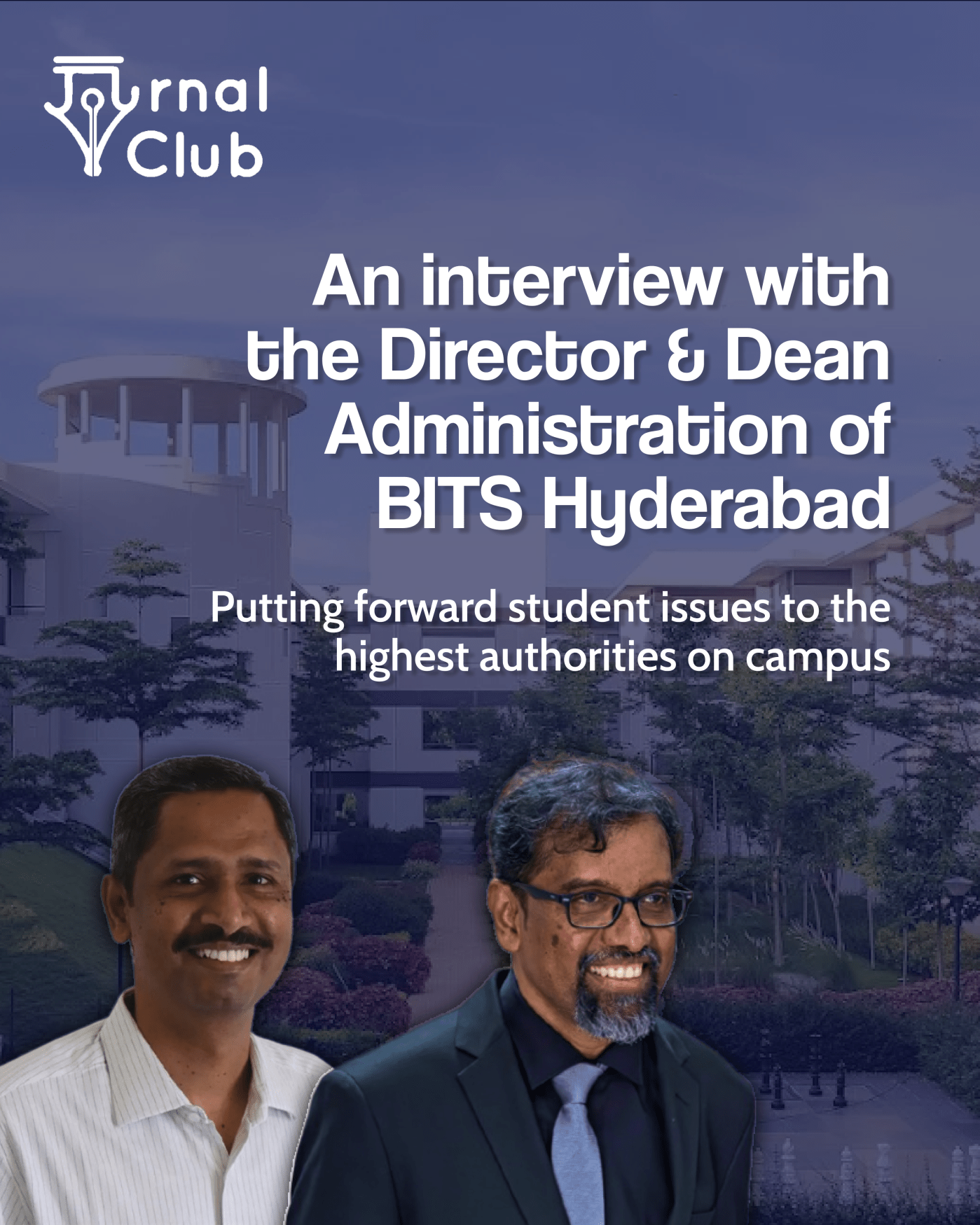
On 22nd January 2026, members from the Journal Club interviewed the new Director-in-Charge of BITS Pilani, Hyderabad Campus, Prof. D Sriram, along with the new Dean of Administration, Prof. A Vasan. The conversation focused on discussing persistent issues faced by students on campus. We talked about the administration’s stand on bringing back Impartus, hygiene issues in messes, academic issues and redressal systems, infrastructural issues in hostels and across the campus, the haphazard implementation of attendance in the past semester and a general lack of strong initiatives by the elected student representatives.
Your official title is Director-in-Charge of the Hyderabad campus. All other directors have the title Director of their respective campuses. Is there a difference between the two? If so, could you please explain?
The current title is a temporary one, as the administration needed time to work through the technicalities amidst the leaving of the previous director and the signing in of the new one. Prof. D Sriram has assumed the position of Director-in-Charge, with all the duties and responsibilities of a Director. There are no differences in the work of the Director-in-Charge from that of a Director, as per the guidelines laid down at the senate meeting. The title shall be changed to Director in the coming months.
One thing that made our campus stand out from the rest (among others) was Impartus. Last semester, we did not have Impartus, which is an essential learning tool. So what is your Impartus policy?
Prof. Vasan shared that in 2013-14, he introduced the Hyderabad campus to Impartus (which is why other campuses don’t have it yet). It wasn’t so easy to implement it even back then. He had to convince the administration that a learning tool would not threaten teachers if students did not attend their lectures for convenience. He explained his ideology for bringing this into force, saying that, as a teacher, one’s responsibility must be to ensure that students are learning. It doesn’t matter how or where they are learning from. There is already ample video material available online from other institutions. Why not give students access to our own institute’s content so they can learn and understand better?
They said that during the previous director’s tenure, the philosophy behind Impartus was inferred in a wrong sense and reduced to attendance. Many members of the administration and professors were not comfortable with it. We asked them whether the previous director’s approach of making Impartus accessible only on the Library premises will be implemented by you even now. They very straightforwardly said that they don’t think of it as a viable solution and will never implement anything in that manner. It will be accessible from all locations, as before.
Instead, they plan to bring back Impartus in the next one or two months during this semester itself, while finding a mechanism for how the administration wants students to access the video lectures. They are also planning to install cameras in the smaller F- and G-block classrooms to improve access for all students.
There was a document titled “Guidelines for Evaluation and Assessment,” dated 31st March, 2025. It has been 9 months since the document was made public. Most of the points in that document are not being followed to date. What is to be done about that?
Like handouts not following rules for surprise evaluations, attendance, and make-ups. Marks being released publicly.
They explained how the Senate rulings dictate all academic measures at the university level. We laid out our points – such as surprise evaluation, attendance, makeup rules etc. not being followed in many handouts, from an article published by Journal Club recently. Profs. Sriram and Vasan expressed their concern at the level of the issue which is prevailing, and asked us for a concrete number of the courses with these issues. In the absence of such data, it was told to us that the data can be collected from the students, and given to the Director in a future meeting.
Another measure which was offered by Prof. Vasan was to tell all students to approach the Course ICs and Associate Dean of AUGSD (Hyderabad Campus) via emails or meetings in order to make them aware of the issues and discrepancies from the rules.
When the issue of delays or going-around-in-circles was brought up by us, based on the general experience in the AUGSD offices, which entails going to the office, then the IC, the HoD, and being stuck in a loop – the answer was that this system is unacceptable. The students should not have to waste their time in such a manner. In case of absurd delays, the students can approach the Director with these issues. He further explained that AUGSD is the body which has to resolve these issues, and mailing or approaching the AD of the same will be the measure the student body has to take primarily.
Sir, measures like self-declaration and the recent strict measures during our examinations don’t bear any fruit other than inconveniencing the majority of the students who write the exams honestly. There have been multiple incidents of students being caught with papers and electronic gadgets, and no action is taken against them. There have also been incidents where people sneak phones into the examination hall without getting caught. Can something be done about the issue?
The answer here was complex, since this is not a simple issue to address. They said they will be stricter with invigilation to address incidents of malpractice. The answer to this was rather ambiguous, as many factors come into play when they take action in such cases.
The recent exit test policy has been implemented haphazardly, providing students no clarity, with biometric machines not working, multiple revisions to handouts, and provisions like minimum percentages required to get marks for exit tests. What are your thoughts on how to go ahead with continuous evaluation inside a classroom?
They clarified that it isn’t the administration at the Hyderabad Campus that is making these decisions. The recent guideline requiring a minimum attendance to avail surprise/exit test marks has been laid down by the senate. The administration doesn’t have any say on whether the policy should remain in place or not. Their initial plan had always been to implement the exit test concept only for the 24 and 25 batch students, not for the 23 batch. An optional mandate requiring attendance for up to 50% has been issued, as deemed necessary by the IC (Instructor-in-Charge) of the course.
We mentioned that, according to the Guidelines for Evaluation and Assessment, the handout for any course can’t include any surprise component that accounts for more than 10% of the course total. Although we don’t yet have a fixed document that says so, the Director also mentioned that the same applies to the attendance requirement: linking minimum attendance to a course beyond 10% of the course total isn’t allowed.
JC brought to their attention that this has been happening repeatedly across multiple courses, and these handouts have been approved by AUGSD, not for one course but for many. When students approached the professors, pointing out a mistake in the handout, they said they relied on AUGSD to approve it and didn’t even realise they had omitted the guideline because it wasn’t pointed out to them by AUGSD. The panel mentioned that this is entirely incorrect, and one can mail the Associate Dean of AUGSD to get it clarified. The exit test component is not going anywhere soon, but they assured that they will work towards a more transparent implementation.
Is a plan to make the grading procedures more transparent in the works or even feasible?
We asked if it is possible to release the histogram and the grade cutoffs for Comprehensive Examinations, as for Mid-Semester Examinations. Prof. Vasan said that it won’t be possible, stating that this is how the system has been for the past 50+ years. It is held in place today for a particular reason, and we must have faith in it.
They mentioned the recent changes to the decision process for assigning grades. Earlier, it was up to the IC’s discretion to decide the grade. However, the process now has an additional step. The IC must present the histogram to the respective department in a meeting for moderation. Only after a discussion and consultation with the members are the final grades submitted to AUGSD.
We brought up the problems that come into play, such as grading errors that can often go unnoticed. To which they said that if a student has the slightest doubt, they must submit it for scrutiny immediately. This provision, whenever opted for by a student, has been thoroughly looked into, and the changes are made in due time. They encouraged students to use this means to rectify any errors made in grading.
Will you be having a Directors’ Open House meeting? If so, when?
They agreed that there is a need to better understand the students’ problems. To look into it, they have been circulating surveys via mail. The response they get to the same is very poor. It might lead the administration to understand that there aren’t many issues. We clarified that the scenario is rather different. The panel encouraged students to fill out the forms, or approach the administration with their concerns. They also said that they’ll be taking rounds of the campus for spot checks on various student facilities like the messes etc.
Prof. Sriram said he has already been planning an Open House Meeting with the students, along with other administrative members. It will certainly happen this semester.
Moving to quality of life on campus, our messes could use improvements in standards and hygiene, in line with government guidelines. Can we have updates on what is being done to improve our food, which we pay for 4 times a day? Pilani and Goa have better dishes and varieties of food in their messes and outlets. What are your thoughts on this issue?
Frequent surprise visits to both messes by the administration team and the Director are being planned. This would involve tasting the food and conducting hygiene checks to ensure the Hygiene Committee is more active. They emphasised the lack of ownership by SMC in handling issues raised by students. They expect the student representatives to handle such issues better by coordinating with the general body. Further, Prof. Vasan mentioned that there is a need to regularly shuffle the vendors, which hasn’t been done. It would ensure that those in charge aren’t neglectful of the measures to be followed.
We proposed adding fruits & eggs/omelettes to the breakfast menu, as they’re already available at the Pilani and Goa campuses. Prof. Sriram said that it would lead to an increase in per-day meal token charges, which may be ideal for many, but for them, the decision needs to be made with the larger body of students in mind. For the menu shuffling under the pretext of menu changes, they said it must be communicated to SMC to trigger a survey, as it is equally their responsibility to look into it.
Sir, could you share the plans and timelines for renovating the old hostels on campus? Plumbing in the washrooms is a big concern. Painting of the interiors is also required. Can something be done about the numerous pests the students are forced to co-exist with?
During monsoons and summer months, Valmiki and Vishwakarma Bhavans (among others at times) famously face the curse of having no power backup in the hostel rooms, unlike other hostels. When can the residents of the 2 largest hostels on campus also have access to lights and fans 24/7?
During summer, the residents of Malaviya Bhawan were asked to shift to other rooms if they wanted to use air coolers, and vice versa, as the electrical wiring and transformer infrastructure are not designed to support individual use of air coolers. Why do we need to pay an additional Rs. 800 for availing basic necessities?
In the older hostels, plumbing work and the replacement of older Indian-style toilets with Western ones are in planning and have already begun at Meera and Shankar Bhawans.
To further ensure that such issues don’t go unaddressed, a portal is being developed where the Superintendent of each hostel can log the issues students face, in accordance with the Hostel Representatives. The complaints can be reviewed immediately by the respective Wardens and the Chief Warden. The goal of this portal is to raise the issues to the Senior Administration to avoid delays in addressing them.
They made special note of the power backup issues at Valmiki and Vishwakarma Bhawan and are looking to fix them as a high priority. They were unaware of the situation at Malaviya Bhawan regarding air coolers. While addressing the lack of infrastructure in all hostels to accommodate air coolers, they said this will also be looked into with urgency as the summer months approach.
They also agreed that charging an extra amount for the use of air coolers during the hot summer months isn’t the best practice, as air coolers are a basic need. However, as the previous year was the first time students were allowed to use air coolers in hostels, it was difficult to manage the installations. This time, they are looking into what can be done to make it convenient.
The medical staff at the MedC sometimes provide improper diagnoses due to a lack of knowledge/equipment. Our friends had to go outside campus to get treatment, and the doctors said that had they come in earlier, the treatment would have been far simpler. Specialist systems (like dermatologists) are not in shape. MPower, a crucial tool to help with mental health, also has numerous issues.
The Medical Centre is only equipped for basic diagnosis. If there are any serious concerns, the nearby hospitals should be consulted. If any discrepancies are noted in the behaviour of staff being negligent of medical protocol during duty, they must be formally reported to the Chief Medical Officer, along with the details. Urgent action will be taken accordingly.
With regards to MPower, we mentioned frequent incidences of violation of confidentiality between a counsellor and the client. How the anonymous confessions on social media have built in a fear of this happening to them, which can hold back many from seeking mental health support.
They were unaware of these incidents happening at large and stated that it was completely wrong. They said that if anyone has faced an issue of this kind, they can directly approach the Director with a hard copy of the incident, without using email. They will ensure that the confidentiality of the complaint is maintained, with the information not even shared with the officer on duty, and that strict action is taken against the staff involved.
Walking is the main mode of transport on campus, since we do not have a permanent bus system running all around campus. Sir, it is difficult to walk without streetlights at night, especially in places where there are none, but the motion-activated lights on the CCTVs still work. We also face the issue of crossing OFG to walk from Mess 1 to Mess 2 (and vice versa) in the absence of a proper, permanent pedestrian path. Can measures be taken to upgrade these facilities under the Project Vistaar?
They have recognised the problem faced while crossing the OFG at night. They have noted it and will immediately look into what can be done to construct the pedestrian path. Concerned about the streetlights, Prof. D Sriram mentioned that there are sufficient streetlights and that electricians have been appointed to conduct timely inspections.
Many mechanical courses are outdated. Students pursuing a degree in chemistry have to take physics courses as a CDC, along with many other department CDCs, which do not contribute much to technical proficiency. The introduction of the new Physical Wellbeing course during hours beyond the usual class hours is affecting student participation in clubs and other activities. Can we have any clarity on the process for revising the curriculum?
The Departmental Committee on Academics (DCA) of each department across all four campuses meets once per semester, after which the course plan for the following semester takes effect. Procedural voting is conducted by the committee to decide which courses to proceed with for a particular specialisation. Profs. Sriram and Vasan mentioned that if any updates in courses are not being made despite some professors agreeing on the need for change, then it is simply the differences within the department due to which they are not converging on a single point to make a decision.
Regarding the Physical Wellbeing Course, we suggested setting a specific time for the activity to give students the freedom to pursue other activities. They said that students enrolled in the course must provide necessary feedback to the IC so it can be looked into.
Additionally, they encourage students to participate in the Student Faculty Committee (SFC), to put forward these issues to their respective departments. The purpose of this committee is to discuss these issues, wherein a resolution can be found. They also asked students to communicate with the Student Senator to understand the discussions happening in the meetings.
Quality of life and student well-being go hand in hand. Students face issues such as multiple examinations in a single day for both midsems and comprehensives. There are situations where 3 exams are in a row, followed by an 8-day break. Can something be done to optimise the scheduling of examinations?
Profs. Sriram and Vasan enlightened us that they had a role to play in the algorithms which schedule our examinations and classes. While checks were made into such systems, after hearing JC, they acknowledged that something must be done to not have CDCs compres and perhaps some other courses as well, on the same day. They directed the student body to email the FIC of the TimeTable Division when the draft timetable is released when such issues are noticed.
In case these issues are not resolved, he said that the student body is empowered to approach the FIC in person, individually or as groups. In the scenario that the changes are not made, or that the reception to these issues is lukewarm, students can approach the Director, so that he can help them resolve the problems in scheduling evaluations.
Will you continue to teach as you did before, alongside your responsibilities as the Director-in-Charge?
Yes, he will teach just the way he did. Prof. Vasan added that the administrative responsibilities in the BITS ecosystem have always been in addition to teaching, and that’s how it will continue to be.
We brought to their attention that students often don’t know who the appropriate person to contact is in case of any issue. Sometimes we’re circling different rooms hoping to solve the issue. There has been a communication gap between the administration and the students. We suggested that it can be resolved by the administration sending us a list of the concerned representatives to approach for any issues every semester.
They applauded Journal Club for reaching out to them to understand where the administration stands on addressing students’ needs, although it isn’t our core responsibility. However, they believe the onus is on the Student Union and Hostel Representatives to raise these issues with the Senior administration team. The Student Union must exercise its duty and responsibility to represent students’ voices beyond merely organising college fests.
Based on Prof. Vasan’s experience of attending fests at Pilani campus back in the days, the technical and cultural performances should be the primary goal of the fest, and the rest is ancillary. They don’t mean to interfere in the workings of the Student Representative Bodies, but expect a better response in communicating the issues in a timely manner to ensure they are looked into. However, on our part, we will do our best to understand the issues faced by students at large and approach the Director again in the future whenever the need arises.
Profs. Sriram and Vasan resonated with us on the deviation in campus culture over the past two years in a way different from what BITS stands for. In a lighthearted joke, Prof. Sriram mentioned that having been part of the BITS ecosystem for 25 years now, he’s no less than a BITSian, with Prof. Vasan adding that he is a true BITSian, also having pursued his PhD from BITS Pilani, Pilani campus. They said that, with them having been part of the BITS ecosystem since decades, they will be making changes from the previous administration. With Prof. A Vasan taking the lead as Dean of Administration and Prof. D Sriram as the Director-in-Charge, they will try to restore the BITS ethos as much as possible in the coming months.
 The Journal Club
Leave a comment