

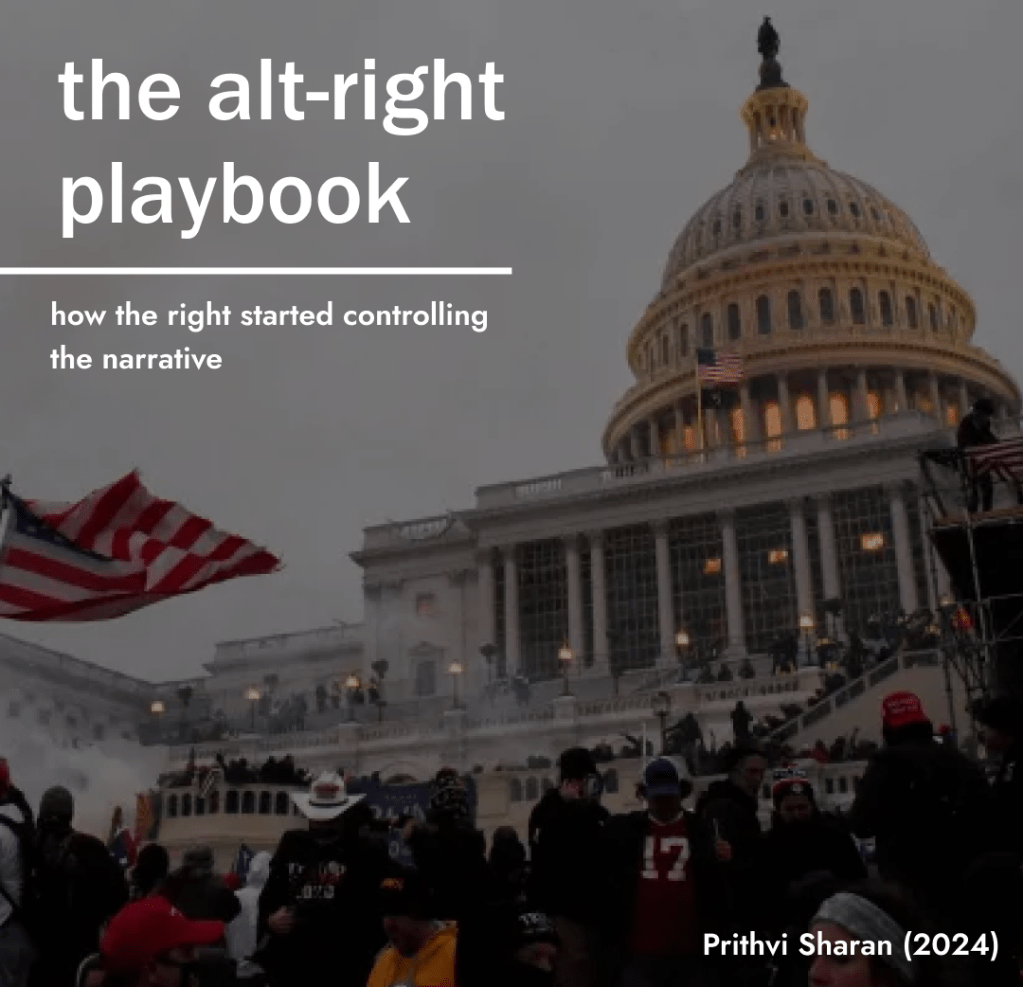
The word alt-right is a euphemism coined by the president of a well-known white supremacist think tank – the National Policy Institute; as a way to paint a happy face on racism. One of the listed goals of the NPI is to remove non-whites from America. The term alt-right was coined so that mainstream white people do not feel like racists when they vote for racists with racist policies.
The alt-right movement, a fringe movement that existed in the periphery of American conservatism, has slowly bled into mainstream American politics. These people genuinely think well-known figures in American Conservatism (like Ronald Reagan and Barry Goldwater) were not “reactionary” enough; for context, Barry Goldwater is said to be the father of American conservatism and his ideas and policies shifted the Republican Party to the right. The alt-right brand themselves as a motley crew of rebels to distinguish themselves from the suit-and-tie, cigar-smoking, golf-playing conservatives of the 80s. The alt-right movement has, over the course of years, congealed into a singular identity and the movement’s success had directly impacted the 2016 elections.
Let’s go through the history of the alt-right movement to understand its ideas and its way of thinking. Richard B. Spencer, the head of the National Policy Institute (the dude who famously got punched in the face during an interview), coined the term alt-right in 2008. The term began to gain traction on the internet around 2014, and white nationalists began using the term to soften their image and draw in recruits from conservatism. The term was very popular and was used as a banner for white identity politics, especially on online forums like 4chan and Reddit. The members of the /pol/ (political board of 4chan) flocked to the term. The term exploded in popularity due to the GamerGate controversy in 2014 and 2015, when there was a huge reaction against the rising feminism in video games. GamerGate began when Depression Quest (a text-based RPG) received a positive article by the developer’s ex-boyfriend, the idea being that it only received positive feedback because of their previous relationship. GamerGate began as a result of reactionism against the growing progressivism and liberalism in video games; the whole smear campaign was marked by malicious ignorance and a sense of intense toxicity. This movement was the watershed moment for the alt-right. Before GamerGate, the alt-right movement was more fractured and more of a set of ideas rather than one cohesive movement. GamerGate gave the movement a rallying cry; so many different platforms, news outlets and far-right content farms emerged as a result of this movement. The “cringe culture” of 2016 fed into this movement and fueled the movement even further. Just when things felt they couldn’t get any worse, Donald J. Trump announced his run for the presidency.
Donald J. Trump announced his presidential run in June 2015. Although Trump himself was not aware of the alt-right movement, the alt-right community was very attracted to Trump; they were enamoured by his stance on immigration and the Wall. Hillary Clinton publicly condemned the alt-right news website Breitbart and called the members of the alt-right movement “a basket of deplorables”. This led to the members of the alt-right adopting the moniker of the Deplorables.
This led even more traffic to the site, and even more members flocked towards the alt-right movement.
After the election, the movement surprisingly stalled. After 2017, the moderation systems became more effective in containing hate speech; the movement didn’t completely stop, but it still slowed down significantly. Then we got Turning Point USA (started by Charlie Kirk) in 2019, which brought the culture war to college campuses. This was a sort of renaissance for the alt-right movement, the movement which more or less died by 2018 was resurrected during the time of the pandemic. New methods of engagement like podcasts and short-form content were used to drive the paranoid masses towards conspiracy theories and snake oil salesmen. This second wave of the alt-right movement is what drove the 2024 US election.
So what is their modus operandi? Control of narrative. For the left, the point of a debate is to arrive at a solution; it’s a means to come to a conclusion that is mutually beneficial to all the parties involved. Now, I’m sure you’ve seen clips of Charlie Kirk debating college students, that isn’t debate, that is an argument which has a winner and a loser, the goal of that faux-debate was never to arrive at the truth. This is partly due to the way the US debates are structured. The point of those debates is not to find solutions to problems, it is to project strength and certainty to your followers; it’s political suicide to concede on a point. The way the alt-right operates is by moving the goalpost. For example, late in his campaign, Trump’s primary goal was making the general public think that over a dozen sexual assault allegations against him were false but, to his dismay, audio tapes of him bragging about groping women have been made public.
How do they control the conversation now? First his alt right supporters say that he doesn’t speak that way anymore, which is provably false, next they say that his opponent’s husband (Bill Clinton) has done the same thing, which is just ad hominem and doesn’t falsify the allegations against him whatsoever, then they say coarse language has no actual effect on women, which is just off topic and do not disprove the allegations. These arguments have no actual position whatsoever, and you (a logical, rational person) assume that these arguments won’t endure. But they have. This is because every one of those bad arguments is a subtle way to change the subject i.e. moving the goalpost; it’s a common phenomenon in debates, but the way they move the goalposts is more sophisticated.
Look at the two sides of the debate, on one side you have the position that Trump admitted to groping people while on the other side you have the argument that it was just locker room talk, i.e. he was just boasting. They never make the argument that he was just boasting, they instead assume that their first argument is already correct and has been accepted by everyone, and move on to the next argument, i.e. it was just locker room talk AND he doesn’t talk that way anymore or his opponent’s husband actually does those things or coarse language has no negative effect on women.
People like Charlie Kirk, Nick Fuentes, and Ben Shapiro constantly and consistently move their goalposts to control the conversation; they are constantly posturing themselves so they project strength and certainty, especially when they have no actual position.
Ben Shapiro, for example, is notorious for “owning the libs” by using “facts and logic”, he uses blanket statements like “10% of the population (black people) commits 80% of the crime”. On the surface, this seems like a solid argument, but it’s not. It doesn’t consider the bias between crime reporting and criminality (police tend to patrol poorer areas more than richer areas so crimes in the poorer areas get reported more), it doesn’t consider the aspect of overpolicing (police enforce laws more strictly on minorities than on the whites; they overpolice the blacks and underpolice the whites) and the socioeconomic context (crime is associated more strongly with poverty than with race, and blacks on average are poorer). Ben Shapiro is notorious for making logical fallacies throughout his arguments, he loves making the strawman fallacy (where you misrepresent the opponents argument to make it easier to attack), the appeal to authority fallacy (authority said so, so it must be correct), and the tu quoque fallacy (liberals complain about capitalism from their iPhones so they are wrong. No, it just means they are hypocrites, but the problems with capitalism still stand unaddressed).
Charlie Kirk’s assassination provoked a massive online response, and the alt-right’s response was extremely overdramatized, with the flags being lowered in response to his death. When the left questions this response, it’s always “Oh, how can you justify someone getting killed for their political opinion?” when the actual debate is about whether this massive response was justified or not. Charlie Kirk’s ideas and his neo-nazi ideology was completely erased to make him look like a martyr for a cause.
The alt-right always, always moves the goalpost. So how do you engage with the alt-right? The answer is you don’t. The alt-right use various tactics to provoke engagements online, they use vitriolic language, they race-bait, and they use coarse ethnic humour. This is all designed to make you engage with them. Every provocation provides them with greater engagement and they’re able to reach a wider audience, this is extremely apparent on twitter, where #WhiteGenocide might carry you to the front page. The alt-right movement thrives on engagement and baits. Never take the bait.


Leave a Reply