
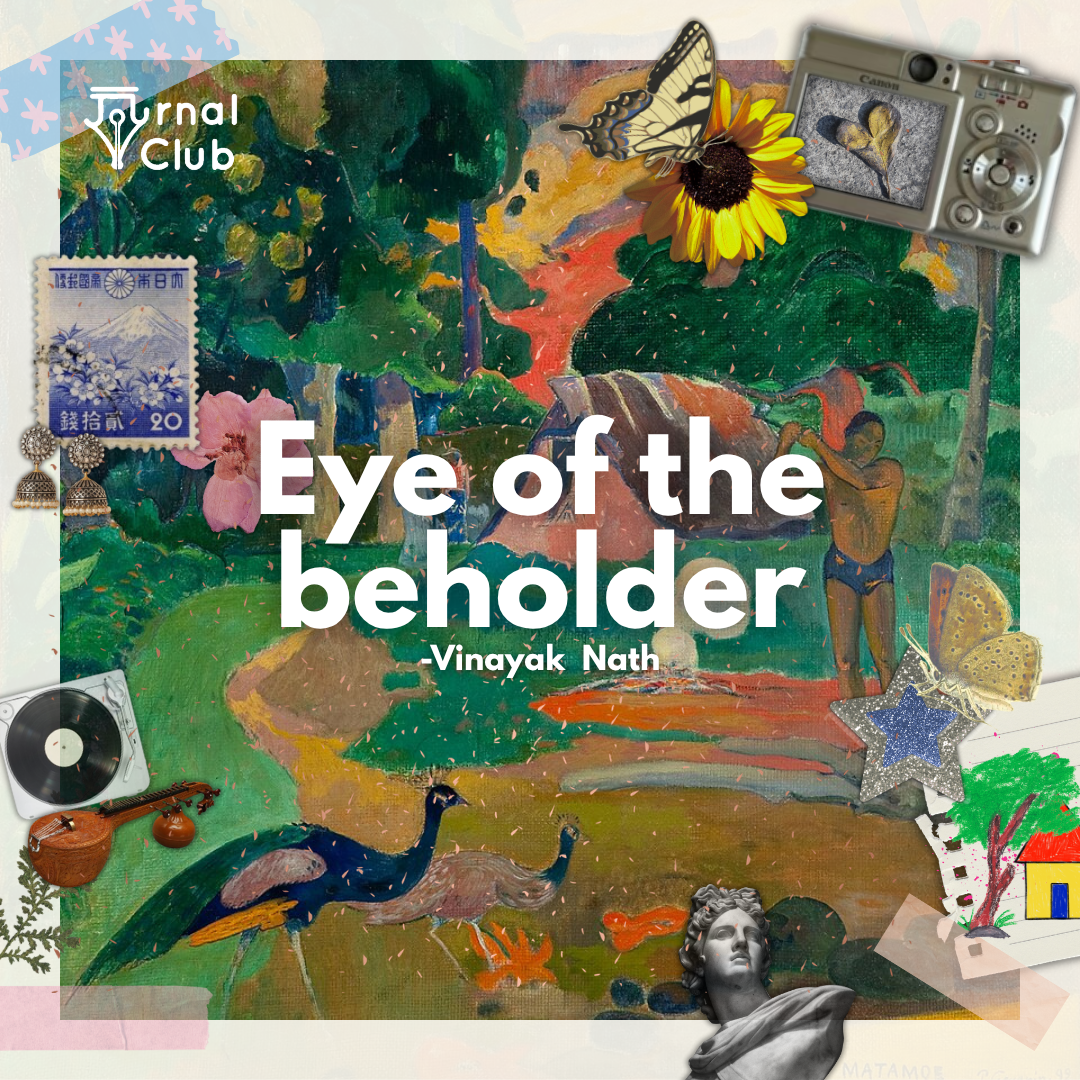
The very famous, often misunderstood aphorism comes from the 1878 book “Molly Bawn” by Margaret Wolfe Hungerford. I ask you this: Is beauty truly subjective? Different people seem to have different ideas of beauty; some define it in absolutes, while others do not. There are traditionally two highly debated ways in which beauty can be described.
The earliest philosophical account of beauty treats it not as a matter of taste or perception, but as something that exists independently of the observer, governed by objective and universal principles. Let us not attempt to wrap our heads around this view unaided, but let Plato himself lend us a hand. Surprisingly, the single most influential philosopher in history held the belief that beauty is entirely objective and independent of our senses.
Plato’s thinking was influenced by Socrates, who, in classic Greek fashion, expressed what beauty is not. Socrates himself never wrote anything; everything we know about him comes from the writings of Plato, in which Socrates, as written by Plato, concedes that beauty is hard to define.
Socrates conveys that beauty is not relative. A single sunflower is not beautiful merely because a wilted one makes it appear so, nor is a field of sunflowers beautiful only by contrast with a barren plain. If beauty exists at all, it must be beautiful in itself.
It is not a ‘pleasure to the senses’, nor is it ‘mere appearance’, and here is where Plato diverges from Socrates. Where Socrates halts with limiting his definition to what beauty is not, Plato presses forward with defining beauty.
Plato writes in the Symposium:
“Beholding beauty with the eye of the mind, he will be enabled to bring forth, not images of beauty, but realities (for he has hold not of an image but of a reality), and bringing forth and nourishing true virtue to become the friend of God and be immortal.”
Plainly, the eye of the mind here refers to intellect as opposed to senses, and Plato directly compares beauty to reality and not perception.
Attempting to extract the essence of his brilliant point of view, after referring to many of his works, I can say Plato believed in two worlds, an objective world and a metaphysical one. For example, crudely, an object is red because it is imitating a metaphysical concept of ‘red’, which objectively exists whether that red object exists to embody it or not.
Similarly, beauty is derived from the objective concept of beauty, which will exist and will be imitated in nature regardless of whether an individual is present to observe it or not.
The more traditional way of viewing beauty is through a subjective lens. In contrast to the Platonic-Socratic notion, a subjective view implies that beauty entirely depends on an individual’s perception. To understand this view of beauty, we again refer to Plato’s Theaetetus, who here is critiquing Protagoras’ words— “Man is the measure of all things, of the things that are, that they are, and of the things that are not, that they are not.”
This principle is one of the first instances where ‘man,’ and by extension, his perception, is given priority over any objective truth and forms the first instance recorded discussing the subjective nature of reality.
So, what is this deeper subjective beauty? Unravelling it, we discover that beauty lies not in fixed definitions or conventions, but in perception itself. To see subjectively is to realise that beauty can appear in everything and everyone, depending on how we behold it.
By the time the early modern period dawned, several authors had given their views on the subjective nature of beauty. All of which follow the same general philosophy.
This personal interpretation of beauty gives the individual the freedom to express and to view the world through countless lenses. This freedom, and breaking free from the societal norms, is a huge factor for the Impressionism movement, where artists sought to capture their own fleeting perceptions of light, colour, and life.
Tying this concept to modern media, we see in many works today how different authors and artists view beauty. Let us examine how Katherine Mansfield, in her short story, ‘The Garden Party’, views death (or, how the protagonist views it).
The lines – “He was wonderful, beautiful. While they were laughing and while the band was playing, this marvel had come to the lane.”- are said about a dead man lying peacefully on his bed. Now I propose a question to you: Do you think the same metaphysical beauty mentioned by Plato is being assumed by the body here? The mere fact that this question arises seems to, at first, contradict the objective truth of beauty.
To truly answer this question, we must discuss the concept of intersubjective beauty.
Immanuel Kant’s Critique of Judgment marks the first instance where beauty is described as a combination of both the subjective and the objective. He argued that beauty is indeed subjective, experienced individually, yet shared universally, making it feel objective without being rooted in any object itself.
What this entails is that there exists a common standard, which we often mistake for objective beauty, but which in truth arises from our upbringing, our shared faculties, and the subconscious influence of the world around us. Even primal concerns, such as our innate sensitivity to symmetry and patterns, which once aided survival, contribute to this collective sense of the beautiful.
This, to me, is the definitive way beauty can be explained to someone who has not thought deeply about it, and Kant wonderfully gives individuals the freedom to seek beauty as they choose.
A question to be posed after understanding all of these perspectives is, can beauty truly only be in ‘the eye of the beholder’?
While the fact that society has a subconscious influence on one’s perception of beauty is indisputable, to truly deem beauty subjective, one needs a human being free from said societal influence – one with a developed mind, but lacking any context of the universe – only such a mind could tell us whether a sunset and a table are equally beautiful, or whether neither is at all.
Such a human is impossible to find; perhaps Frankenstein’s monster could have given us some insights were he real.
As we stand today, to simply label something as beautiful or ugly is, in truth, a naïve way of engaging with the world. True engagement requires keeping the soul in mind and recognising that the very fact that we discuss such questions in itself proves that beauty cannot be reduced to mere objectivity, even if the subjective nature is impossible to confirm.
As J. Krishnamurti put it: “When you teach a child that a bird is named ‘bird,’ the child will never see the bird again.” At first, the quote appears counterintuitive. But its meaning is simple: the moment we impose objective labels on things; we stop truly seeing them. Naming replaces direct perception, and what was once ‘alive’ is reduced to a mental category. In classifying the world, we distance ourselves from it, and in doing so, quietly strip it of its beauty.
I feel both Plato and Katherine are correct in their own way, and so are we all. Perhaps beauty resists a final definition because it is both universal and fleeting; an experience rather than a quantity.
And that, in itself, might be its greatest beauty.


Leave a Reply