
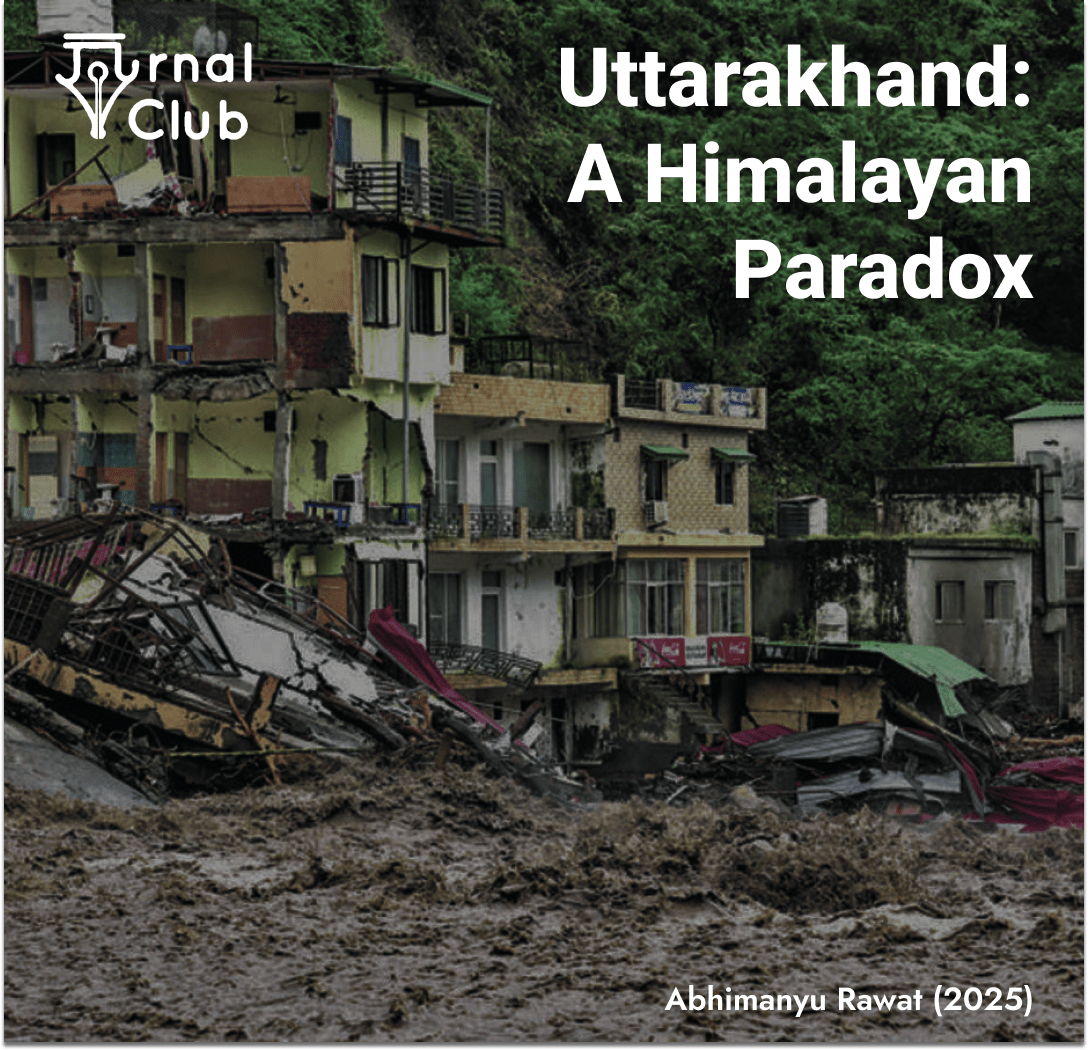
The hills of Uttarakhand are screaming in pain as they reflect on the anguish the Himalayas have been facing as a whole. And the screams only get louder with every unauthorised hotel, unplanned road, and unperceptive policy. Uttarakhand in itself has become a paradox of realities. On one end, there lies the omnipresent need of taking forward the economy. The other end tells a story of capitalism and natural destruction.
2025 was supposed to be the Silver Jubilee year of the formation of Uttarakhand. While the government was busy with preparations, nature decided to join in. And when nature burst firecrackers for jubilee celebrations, forests flared up in Chamoli district, the Bhagirathi river rose to devour the hills and mortals ran for their lives.
NATURAL CALAMITIES
The tourism industry is crucial to the state’s development. Contributing a massive 14.5% to the state’s GDP and employing lakhs of people directly and indirectly, it is often cited as the central factor behind the state’s growth. Yet, this very industry might be bringing upon the state potentially existential threats.
There has been a massive rise in the number of homestays and hotels coming up, even in high-risk zones. Mussoorie, one of the country’s most popular tourist destinations, saw its houses and roads develop cracks in 2025. Indian Express’ teams approached the municipality chief and the MLA, who only said a survey was being done. A survey by IIT Roorkee has been in the works since 2024, but the question persists: will it do any good after most of the city, located in an “ecologically sensitive zone”, has already been encroached upon? The NGT (National Green Tribunal) said that the city was “being pushed beyond limits for a very long time”.
Joshimath, which carries significance as the seat of Shankaracharya, saw a similar situation in 2022, followed by flashfloods, houses and buildings falling, and hundreds forced to depart. Such happenings make one question the thin line between promoting tourism and saving the very hills due to which it exists.
The Chaar Dham Yatra saw over 5 million pilgrims last year. Beyond the religious factor, it is the biggest tourist puller. A 932 km-long all-weather road plan for the route has been almost completed. A Supreme Court committee proposed a 5.5 metre road, but the state government pushed for a 10 metre wide road and eventually got it passed. Going along the “all-weather” roads, you are often at risk of boulders falling or landslides occurring. With more people moving in every year, wider roads are urgently needed, but who is to blame for the disastrous aftermath they bring upon?
The biggest fallacy in the government’s “ecotourism” projects and ideas is that hardly any conclusive survey or data has been prepared post major tragedies like the catastrophic Kedarnath disaster (2013), among others. Most of Uttarakhand falls under Zone 4 and Zone 5, making it heavily prone to earthquakes, accompanied by high landslide and cloudburst risks.
The lack of guidelines and checks on haphazard construction in the hills is alarming. The infamous video from Dharali (Uttarakashi) went viral in August 2025, which saw people running against a flash flood for their lives. The tragedy exposed even the locals’ nonchalance toward nature. Homestays, restaurants, houses, and other structures had been built very close to the Bhagirathi river, which responded by turning them all into debris.
CHANGING WEATHER PATTERNS
With the “all eyes on AQI” trend from Delhi, Dehradun residents’ eyes finally went to the spiking AQI levels in the city in winter 2025. While smoke and traffic clogged the winter capital, the summer capital, Gairsain (bet you didn’t know of it), missed the snow. For the first time, the Kedarnath temple was without snow for the whole of December. Winter rainfall is essential for snowfall in the Himalayas. All 13 districts recorded zero rainfall and zero snow in December 2025. The declining levels of snow and changing heat patterns are alarming.
The Gangotri glacier (home to the Ganga) has been receding by 12 meters per year for a long time. Melting of glaciers, as everyone knows, is directly proportional to future water scarcity and threatens sea levels. Meanwhile, the residents of Dehradun did not miss the winter rain because they had seen more than enough during the monsoon. The city saw a 74-year record break after recording 175 mm of rain in a single day. Multiple bridges broke, leaving over 2000 tourists stranded in Mussoorie. The incident raised questions when the singular identity of the work that seemed to be done (roads) crashed under heavy rain.
IDENTITY AND INDUSTRY
Culture and identity are central to Uttarakhand’s creation and principles. The pivotal reason behind the separation of the state from Uttar Pradesh was the lack of representation in the assembly and the preservation of hill culture. With the heavy influx of people from neighbouring states, this identity is at stake.
After statewide protests in 2023, land laws were brought into enforcement, as per which outsiders can now purchase no more than 250 sq. ft. of agricultural land in all but Haridwar and Udhamsinghnagar districts, where a concession has been given. The districts do not subscribe to Pahari (hill) culture as such and were included for the sake of promoting industrialisation. The districts contain most of the state’s industries.
With the central government planning to bring in delimitation (rearrangement of assembly and parliamentary boundaries), fear lingers that with the inclusion of industry people and an influx of outsiders, the two districts, along with Dehradun, would overpower the ten hill districts in the assembly. These districts already occupy 30 of the 70 seats. Now it has become a two-edged sword for the government to handle this.
THE PARADOX AND THE NON-PARADOX
As Uttarakhand straddles economic ambition and environmental preservation, some realities remain obvious: There’s no grey, just black and white. Like the philosopher’s observation that one must own their actions, the state faces the consequences — both positive and negative — of its choices. While ‘Devbhoomi’ has made significant progress since its formation, ongoing corruption and political apathy continue to hinder solutions to the economic versus environmental paradox. BJP will seemingly continue to play the Modi/Yogi card till the end of Kaliyug. INC will start caring only when the state is gone, and now they have just 27 states to lose. The lone regional party, UKD’s affiliation, you need to guess from a sample space of five (BJP, INC, themselves, independent… or, by the time this article is published, they would have formed a new faction out of themselves). Until action matches rhetoric, the core conflict will persist.
Another black mark is the rising rate of crime. The recent killing of a Tripura student in Dehradun made national headlines. The adoption of a supposedly “Chad” culture and wannabe efforts to be “cool” like UP and Delhi peeps among the youth are blemishing.
Among the list of black marks, coal-charred is the uncanny record the state made for most ghost villages in the country. Ghost villages are villages with zero live population. More than a thousand villages stand completely empty owing to a lack of basic healthcare, schools and local migration to plains. Vinod Kapri’s film, Pyre saw the story of an old couple who were the final residents of their village. Every evening they would lie down on their own pyre so it is easier to burn for a passerby in case they don’t wake up the next day. Perhaps, the two of them are actually sitting somewhere in the silent corner of a village, burning their lungs on a hearth, waiting for their children, who are at their Delhi home, waiting for their kid who would never know of the language and short-heighted fair men and women who once ruled the hills.


Leave a comment