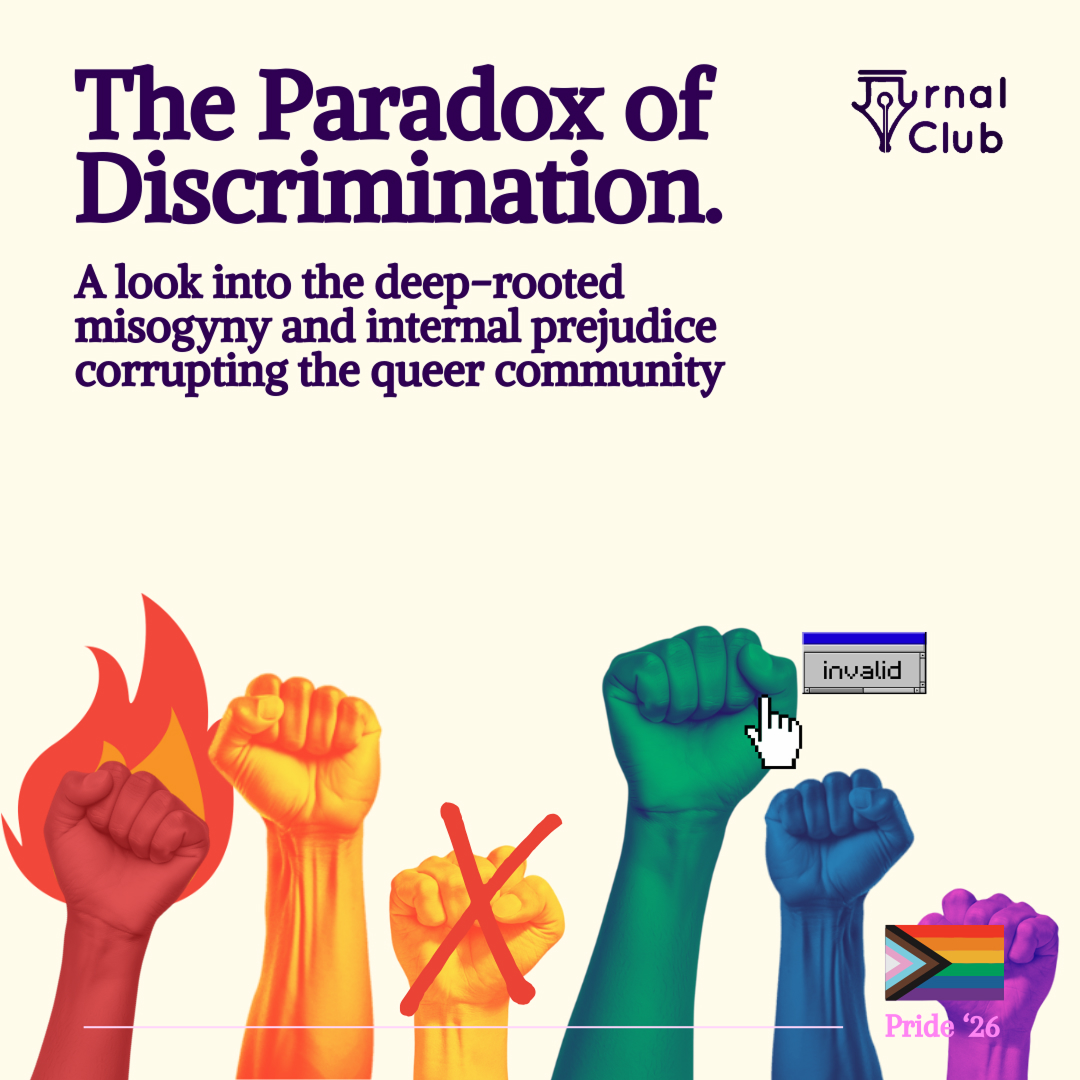
Modern queer culture has come a long way in reshaping how the general public now views the LGBTQ+ community. The people that were once considered ‘queer’ are slowly being accepted in many countries across the world. Along with acceptance, queer culture has become a cornerstone in shaping internet culture by directly influencing the sense of humour of individuals and even political opinions. However, quite ironically, the past few decades have seen a rise in an interesting phenomenon, wherein the community that was built upon accepting people that were considered ‘different’ has begun to harbor discourse within itself— discourse centered upon arguing about who is considered a part of the community and who is not.
Biphobia and panphobia can be considered some of the most common examples of exclusion within the queer community. Recently, discourse has emerged upon social media sites where many lesbian women, primarily those that identify as TERFs (Trans Exclusionary Radical Feminists), systematically exclude bisexual women from sapphic spaces, claiming they are ‘tainted’ by their attraction or perceived sexual histories with men. This can also be linked to a phenomenon online where some lesbians claim that the only reason that they do not want to date a bisexual woman is because they might leave them for a man. This, essentially, calls back to a judgement of a woman based upon their past sexual or romantic history with men, which is one of the main features of misogyny. This argument can also be considered a debate between monosexuals and multisexuals. Multi-gender attraction has thus become a hot topic within the queer community, less because people are prioritising shared experiences in the relationships they pursue and more because there is judgement rooted in misogyny that is now being used to punish multisexual women.
The validation of one’s sexuality based on their past sexual history does not spare even lesbians or gay people. “Gold star” is a slang term used for a queer individual that has never had any sexual relations with someone of the opposite sex. Although it is occasionally lightheartedly used as a word for someone who discovered their sexuality at a young age, it also causes disparities within people by determining how valid their sexuality is just by their past.
Bisexuality is a spectrum that only a bisexual person can determine, yet constant debate regarding the validity of their sexuality persists. There is a very common assumption that floats around that bisexual men are gay and bisexual women are straight. People’s bisexuality also seems to depend on the gender ratio of the people they’ve dated. Billie Eilish, a celebrity who has expressed attraction to both men and women, has been heavily criticized for dating too many men, and her sexuality has been questioned since she has not been publicly romantically linked with many women. Placing the bisexuality of people on a scale and judging them based on superficial assumptions directly harms the self-image of someone who’s trying to stay true to themselves.
Even within multisexuality, there lies primarily conflict between the bisexual and pansexual identities. Although they do share similar features, the fundamental method of attraction between them is different. Often, when one comes out as pansexual, some queer people prefer to call them bisexual in opposition to using a ‘more complicated’ term. Some pansexual people have even resorted to calling themselves bisexual to avoid confusion. This erasure of a very popular label is something that greatly affects the public perception of pansexuals. This applies to all multisexual identities, not just pansexual people. “Battleaxe bisexual” is an uncommonly-used term for bisexuals that do not believe in the existence of the multiple identities within the multisexual community— instead choosing to assert that all of these labels are essentially bisexual, and that other multisexual identities only developed as a result of biphobia.
Another problem that persists within the queer community is misogyny. It comes in many shapes and forms. Assuming that gay men are immune to being misogynists just because of their sexuality is a misconception. Misogyny in gay men is a concept that is often overlooked due to their existing struggles in regular society. Constantly entering female spaces and belittling, criticizing, and insulting women is sexism veiled as sass. Gay men who present themselves as dominant tend to show misogynistic attitudes towards men who present themselves as submissive. Despite being LGBTQ+, men can still be raised with patriarchal values, which makes them lack the social understanding to unlearn their ingrained misogynistic values.
Misogyny is surprisingly present in more of the LGBTQ+ community, and this specific form discriminates against trans-feminine and feminine-presenting intersex individuals. Constant exclusion of these individuals from woman-only spaces because of them not being fundamentally similar to a biological woman is a persisting problem. Even in the dating pool, people who claim to not be transphobic express their aversion to dating trans people as opposed to cis people due to mere ‘preference’. This transcends the border of misogyny and is directly skirting the lines of transphobia. Being discriminatory of each other despite existing under the same umbrella is directly contradictory to the reason the umbrella was created in the first place.
There is ongoing conflict within the community on whether or not asexuality and aromanticism should be considered as valid sexualities. People argue that they can still be fundamentally ‘straight’, which should warrant their exclusion from the community. We have to understand that the LGBTQ+ community was created as a safe haven for individuals who were considered ‘abnormal’ in heteronormative societies. This also includes people who do not express their love ‘correctly’, such as a lack of sexual or romantic attraction. Trying to exclude individuals who already have been shunned by regular society is directly invalidating their self-expression and identity, which is absolutely unfair to them.
Every person in the LGBTQ+ community is unique to themselves. Being called sexualities that they aren’t and forcing them into labels that they didn’t choose is incredibly dehumanizing, and yet it is still a common practice within this community, the place they are supposed to find solace in. Arguing over a person’s sexuality is extremely pointless yet harmful, since it can destroy their personal image and what they stand for. The concept of one’s sexuality is one of the most complicated spectrums that is being studied to this day, and the least we can do to protect a person’s peace and our own peace is to accept them for who they are.


Leave a Reply