
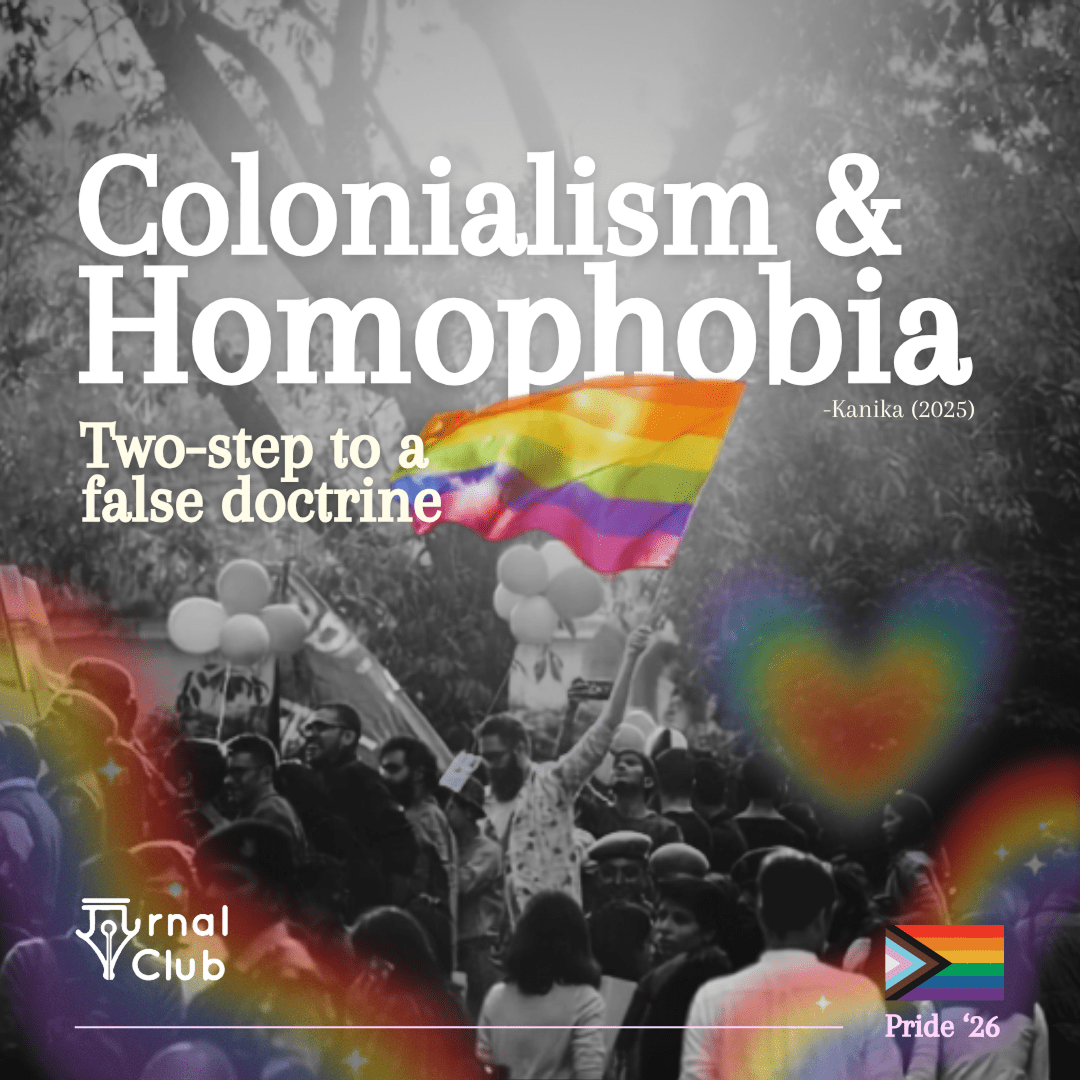
We start in the year 1942. The Second World War is to blame for wartime mobilizations across the country, coupled with mass political unrest and internal tension bubbling over from almost two centuries of colonial rule. The colonial Gothic architecture appears uncomfortably flagrant in the Indian landscape. The air is thick with the anticipation of being on the brink of a monumental point in Indian history. This is when Ismat Chughtai published Lihaaf (The Quilt). Queerness will not be forgotten, let alone ostracized. Lihaaf is a searing short story based on the queer experiences of aristocratic women she witnessed as a child. Being a pioneer of the feminist narrative, Chughtai offered a critical perspective on female sexuality. The story is presented as an innocent chronicle by a young girl staying at her aunt, Begum Jaan’s, home. It tackles the clandestine nature of the Begum’s sapphic relationship with her maidservant & confidante, Rabbu, and their suspected shared intimacy under the titular quilt. Chughtai also suggests the homosexuality of the Begum’s husband, referred to in the story as Nawab Sahab. So I’d count on you not to be surprised when I tell you that the British Raj took offence to the publication of her work.
And thus began the 4-year-long obscenity trial. She was tried under Section 292 of the ‘Indian Penal Code’. An odd name for a criminal code drafted by five white men in a country of 200 million desis. We couldn’t talk about the obscenity trials without talking about Saadat Hasan Manto. In many ways, he was Chughtai’s contemporary. His work is a mosaic of brutally candid writings regarding sexual desire, classism, and the savagery of the Partition. Chughtai and Manto were both members of the Progressive Writers Association, an anti-imperialist literary movement. Manto was a veteran of obscenity charges, having been called to court a total of six times. In this instance, Chughtai and Manto went to court together to defend their works. They got the charges dropped by shifting the narrative from the cultural interpretations of phrases to the absence of such overtly “obscene” phrases. Though the charges were dropped, this experience only emphasised how writers had to run the gauntlet simply to publish and distribute queer stories. We will soon return to the importance of literature for tracing the history of queerness.
This was one of the innumerable instances where the colonial government silenced queer experiences through censorship. State-sanctioned persecution, social erasure, and perpetuation of British patriarchal ideas furthered the alienation and antagonization of the existing queer populace of India. Now, it is with absolute displeasure that I introduce you to the Criminal Tribes Act and Section 377.
The Criminal Tribes Act of 1871 criminalized entire communities (“tribes”). Originally, the act was only imposed on nomadic tribes since it was difficult to surveil and collect revenue from them due to their transient nature [insert white man in a suit with £’s in his eyes]. The colonial government then slowly expanded the definition to include pastoral and artisan castes, wandering ascetics, and the entire third gender populace. Where criminality was considered to be socially determined, it had now become a biologically determined fact; babies were born already labelled unlawful, and crime was ethnicized. This segregation, along with the prolonged imposition of the caste system, allowed the British colonial government to leave India as divided as possible by the time 1947 rolled around. This draconian law has resounding effects on the transgender, non-binary, and hijra communities to this day.
Section 377 was introduced in India in 1860. Where the Criminal Tribes Act persecuted gender non-conformity, Section 377 attempted to curb any form of homosexuality. It stated, “Whoever voluntarily has carnal intercourse against the order of nature with any man, woman or animal, shall be punished with 1 [imprisonment for life], or with imprisonment of either description for a term which may extend to ten years, and shall also be liable to fine.” Section 377 was a derivative of Britain’s Buggery Act from the 1530’s. The Buggery Act referred to the misdeed of partaking in any sexual activity not related to procreation, i.e., sodomy. I might consider capitalising the next couple of sentences to emphasise how spectacularly absurd they are going to be. The Buggery Act never made a mention of lesbian sexual relations, not because female autonomy was all the rage in the 1530’s, but because the male legislators couldn’t fathom the idea of women not being attracted to men. I’m inclined to call this one of the saddest “wins” for the sapphics. This act was not explicitly introduced as a means to police homosexual activity, but rather as a probationary civil law during the devolution of ecclesiastical courts. Several Catholic canon laws were borrowed and reconstructed as civil laws during the transfer of power from the church during the reign of Henry VIII. Consequently, with the mention of the Catholic Church, it seems we have ventured into the muddy waters of sinning and religion.
We cannot escape the fact that the writings of several religions explicitly state the “immorality” of homosexuality. It is also an irrefutable fact that these writings were translated, retranslated, edited, and passed on through generations, having suffered the repercussions of the contemporary landscape. We can never be sure about what the writings were precisely meant to convey after centuries of modification. What we can be sure about is that after everything, religion only came about as a means for people to better themselves, to grow, to learn acceptance, to eradicate intolerance, and to ultimately support humanity. And yet, the unfortunate fact of the matter is that we have transmogrified religion into an instrument used to amplify personal agendas and rebrand bigotry under the guise of “traditional values.” So colonial governments weaponized Christianity and considered any other religions as “heathen.” This patriarchal interpretation (shocker) of Christianity aided in the mass spread of homophobia.
But homosexuality and transsexuality predate modern fanaticism and undoubtedly predate colonialism. Literature is a handy sextant when trying to navigate the history of queerness. Written poetry, oral tradition of storytelling, and various other texts serve as our guides. One of the first records of a possible queer relationship dates back to 2400 BCE, Egypt. Khnumhotep and Niankhkhnum’s tomb depicts them embracing nose-to-nose, a pose almost exclusively reserved for a wife and husband. The Epic of Gilgamesh from 2100 BCE mentions the fierce bond that Gilgamesh and Enkidu shared. It suggests the more than platonic nature of the two men’s relationship. It is said that Enkidu was created by the gods to rival Gilgamesh, but they became fast friends after an intense wrestling match, with Gilgamesh even rejecting the romantic advances of the goddess Ishtar. I’ll have you know, the smirk on my face right now is very evident; this is the ancient Heated Rivalry, and I’m hooked…? [insert teary-eyed emoji] 600 BCE saw the birth of Sappho’s exquisite body of work. Widely known as one of the first self-identified queer women, Sappho of Lesbos is known for her lyrical, profoundly romantic poetry addressed to women. She is monikered “The Poetess,” like Homer (doomed yaoi chronicler) is “The Poet.” In India, the Kama Sutra, published in 300 CE, openly references and details homosexual sex. Notably, it introduces lesbian sex and gay sex with equal sincerity. With queer women usually being swept under the rug by deep-rooted patriarchy, this was a welcome acknowledgement. We move closer to today as we talk about the Mughal empire between the 15th and 18th centuries.
Sufi poetry served as a vital bridge between Islamic mysticism and local Indian philosophies during this time. Homoerotic and gender-fluid tropes were some of the hallmarks of the Sufi tradition from this time. The two main types of Mughal queer poetry are Ghazals and Rekhti. Ghazals refer to the relationship between the male speaker and the male beloved. The line between divine longing and carnal desire blurs, and yet, it’s not considered sinful or wrong. Rekhti poetry is written by male writers employing female voices to talk about female relationships, desire, and sensuality. Rekhti could involve both heterosexual and sapphic experiences. The Mughal queer ethnology also extended to its courts and politics.
Eunuchs (Khwaja Saras) were integral to the Mughal bureaucracy. They were considered loyal servants since they had no family ties and could not have heirs. They regularly occupied influential positions in political and strategic spheres and were held in high regard by royalty. But the system that created them was deeply cruel. Young boys would be trapped in the borderlands and subjected to non-consensual surgical castration. The high mortality rate implied that only a few survived, while others suffered fatal infection and haemorrhage. They would then enter the slave trade, where they were frequently bought by the Mughal elite. The gruesome origins of this system bring to light the brutalisation and pain behind these intrinsic members of the Mughal aristocracy.
The Criminal Tribes Act and Section 377 criminalised and estranged members of the gender non-conforming and non-heteronormative community in India. There is a term that comes up quite often in discussions of gender non-conformity and gender fluidity: the “third gender.” In the current Western landscape, the term tends to garner a net negative reaction as it has been used to alienate people who don’t fall neatly into place within the binary. I acknowledge the damage the term can do as I explain the historical significance of the “third gender” in the Indian subcontext. Members of the third-gender community identify as neither female nor male. In 2014, the Supreme Court defined the third gender to include eunuchs, intersex, non-binary, and transgender individuals, allowing for self-identification as female, male, or the third gender, until now. A massive step backwards always helps the cause. Thank you so much, government, you’re doing a great job.
The third gender is a familiar concept in various other precolonial societies. Indigenous North American communities recognized “Two-Spirit” individuals, who were believed to embody both female and male spirits. The indigenous Sakalava people of Madagascar recognize the gender sekrata. Sekrata are raised as girls after exhibiting feminine characteristics in their childhood, and they adopt a feminine appearance in adolescence and adulthood. Similarly, the Muxe from Mexico and the Bakla from the Philippines refer to individuals with male sexual characteristics who identify with femininity. The Bugis ethnic group of South Sulawesi in Indonesia recognizes three genders outside the binary. Calalai refers to people with female sexual characteristics and present as traditionally masculine, Calabai refers to people with male sexual characteristics and present as traditionally feminine, and Bissu refers to people who embody the totality of femininity and masculinity. Native Polynesian cultures in Hawaii and Tahiti recognize the māhū as a gender-liminal identity, allowing members to identify anywhere on the gender continuum.
There are numerous mentions of hijras and the third gender in Indian mythology. In the Ramayana, when Rama leaves on his 14-year-long exile to the forest, he asks the “men and women” of the kingdom to return to the kingdom and not mourn his departure. When he returns, he realizes that the hijras had remained at the edge of the forest, since they were neither man nor woman. Touched by their devotion, he grants them the boon to confer blessings on auspicious celebrations, like childbirth and weddings. In the Mahabharata, during the Pandavas’ 13th year of exile in King Virata’s court, Arjuna assumes the role of a transvestite dance teacher named Brihannala. Another instance takes place during the Kurukshetra war, when Aravan offered to sacrifice himself to ensure the Pandavas’ victory, and he wished to be married before he died. Considering no woman wanted to marry a man doomed to die, Krishna assumes the form of Mohini and marries Aravan. For people considered to be divinity personified, we sure treat them terribly.
The more I write, the more I mourn the future we could’ve been living in. One where gender and sexuality are recognized as spectrums and not binaries. One where modern religious fanaticism hasn’t contaminated the spirituality of the human experience. One where acceptance is the norm, not dogmatism. But woe is me, the world didn’t stop spinning for everyone when colonial patriarchy instilled hatred on land that wasn’t even theirs. Everywhere I look, I see hatred where we would’ve been welcoming, remnants of the British penal codes emulating locked doors, stopping queer people from meeting the truest versions of themselves. But I can’t blame it all on the Brits; some of this is homegrown hatred, and every day, it grows. Political parties in power have your so-called nationalist uncle fooled. Contempt is not our culture; queerness is Indian, homophobia is not.
So I ask you to do one thing: be outrageous. Argue with your dad over breakfast, piss off that lady who told you “homosexuality is a Western concept,” call out your friends who laugh at the boy with painted nails, speak out against anti-LGBTIQA+ policies, and go to that local protest. Be the voice for someone who is too terrified to speak. Most importantly, tell the people in your life you love them, no matter what.


A powerful and deeply researched piece. Thank you for sharing this important history and reminding us that queerness has always existed, while prejudice was often strengthened through systems of power and discrimination. Wishing for a future built on dignity, compassion, and respect for every human being.
LikeLike