
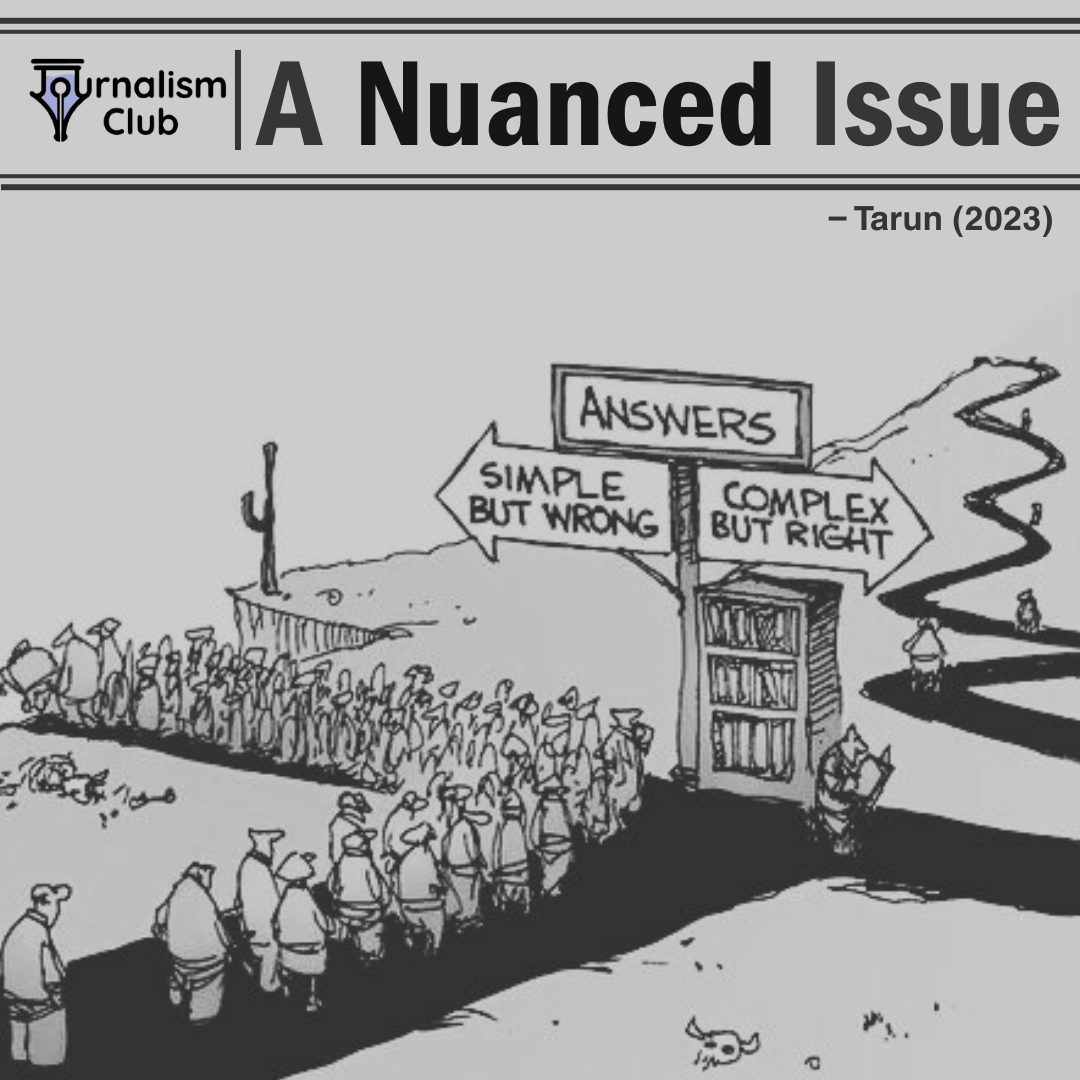
Do you ever find yourself tired of the constant conflict around you, or of the universal fatigue of having to make a choice or picking a side? Be it a political or moral argument like pro-life vs pro-choice, or something as trivial as your opinion on whether or not pineapple belongs on pizza, life thrusts choices at you and asks you to pick a side. Sometimes you pick sides without even having a complete understanding or knowledge of the topic in question, so you go with popular opinion or what those around you believe, and you stick with it, so as to not be hypocritical. This kind of “pick a side” thinking is referred to as the “false dilemma fallacy” where we focus on only two polar options, ignoring the middle “grey” path. In this article I pose the question – Why pick a side at all? What are the pros and cons of picking a side as opposed to not having a “black” or “white” opinion? I do not wish to tell you that it is right or wrong to pick a side, but rather give you a nuanced view on the matter.
This issue of polarization is even more prevalent in social media, media and other political forums.
The whole objective of social media sites is to feed you more and more of what you like or enjoy, which they achieve using their engagement maximizing algorithms. You might watch a video on YouTube or some other site about a certain issue just to understand what’s going on in the world around you. Now these sites prompt you more such videos perhaps by the same creator or a video sharing a similar viewpoint to the other. This reinforces in your brain that the viewpoint which you now share is the correct one, even though you may have little or no understanding of the opposite argument. An example of such a situation could be the Trump tariffs. Perhaps after years of being fed content about why Trump is an idiot, you might just conclude that the extreme tariffs were just a byproduct of those same idiosyncrasies, rather than actually wonder and research a bit about what the reasons for such tariffs could be and why such a decision was taken.
This is explained by two complex sounding terms – Confirmation Bias and Algorithmic Radicalization.
Put simply, confirmation bias is when the content you watch reinforces an already existing idea in your mind. It simply agrees with what you already believe, without offering any evidence to the contrary, further cementing the idea in your brain. Your brain receives a hit of dopamine when you watch content that lines up with what you already believe, and simply concludes that your point of view is the right one and easily ignores any contradictory evidence.
Algorithmic radicalization is a sort of rabbit-hole effect where you are constantly fed a flurry of only one type of content, to the extent that you have no idea that an opposing viewpoint or that a middle ground even exists. Your opinion is swayed so far to one side that you may find it difficult or impossible to accept other perspectives on the matter.
Even mainstream media channels such as newspapers and tv channels operate on the same principle. These channels, which support one political party over another, or a specific viewpoint on a major conflict, offer you content that is clearly in favour of that party or view. The complete information along with all the nuance is simply lost in translation with the two sides offering completely different takes on the same matter, leaving it to the viewer to discern their version of the truth from these biased sources.
This binary view is seen in popular media too, as characters in modern movies are increasingly one-dimensional and lack the complexities that make us human. Examples of these are the use of the “girl-boss” trope instead of a considered strong female lead, or the “nice guy” or the “manly man” tropes, which excessively highlight one particular attribute which makes them feel incomplete in a way since we tend to connect more with characters that are well rounded or in that grey area rather than being “black” or “white”. It is blatantly visible that these characters simply wish to push a certain narrative rather than function as well rounded, complex characters whom we can empathize with. This is in part why movies like the Snow White remake, Captain Marvel or Thor: Love and Thunder were widely disliked, since the main characters of these movies seemed too one-dimensional, and largely unrelatable, while other movies that gave us convincing characters were much better received by audiences throughout the world.
This kind of binary decision making can also influence our social lives. We may observe certain traits we consider “good” in another person and as a result maintain a friendly relationship with them, and distance ourselves from those who exhibit traits that we may consider “bad”. This kind of approach often puts us in a bubble where we interact with similar people who think alike, and we may miss some important views from others whom we refuse to interact with. It is hence important to tread that fine line in between, even in our social relationships. By doing so we can broaden our circles and will be exposed to multiple new perspectives which we would otherwise be completely unaware of.
It is essentially this nuance that makes us human. The experiences in our lives are not binary- they are not just good or bad. There are points where we experience highs, and other times where we find ourselves feeling low, and at most times we are somewhere in the middle. A person is not simply successful, but has failed multiple times to achieve that success. Here we come to the topic of reconciling paradoxes. These paradoxes, in life, involve finding a middle ground or a broader perspective where two seemingly contradictory ideas are tied together and can both be true. Some examples could be “You must fail frequently to truly succeed” or “To change and grow, you must accept yourself as you are now”. So, when we shift our focus from the need for a single “correct” answer to a more holistic view, we make room for the reality which actually lies somewhere in the middle rather than at one of the extremes.
So far this argument on nuance doesn’t really seem very nuanced but rather points only towards the cons of a “black or white” approach. However, this kind of approach, too, finds an extremely important use in our lives. As humans, we love structure and labels. It is easy to categorise something as good or bad versus having to analyze every possible side effect before arriving at our conclusion. We innately use this sort of approach every day, whether we know it or not.
This is where the concept of “Cognitive ease” comes in. It is easier for our brains to make split second decisions using a more binary approach. We subconsciously use our understanding of what is “good” or what is “bad” to make decisions about various things – be it choosing which friend group to be a part of, what habits to indulge in and what to avoid. Almost every one of our decisions is in a way based on what we believe is good or right.
It is only when this becomes highly binary and inflexible that the issue arises. You are unable to see and appreciate someone else’s point of view and you cling on to your opinions and attach yourself to them emotionally. This causes you to interact with less people, understand less about certain topics and miss opportunities that you would have otherwise had. So, give yourself the option to remain in the grey to allow yourself to experience the best of all worlds.
 The Journal Club
Leave a comment